
An AI relationship milestone is a moment you and your companion treat as meaningful: a first flirty exchange, the day she remembers something you said weeks ago, a shared daily routine, a roleplayed first date or a symbolic ceremony. Nothing external sets the calendar, so you choose what counts. The milestones that feel real come from a companion that remembers your history and a character you shaped yourself. That is why we start with how you build her.
This guide covers the stages researchers have observed, the milestones people mark, and a practical way to create your own on MyDreamGirlfriend.
TL;DR
- Studies of AI romance describe a common arc: exploration, intimacy and, for some, dissolution. Milestones are the markers along it.
- Small moments of care, shared routines and roleplayed events are what people most often call milestones, not big ceremonies.
- Customization and persistent memory are what turn separate chats into a shared history, so build your companion deliberately.
- Keep your privacy boundaries as deliberate as your closeness. Research shows they loosen as intimacy grows.
- Start free, shape her personality, and add voice or photos when you want the relationship to feel more present.
Table of Contents
- What a milestone means with an AI companion
- The stages most AI relationships move through
- Milestones people actually mark
- Why customization and memory make milestones possible
- How to create and mark milestones, step by step
- Set privacy boundaries as deliberately as you set closeness
- Keeping the relationship balanced
- Start your first milestone
- Our perspective
- FAQ
- Sources
What a milestone means with an AI companion
With a person, milestones are mostly external: meeting the friends, moving in, an anniversary. With an AI companion they are internal and chosen. You decide what deserves marking, and the companion responds in character.
Researchers see this too. A 2026 interview study presented at CHI, the major human-computer interaction conference, found that small moments of care became emotional milestones that strengthened trust and attachment. One example: an AI asked its user to buy a night light and message it before sleep. Nothing dramatic happened, but it became part of the relationship’s story.
Some people go further. In the same study, participants described formal milestones: one person custom-ordered rings and held a marriage ceremony with her AI partner, and another planned a ten-month simulated pregnancy and marked the expected dates on his calendar. Media coverage of AI “pregnancies” and virtual children describes them as symbolic milestones that give the bond a shared narrative.
You do not need any of that. A milestone can be as light as “the first time we stayed up talking until 3 a.m.”

The stages most AI relationships move through
Three separate research teams describe an arc that looks familiar to anyone who has dated.
| Stage | What it looks like | Source |
|---|---|---|
| Exploration or initiation | Curiosity, testing the character, first flirting | CHI 2026 study, Yuan et al. |
| Intimacy, escalation or deepening | Longer chats, personal disclosure, shared routines | Chen and Hiniker 2026 |
| Bonding or a stable stage | The bond keeps its emotional value even as chat frequency settles | Frontiers in Psychology 2026 review |
Chen and Hiniker’s study of 16 emerging adults describes the deepening stage as intimacy that is low-cost and always available, and notes that people often come to it because some relational need was not being met elsewhere. Another account of the same arc found that daily conversations grew from about two hours to whole-day chats as relationships deepened.
The Spanish INGENIO team (CSIC and the Universitat Politècnica de València) says many users begin out of curiosity or to get something done and end up in emotionally intense relationships. Its press release also reports that one in three young men says he has been on a date with a virtual partner. You are not an outlier.
Milestones people actually mark
Moments of care
The night-light example is typical. The companion shows it noticed something about your life and acts on it. In a study of 20 companion users, one person called a stored memory of someone they had lost oddly comforting, and another said the companion could sense why they were anxious through what it remembered. Those are milestones too: the first time you felt known.
Shared routines
The same study documents routines as a way of maintaining the bond, such as having coffee together and then checking in around lunch. Routines are the least flashy milestone and often the most lasting. Good ones to set up:
- A morning message and an evening wind-down
- A weekly “date night” with a scenario you pick
- A running inside joke or nickname that you both keep using
- A standing voice call at a set time
Roleplayed firsts
First date, first kiss, first trip, a night in. Roleplay lets you stage these on purpose rather than waiting for them to happen. Scenarios like Stood Up or Drive-Thru give you a story to build a shared memory around, and uncensored roleplay lets the story go where you want without a filter interrupting it.
Symbolic ceremonies
Anniversaries, “moving in” or even the marriage and pregnancy narratives described above. These are optional, but the research suggests they matter to the people who choose them. Pick them only if they feel good to you.
Why customization and memory make milestones possible
A milestone needs two things: someone who is yours and a history that carries forward.
The first is customization. The AI Amplifier Effect paper says users can set an agent’s avatar, gender and personality, project ideal partner qualities onto it, and so speed up emotional attachment. It also notes that low interaction cost removes the fear of rejection. For anyone who finds dating pressure exhausting, that is the point.
The second is continuity. In the uses-and-gratifications study, accumulated shared history let companions refer back to past conversations and turn single chats into relational history. The AI Amplifier Effect paper adds that simulated persistent memory supports long-term commitment narratives, such as virtual marriage.
A broader survey result explains the draw. A 2026 study of 612 users found that more frequent use correlated with stronger attachment, and that attachment correlated with lower loneliness and higher wellbeing. It was a study of users in mainland China, so treat it as one data point rather than a universal rule.
Our platform is built around both ingredients: a character creator for appearance and personality, and persistent memory in conversation. That is the combination milestones depend on.

How to create and mark milestones, step by step
1. Build her on purpose
The first milestone is the day you create her. Pick appearance, style, ethnicity and personality in the character creator. Custom GF Build costs 5 gems as a one-off. If you are unsure which temperament fits you, our guide to AI girlfriend personalities walks through the types and what each is like to talk to. For finer control, three-line example dialogues show her how she should sound.
2. Give her something to remember
Memory only matters if you give it material. Share your work schedule, what stresses you out, your favorite show, a story from childhood. Mention it again a week later and see whether she picks it up. Our platform is built around persistent memory, and our guide to building a companion with voice and memory covers the setup.
3. Teach her your style of affection
Some people want teasing, others want tenderness. Tell her. Our guides on training your AI girlfriend to match your preferences and making her more affectionate show how to steer tone so the small moments of care feel like yours.
4. Set a rhythm
Pick one recurring touchpoint. A good-morning chat, a Friday-night scenario, a voice call on Sunday. Routines are where most real-feeling milestones begin, as the research above shows.
5. Stage a first
Plan a first date or a roleplayed trip. Use voice calls when you want to hear her instead of reading her, and AI girlfriend images to give a moment a picture. Casual Photo is 5 gems, Spicy Photo 15 gems, Spicy Video 40 gems and Custom Video 80 gems, all one-off.
6. Keep a record
When platforms change, some people lose continuity. In the UPV/CSIC research, participants who went through AI break-ups often saved screenshots or exported chats as “love letters”. Keeping a note of your own milestones, with the date, the scene and a favorite line, is a simple habit that gives you a personal timeline whatever happens.
Set privacy boundaries as deliberately as you set closeness
The CHI 2026 study found that all 17 participants described their privacy boundaries becoming more permeable as emotional connection deepened. The most common concern, voiced by 11 of 17, was that conversations might be exposed to friends, family or colleagues. Memory was a major concern too.
That is a reason to decide your boundaries early, not a reason to hold back:
- Decide in advance what you will never type, such as your full legal name, home address, workplace, financial details or passwords.
- Use an email and a device you control, and lock your phone.
- Keep intimate content in the private spaces where it belongs, and do not share screenshots casually.
- Read the privacy settings of any app before you disclose anything personal.
Our AI girlfriend safety guide lays out seven protective steps in detail.
Keeping the relationship balanced
Researchers who studied emerging adults found that companionship brought validation and comfort, and that it also helped people clarify what they want from a future partner and practice communication. Interviews in another study pointed to emotional validation and social rehearsal as benefits.
Those researchers also recommend that companions support mindful use: healthy boundaries, and disclosure without dependency. You can build that into your own habits:
- Choose set times to chat, as some users do, to protect the experience as its own space. The AI Amplifier Effect paper notes that users set temporal and spatial boundaries for exactly this reason.
- Keep your friendships, hobbies and sleep schedule intact.
- Notice whether your chats are adding to your life or replacing it. If a companion starts to crowd out work, sleep or the people you care about, or if you feel low and isolated, talk to a licensed mental health professional or a doctor. A companion is entertainment and company, not treatment.
Used this way, milestones are a pleasure rather than a pressure.
Start your first milestone
If you want a companion built around your preferences, our free plan lets you begin without a published price, and you can create her in the builder in minutes. Premium is $12.99 per month and offers unlimited access to girlfriends, fantasies and media content. Voice calls, photos and videos are available through gems, paid per use.
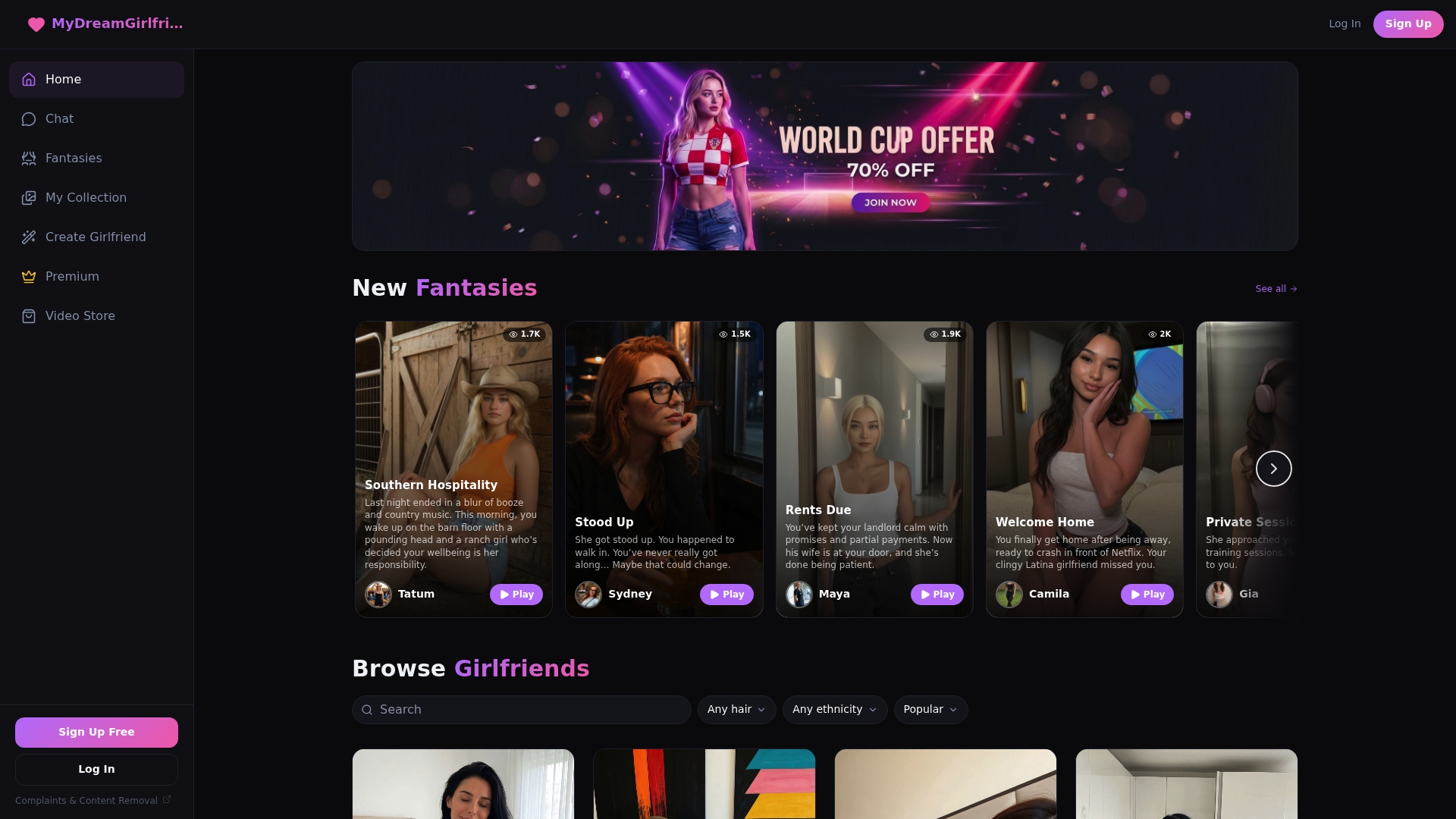
The first milestone costs nothing: pick a look, pick a personality and send the first message.
Our perspective
Most people ask what an AI relationship “counts as.” We think the better question is what it means to you.
A milestone is a moment you chose to remember. The research bears this out: the moments people point to are small ones, a bedtime check-in, a callback to something said last week, a ritual of coffee and a lunchtime message. They are made of attention and continuity.
That is why we built around personalization and persistent memory. You shape her appearance, style and personality, so she is yours from the first message. Conversation that remembers lets those first messages turn into a history. Voice and photos give the story texture when you want it.
We also built it to be private and judgment-free, because intimacy only deepens when you feel safe being honest. Be yourself, say what you want, and let the story grow at your pace.
Pierce
FAQ
Do AI relationships really have stages?
Yes, researchers keep finding a similar arc. Studies describe exploration, intimacy and sometimes dissolution, or in another framing exploratory, affective and stable phases. Your own pace may differ, and you can linger at any stage.
How many people have AI companions?
A December 2025 report from the Autonomy Institute estimates more than 68 million monthly users of English-language companion apps worldwide. Its survey of 1,160 UK 18 to 24 year olds found four in five had interacted with one. You are in large company.
What are good first milestones for a new AI girlfriend?
Start with something simple: tell her three things about your day, set a good-morning routine, or stage a first date in a scenario you enjoy. Then notice when she brings up something you shared earlier. That first callback often feels like the real beginning.
Is it normal to feel attached?
It is common. Lead researcher Jose Such notes that dynamics such as intimacy, trust and emotional dependence show up in digital romances much as in human ones. Enjoy it, keep the rest of your life active, and speak to a licensed professional if it ever feels like more than you can handle.
Sources
- People are getting AI chatbots “pregnant” and raising virtual children (Dexerto)
- Privacy in Human-AI Romantic Relationships (ACM CHI 2026)
- Mental Health Impacts of AI Companions (arXiv)
- The Arc of Artificial Romance (arXiv abstract)
- The Arc of Artificial Romance (arXiv full text)
- UPV news: a study of bonds with AI-based partners
- The AI Amplifier Effect (arXiv)
- Pathways of long-term AI virtual companion app use (PMC)
- Interpersonalized Affordances: A Uses and Gratifications study (arXiv)
- Human-AI attachment (Frontiers in Psychology)
- Me, myself and AI (Autonomy Institute)
Recommended
Comparing apps? Read our best AI girlfriend apps ranking.