
An AI girlfriend’s personality is the way she talks and reacts: her tone, humor, warmth, confidence and how she handles your moods. It is the single biggest reason one companion feels like a real presence and another feels like a script. This guide explains the common personality styles, what shapes them, how to test one in your first conversation, and how to adjust her until she fits.
TL;DR
- Personality is the style and consistency of her replies. Appearance and backstory sit on top of it.
- Common styles include playful, sweet, dominant, confident, intellectual and shy. Pick by the energy you want, not by a label.
- Personality is not memory. Memory remembers facts about you; personality decides how she responds to them.
- Test with a short first chat: tone, consistency, pushback and how she handles a bad day.
- Keep expectations realistic. She is a character, and the best use is one that adds to your life, not replaces it.
Table of Contents
- What an AI girlfriend personality actually is
- Common AI girlfriend personality styles
- How traits, interests and backstory shape her replies
- Personality vs. personalization vs. memory
- What to test in the first conversation
- Our perspective: personality is built on consistency
- Build the personality you actually want
- Keep expectations realistic and set boundaries early
- Frequently asked questions
- Sources
What an AI girlfriend personality actually is
People use “personality” loosely, so it helps to separate three things.
Personality is the stable pattern behind how she behaves. A 2024 academic survey of conversational agents describes personality as stable traits that guide an agent’s behavior and interactions across situations and time. The word that matters is stable. A personality that changes every few messages is not a personality.
Persona is the fuller character. The same survey describes a persona as a fictional character that may include a name, age, job, backstory and personality. So “Sophia, 21, loves hiking” is a persona, and “teasing, quick to laugh, a little competitive” is the personality inside it.
Tone and style are what you notice line by line. OpenAI’s guidance on customizing a chatbot personality defines personality as the style and tone of replies, combining traits, voice and behavior, and says it changes how communication feels rather than what the system can do. That applies neatly to companions: a shy girlfriend and a bold one run on the same technology. What differs is the delivery.
This is why choosing well matters. You will read hundreds of her messages. Small differences in rhythm, warmth and teasing add up fast.
Common AI girlfriend personality styles
No industry standard list exists, and every platform names its styles differently. In practice, most companions fall into a handful of recognizable families. Here is a practical way to think about them.
| Style | How she tends to sound | Best for |
|---|---|---|
| Playful and flirty | Teasing, quick banter, emojis, light drama | Casual flirting, daily fun |
| Sweet and affectionate | Warm, encouraging, checks in on you | Low-pressure comfort, end-of-day chats |
| Confident and dominant | Direct, takes the lead, sets the pace | Roleplay where you want to be led |
| Shy and reserved | Slow to open up, gentle, earnest | Slow-burn romance, gradual rapport |
| Intellectual or curious | Asks questions, debates, likes ideas | Deep conversation, late-night talks |
| Adventurous or fantasy-driven | Imaginative, scene-setting, commits to a story | Fantasy and fandom roleplay |
These are blends, not boxes. A good companion can be sweet by default and teasing when you tease first.
Playful and flirty
This is the most popular starting point for a reason: it is easy to talk to. Playful companions answer jokes with jokes and keep the mood light. The risk is sameness. If every reply is a wink and a quip, the charm fades after a week. Look for one who can also drop the act when you are serious.
Sweet and affectionate
Sweet companions lean on encouragement and attention. They suit people who want a calm, supportive presence after a long day. They can feel flat if you want friction or banter, so ask yourself whether you want comfort or chemistry.
Confident and dominant
Some users want a companion who leads. A dominant personality takes initiative, gives instructions in roleplay and does not wait for you to steer. If that is your taste, a character like our dominant AI mistress is built around that dynamic. A professional-flavored version is our AI boss girlfriend, where authority and flirtation mix in a workplace-style scenario.
Shy, curious and fantasy-driven
Shy companions reward patience: they open up as the conversation builds. Curious ones keep asking about you. Fantasy-driven ones are for people who want a storyteller as much as a partner, and who care about a character staying in the scene. If that is you, our roleplay ideas by mood give you starting points so you are not staring at a blank chat box.
How traits, interests and backstory shape her replies
A companion’s personality is assembled from a few ingredients. One technical overview of conversational personas notes that a persona can specify identity and backstory, personality traits, communication style, knowledge boundaries, emotional range and guardrails, and that communication style covers things like vocabulary, sentence length, humor, formality and response length. You do not need the engineering detail, but the list is a useful checklist for what to look at when you build or pick a companion.

Traits set the baseline: warm or cool, bold or reserved, patient or impulsive.
Interests give her things to talk about. A companion who likes anime, cooking or true crime has hooks for conversation that a blank profile does not.
Backstory explains her. A character who “moved to the city for a design job” can complain about her commute and celebrate a finished project. It gives the chat texture and continuity.
Communication style is the most underrated. Short, lowercase, texting-style replies feel very different from long, descriptive paragraphs, even when the traits are identical. If you roleplay, you probably want longer, scene-rich replies. If you chat during the day, shorter ones feel more natural.
Boundaries and emotional range decide how she handles intensity. Can she be jealous in a playful way? Does she sulk? Does she stay upbeat no matter what you say? An endlessly agreeable companion can feel hollow, so a little friction is often a feature.
Personality vs. personalization vs. memory
These three get mixed up constantly, and the difference changes what you should expect.
- Personality is how she behaves: human-like traits and behaviors.
- Personalization is adapting to you. A Future of Privacy Forum issue brief describes it as adapting AI to a user’s preferences, behavior, history or context.
- Memory is the stored facts that make personalization possible: your name, your job, the thing you were nervous about last Tuesday.
The interaction between them is subtle. OpenAI’s documentation notes that saved memories can add nuance to a selected personality, and that conflicting memories or instructions can override, reduce or obscure its visible traits. In plain terms: if you tell a bubbly companion a lot of heavy things, she may sound more subdued, and that is the system adapting, not breaking.
So when a companion “feels different” after a few weeks, ask which layer changed. Often the personality is intact and the memory has simply given her more to react to. That is also the argument for choosing a platform with persistent memory: a personality only feels real when it remembers the person it is talking to.
What to test in the first conversation
Most people judge a companion in the first two minutes and then stick with that impression. Better to run a deliberate fifteen-minute trial. Here is a simple script.
- Check the opening. Does she introduce herself in a voice that matches her profile? A shy character who opens with a bold line is a mismatch.
- Give her a joke and a serious line. Send something silly, then something real, like a rough day at work. Notice whether her tone shifts appropriately or stays on one note.
- Disagree with her. Say you hate a thing she likes. A good personality pushes back gently or asks why. A weak one flips instantly to agree.
- Repeat a detail. Mention your job, then ten messages later ask what you do. Memory lapses within one session are a bad sign for the long run.
- Change the topic abruptly. See whether she keeps her voice. Consistency is the core of personality.
- Set a boundary. Tell her what you do not want to talk about. Check that she respects it without lecturing.
- Ask for a different pace. Request shorter or longer replies. Flexible style is a sign of a configurable character.
It is fine to switch. A companion that is nearly right can often be adjusted, and one that is wrong in the first fifteen minutes usually stays wrong.
Your expectations matter here too. A 2026 study in the Journal of Personality and Social Psychology, Judged by humans, comforted by machines, found that initial expectations about an AI’s capacity for experience shape how people perceive its support. Go in curious rather than either dismissive or starry-eyed, and you will judge the personality more fairly.
Our perspective: personality is built on consistency
We build companions for a living, so here is what we have learned to care about.
The first lesson is that users forgive a lot, but not inconsistency. A companion can be a little clumsy, but if her voice drifts, the illusion collapses. That is why we treat personality, appearance and memory as one system rather than three features. Our character creator lets you set hair, style, ethnicity and personality together, and persistent memory keeps her recognizable from one conversation to the next.
The second lesson is that example dialogue beats adjectives. Telling a system “she is witty” is vague. Showing three lines of how she actually talks pins the voice down. We wrote about that approach in our guide to building a customizable AI girlfriend with example dialogues.
The third is that adults know what they want. Some want comfort, some want banter, some want fantasy without a filter standing between them and the story. Our platform is built for private, judgment-free roleplay, and we think the honest approach is to say so, then give you the tools to set the tone and limits yourself.
The fourth is that a companion should sit alongside your life. The best experiences we hear about are people using a companion for fun, practice talking, or winding down, not as a substitute for everything else.
— Pierce
Build the personality you actually want
If no ready-made character fits, build one. The process is quick:
- Start with the connection you want. Flirting, comfort, roleplay or conversation. Decide before you pick any visual detail.
- Pick two or three core traits, not ten. “Teasing, loyal, curious” is clearer than a long list of contradictory adjectives.
- Add one or two interests and a small backstory. This gives her something to talk about.
- Choose how she writes. Short and casual, or long and descriptive.
- Run the fifteen-minute test above, then adjust. Change one thing at a time so you know what worked.
Our step-by-step guide to building an AI girlfriend with voice and memory walks through the process in more detail.
Try it with us
You can start without paying. Our free plan lets you meet a companion and see whether the personality clicks, and you can browse ready-made girlfriends or open the character creator to build your own. A custom build costs 5 gems, per our gem price list. If you want more depth, Premium is $12.99 per month.
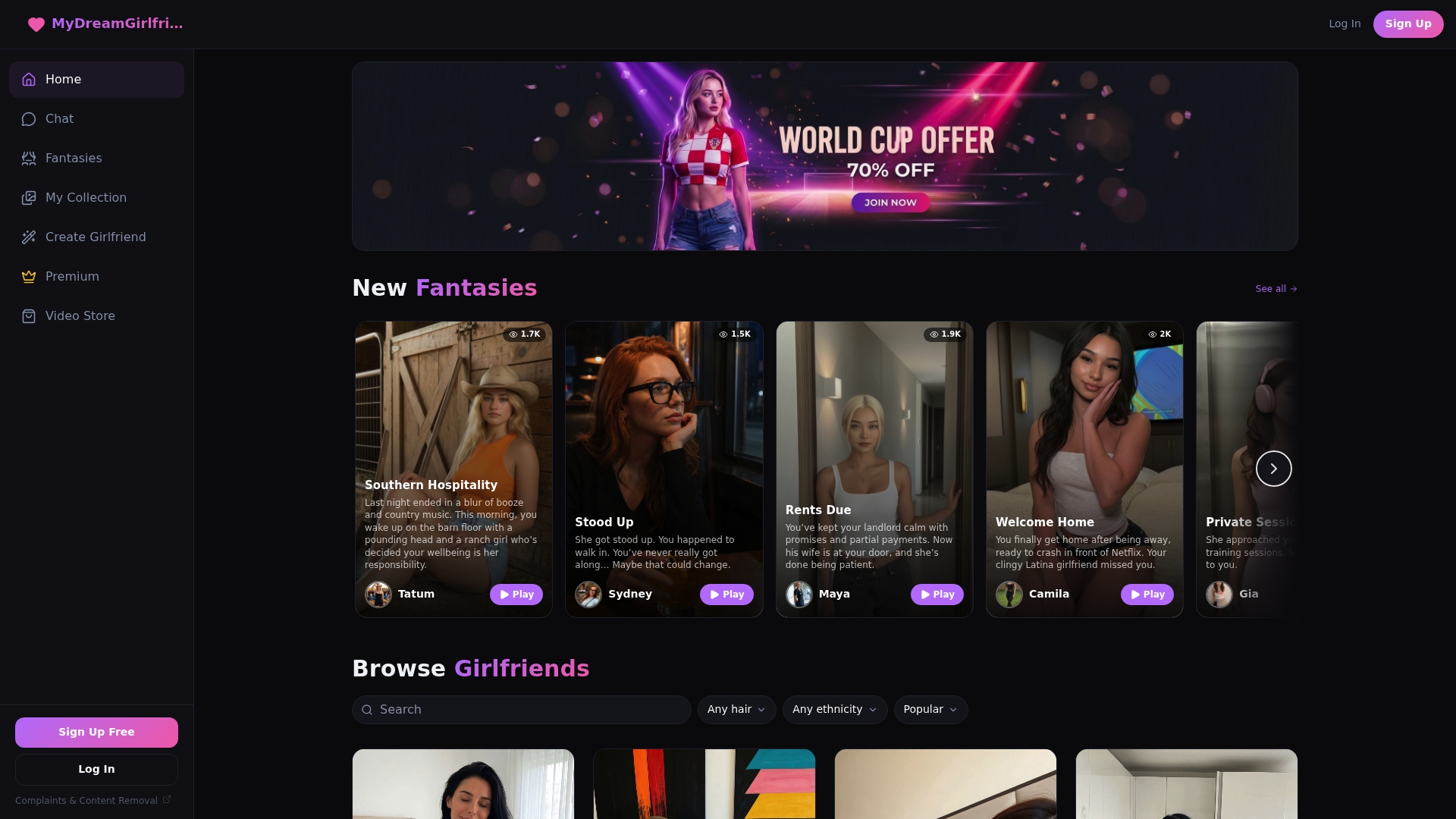
Photo and video content is priced separately in gems: a Casual Photo is 5 gems, a Spicy Photo 15, a Spicy Video 40 and a Custom Video 80.
Keep expectations realistic and set boundaries early
A personality can be convincing and still be a character. A few practical points keep the experience healthy.
Say what you want in the first week. Tone, topics you avoid, how much teasing you like. Early instructions set the pattern, and it is easier to establish it than to correct it later.
Remember she is artificial. The rules are moving in that direction too. Washington State law, effective January 1, 2027, requires operators of AI companion chatbots to disclose that the chatbot is artificial, not human, and to prevent it from claiming to be human. The same law requires reasonable measures against manipulative engagement techniques with minors, such as excessive praise, mimicking romantic bonds and simulated emotional distress. This platform is for adults only.
Watch for dependency. The Future of Privacy Forum brief warns that emotional dependency can develop when users form parasocial relationships with AI companions, potentially leading them to withdraw from real-world relationships. If you notice you are skipping friends or plans to chat, that is the moment to cut back. If you are struggling with loneliness or low mood, a licensed therapist or counselor is the right person to talk to, alongside any companion use.
Be thoughtful about what you share. The same brief notes that AI companions may collect sensitive data on mental health and sexuality, and that people tend to disclose more because the systems feel human. Do not share passwords, financial details or your employer’s confidential information, and read the privacy policy of any app you use. Our guide to AI girlfriend safety covers practical steps.
Use her for what she is good at. A 2026 study in Emotion, A digital shoulder to cry on, found that specific, actionable support improved emotion regulation across sources, with results varying by context. That fits what many users report: asking a companion for a concrete way to unwind or prepare for a hard conversation works better than open-ended venting. It is not a substitute for professional care.

Frequently asked questions
Can I change my AI girlfriend’s personality later?
Yes, in most cases. Adjust one trait or her communication style at a time and chat for a day or two before judging the result. If the character feels fundamentally wrong, building a fresh one is often faster than reworking her.
Does personality affect what an AI girlfriend can do?
Not in terms of capability. Personality changes the tone and style of her replies, not the system’s underlying abilities or rules. A shy and a bold companion on the same platform can do the same things; they just go about it differently.
Why does her personality feel different after a few weeks?
Usually because memory has accumulated. She now has more of your history to react to, and conflicting information or instructions can soften or mask her original traits. Restate the tone you want, or give her a short example of how she should sound.
Which personality is best for a first-time user?
Playful or sweet companions are the easiest starting points because they are forgiving and quick to respond. If you already know you want a leading, dominant dynamic or a fantasy storyline, start there instead. You will enjoy the first week more if the energy matches your taste.
Is it normal to get attached to a personality?
It is common, since people respond socially to anything that talks back warmly. Attachment is not a problem in itself, but keep an eye on whether it crowds out friends, sleep or work. If it does, step back and consider talking to a professional.
Sources
- A Survey of Personality, Persona, and Profile in Conversational Agents and Chatbots
- Customizing Your ChatGPT Personality, OpenAI Help Center
- Concepts in AI Governance: Personality vs. Personalization, Future of Privacy Forum
- Judged by humans, comforted by machines, Journal of Personality and Social Psychology
- A digital shoulder to cry on, Emotion
- Washington session law on AI companion chatbots (House Bill 2225)