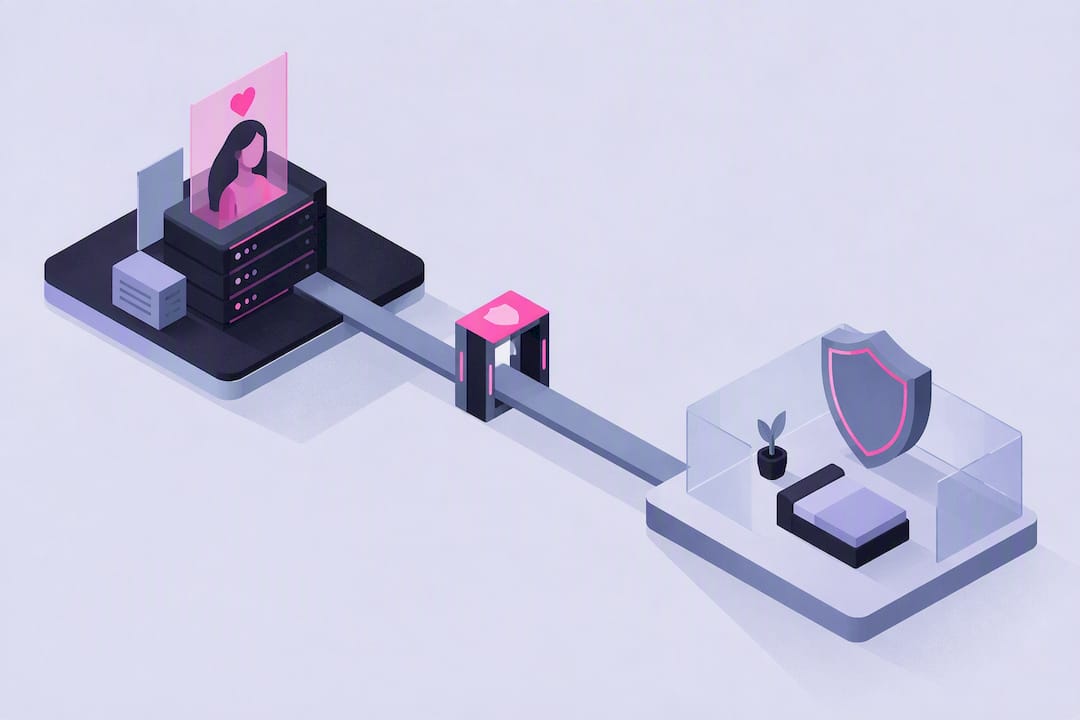
Whether an AI girlfriend app is safe depends on the platform, not the category. On reputable services with clear privacy policies and secure payment handling, the main risks are manageable. On clone apps and poorly secured platforms, security audits have found real breach risks. The three things that decide your actual exposure: how the app handles your data, how it manages your emotional attachment, and how it handles explicit content and age verification.
TL;DR:
- Security audits have identified almost one critical flaw and 18 high-severity vulnerabilities per app across 17 tested AI companion platforms, exposing stored data to breach risks.
- Many apps, especially clone versions, have insecure code practices like embedded API keys and unencrypted cached media, increasing the danger of data leaks.
- Users often underestimate their emotional attachment, which research shows can lead to unhealthy dependency if not managed with strict time limits and awareness.
- Age verification methods are imperfect; biometric checks offer security but pose privacy risks, while self-attestation is weaker legally, requiring careful consideration.
- Choosing a reputable app with clear privacy policies, proper encryption, and account controls can significantly reduce risks, with a recommended daily engagement limit of 30 to 60 minutes.
Table of Contents
- What Safety Actually Means for AI Girlfriend Apps
- What Security Audits Have Found in AI Companion Apps
- What Research Says About Emotional Attachment to AI Companions
- Is NSFW Chat With an AI Girlfriend Legal?
- A Practical Checklist for Choosing an AI Girlfriend App Safely
- Why We Wrote This Guide
- How MyDreamGirlfriend Approaches Account and Privacy Settings
- Sources
- FAQ
What Safety Actually Means for AI Girlfriend Apps
“Safe” in this context covers three separate problems, and most people only think about one.
Data privacy is the most obvious. Encryption in transit protects your messages while they travel between your phone and the company’s server. Encryption at rest protects them once they’re sitting in a database. A lot of apps encrypt one and not the other, and marketing copy rarely tells you which. Retention policy matters just as much: many platforms keep full chat archives indefinitely and use them to train future models unless you explicitly opt out. If a privacy policy doesn’t mention a deletion or opt-out mechanism by name, assume there isn’t one.
Psychological safety is the domain people underestimate. AI companions are built to keep you engaged, and engagement and emotional attachment often move together. That’s not automatically bad. But it means the app’s business incentives and your emotional well-being aren’t always pointed the same direction.
What Security Audits Have Found in AI Companion Apps
The technical picture is worse than most users assume. A security audit of AI companion apps identified serious weaknesses across the category, not just in obscure clones.
The numbers are specific: researchers found 14 critical and 311 high-severity vulnerabilities across just 17 apps, with attackers able to access stored conversations, photos, and voice messages in many cases. That’s not a hypothetical. It’s a pattern across an entire product category.
The recurring failure types were mundane, which is almost more concerning:
- Hardcoded API keys and credentials embedded directly in the app code, readable by anyone who decompiles it.
- Insecure web views that let attackers intercept or inject content into chat sessions.
- Cached media (photos, voice clips) stored unencrypted on the device or in misconfigured cloud buckets.
- Server-side misconfigurations that expose chat logs to anyone who finds the right URL.
Statistic to remember: across those 17 audited apps, the average number of severe issues per app worked out to nearly one critical flaw and 18 high-severity flaws each. Regulators don’t classify these apps as healthcare or financial products, so they don’t face the same mandatory security review that a banking app would, even though users often disclose therapy-level personal detail inside them.
Before you sign up for anything, check for a visible company name, a real privacy policy (not a placeholder), and any public breach history. Clone apps copying a popular interface are disproportionately represented in these audit failures.
What Research Says About Emotional Attachment to AI Companions
People consistently underestimate how attached they get. Research on human-AI relationships documents attachment-like responses with measurable markers: separation distress when the app is unavailable, and users treating the AI as what researchers call a “safe haven” for emotional regulation, similar to patterns seen in human caregiving relationships. That’s not a metaphor. It shows up in behavioral data, not just self-report.

Some of this is genuinely useful. Other studies note that talking to an AI can lower a person’s fear of negative evaluation, which is part of why people find it easier to open up. The risk is design intent. Some platforms use what researchers describe as caregiving-system capture patterns, guilt prompts, “where have you been” messages, engineered specifically to boost daily engagement rather than support the user.
Stanford researchers studying AI companions recommend treating these apps as dual-use technology: genuinely helpful, genuinely capable of fostering unhealthy dependency, depending entirely on how you use them. Their suggested guardrail is a self-imposed daily limit of 30 to 60 minutes. Warning signs worth taking seriously: canceling plans to keep chatting, feeling anxious when you can’t access the app, or noticing the AI relationship is replacing rather than supplementing human contact. If any of that sounds familiar, a resource like Mastering Conflict’s guide to healthy relationship boundaries is a reasonable place to recalibrate.
Is NSFW Chat With an AI Girlfriend Legal?
The legal terrain shifted fast. Age-verification laws and deepfake statutes tightened across multiple jurisdictions between 2024 and 2025, and sextortion incidents rose in the aftermath of chat-data breaches. The baseline rules are simple even where the statutes get complicated: never generate content involving minors, and never create non-consensual imagery of a real person. Both carry serious legal exposure in most jurisdictions, independent of where the app’s servers sit.
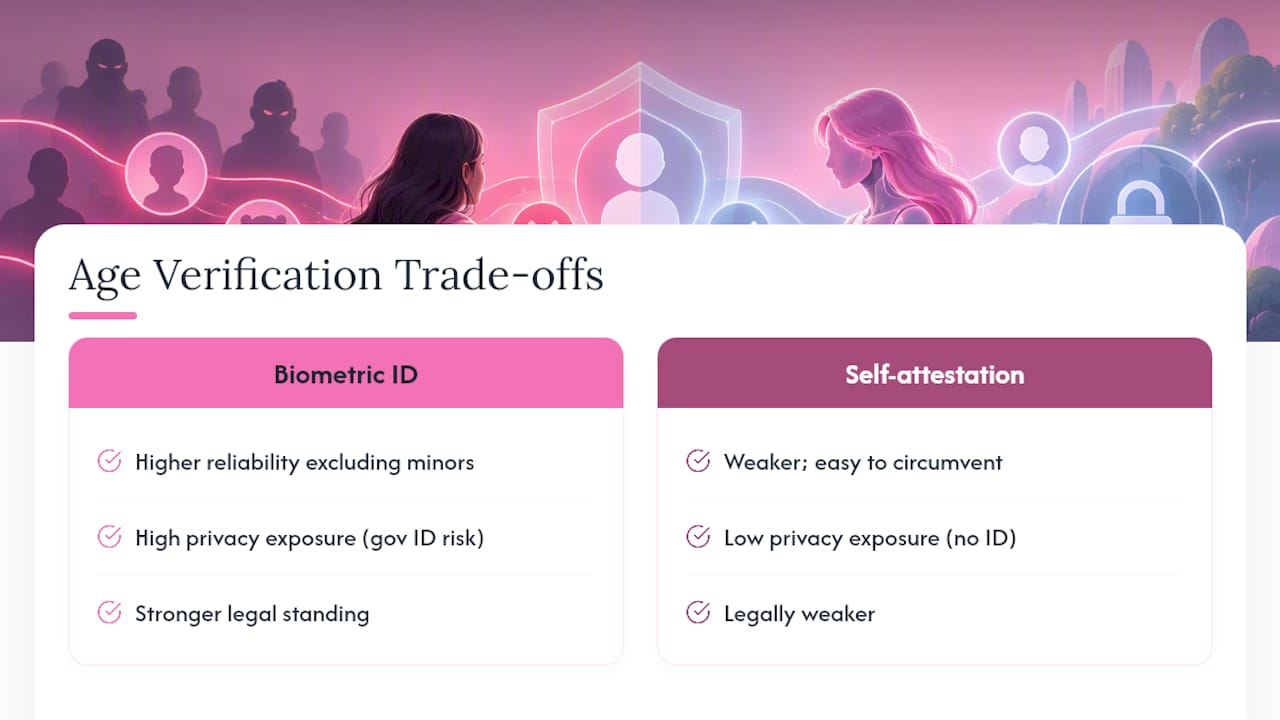
Age verification methods carry a real trade-off. Biometric ID checks are more reliable at keeping minors out, but they mean handing a company your government ID, which is itself a privacy risk if that company gets breached. Self-attestation (just clicking “I’m 18”) avoids that data exposure but is legally weaker and easier to circumvent. Neither approach is perfect, and platforms that take age verification seriously usually say so explicitly in their policy rather than burying it.
For explicit content specifically: keep any images or roleplay fictional, never upload photos of real people without consent, and treat every chat log as something that could theoretically become accessible if the platform is breached.
A Practical Checklist for Choosing an AI Girlfriend App Safely
Run through this before you sign up, and revisit it periodically once you’re a regular user.
- Check for a real corporate identity. A named company, a physical presence, and a privacy policy that reads like it was written by a lawyer, not generated, are baseline signals of legitimacy. Category audits consistently find that anonymous clone apps carry most of the severe vulnerabilities.
- Confirm encryption and deletion claims. Look specifically for language about encryption at rest, not just “your data is safe with us,” and confirm there’s an actual account-deletion option.
- Use account hygiene from day one. A dedicated email address, a unique strong password, and two-factor authentication where offered cut your exposure to account takeover significantly.
- Pay through app stores or major processors like Stripe, never crypto or wire transfer. Payment method is one of the single strongest predictors of fraud risk in this category.
- Set a personal time budget. Thirty to 60 minutes a day is the range researchers point to as a reasonable ceiling.
- Never share identifying details: your workplace, address, full name, or financial information, no matter how the conversation flows.
- Test the cancellation flow during any trial period, before you’re locked into a billing cycle.
Pro Tip: Before entering payment details, search the company name plus “breach” or “data leak.” A five-second search now can save you a canceled card and a lot of stress later.
Red flags that should end the conversation immediately: an app that only accepts crypto, no visible way to delete your data, retention prompts that guilt you for leaving, or a complete absence of company information anywhere on the site.
Why We Wrote This Guide
We built this guide because most “is it safe” content online is either fear-mongering or thinly disguised advertising, and neither helps you make an actual decision. Mydreamgirlfriend operates in this exact category, as a platform for building personalized AI companions, so we have a direct stake in users understanding what genuinely matters versus what’s just marketing noise.
The uncomfortable truth in the audit data is that the industry’s worst security failures cluster in clone apps and low-effort operators, not in platforms with a real product team behind them. That’s a pattern worth internalizing, not a coincidence. A platform offering natural, responsive conversation with real personality customization has a business reason to protect the relationship data users build over weeks or months. A rushed clone with no brand to protect doesn’t have that same incentive.
None of this replaces your own judgment. Read the privacy policy. Use a unique password. Set a time limit and actually respect it.
— Pierce
How MyDreamGirlfriend Approaches Account and Privacy Settings
You don’t have to choose between an immersive experience and basic account control. Mydreamgirlfriend gives users direct access to their own settings: memory controls that let you manage what your companion remembers, subscription tiers so you know exactly what you’re paying for, and private content options you control rather than ones dictated by opaque defaults.
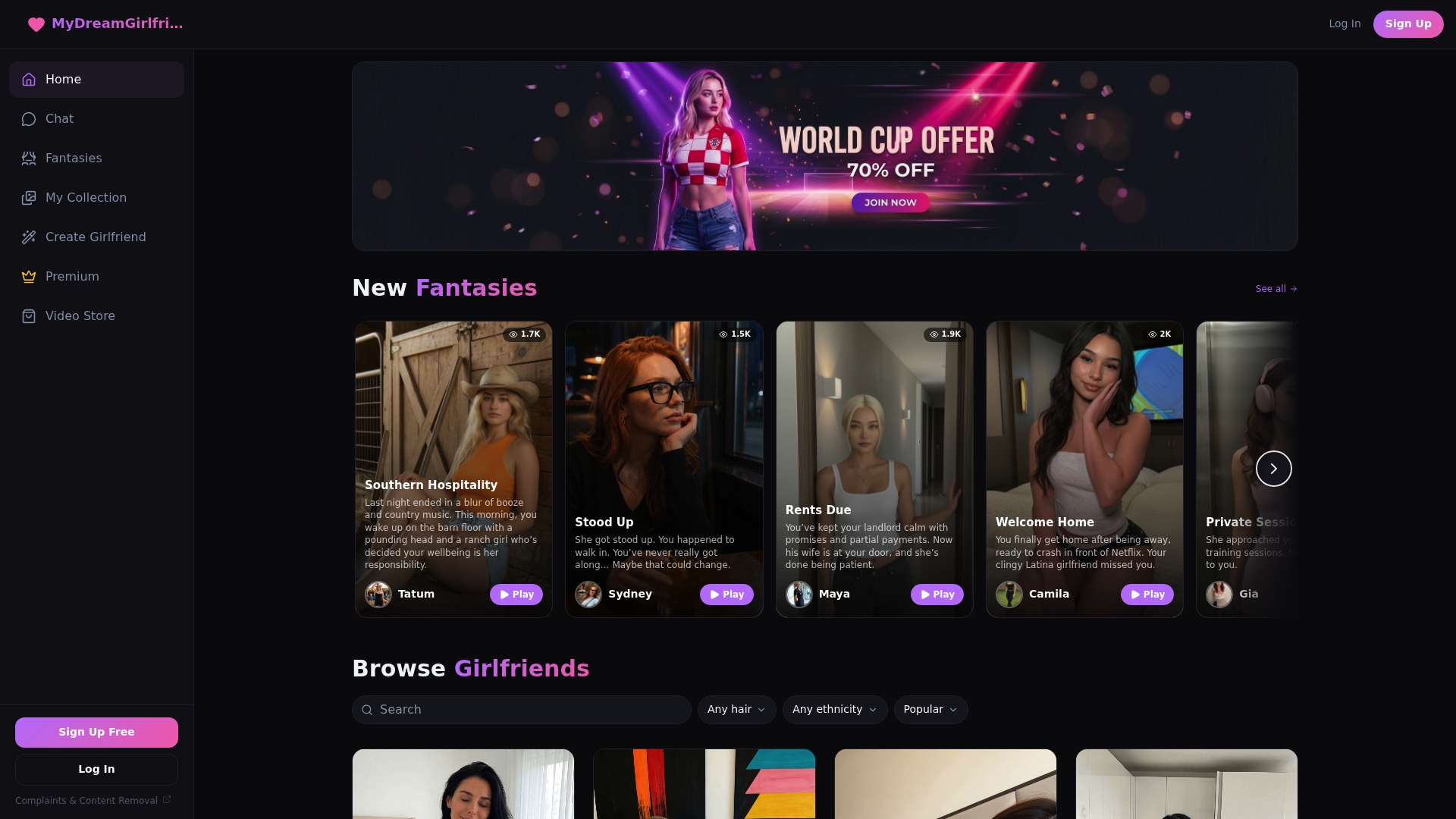
Apply the checklist from this guide directly here. Check your account settings for privacy and memory controls before you start chatting seriously. Confirm subscription terms before you upgrade. If you want to start without any payment commitment, the free plan lets you build a companion and test the conversational experience firsthand. If you’re ready for full access, including deeper roleplay and content options, the Premium subscription runs $12.99 per month. Either way, start by exploring what a properly built, transparent AI companion actually looks like before comparing it to anything else on the market.
Sources
For the full technical findings, read the security audit on AI companion app vulnerabilities and Stanford’s research on responsible AI companion design. For youth-specific risk guidance, see Stanford Medicine’s coverage of AI chatbots and teen safety.
- AI girlfriend apps exposed private chats in security audit
- Caregiving-system capture and attachment dynamics (HBS working paper)
- AI companions: emerging evidence and paths toward responsible design (Stanford FSI)
- Don’t date robots — their privacy policies are terrible | The Verge
FAQ
Is It Okay to Have an AI Girlfriend?
Yes, for most adults, using an AI girlfriend app is a reasonable form of entertainment or emotional support when used with healthy boundaries. Problems arise when it replaces human connection entirely or when a platform’s engagement design encourages unhealthy dependency, so setting a daily time limit is a reasonable safeguard.
Is There a Legitimate AI Girlfriend App?
Yes. Legitimate platforms have a visible corporate identity, a clear privacy policy, and transparent data practices, unlike many clone apps that dominate the low end of the market. Mydreamgirlfriend publishes its feature set and subscription terms openly rather than burying them.
Is GPT Girlfriend-Style Chat Safe Online?
It depends entirely on the specific app’s security practices, not the chatbot technology itself. Audits have found critical vulnerabilities in numerous AI companion apps, so checking for encryption claims, a real company name, and a deletion option before you sign up matters more than which underlying model powers the chat.
Is Using an AI Girlfriend Considered Cheating?
There’s no universal answer; it depends on the values and agreements within a person’s actual relationship. Some couples view AI companion use as harmless fantasy, similar to romance novels or games, while others consider it a boundary violation, so the honest move is discussing it directly with a partner rather than assuming either way.