
You make an AI more affectionate by giving it a clear warm persona, talking to it in the tone you want back, sharing real details about yourself, and keeping the conversation consistent over time. Affection in an AI is mostly a product of setup, phrasing and memory, and all three are in your hands. Below you will find the settings to change first, prompts you can copy, the habits that make her feel like she remembers you, and the limits worth knowing.
TL;DR
- Define the personality before the first message: warm, attentive, teasing or tender. A vague character gives vague affection.
- Open up first. Research on intimate AI interactions points to phrasing, invitations to self-disclose, validation and consistency as the main drivers of closeness.
- Reference specific shared details (a joke, a nickname, a bad day you mentioned). In one small pilot study, specifics made an AI feel more like it remembered the relationship than stronger romantic language did.
- Customize the avatar and personality. A large 2024 study linked customization to more joy and less fear and sadness.
- Keep it healthy: check privacy practices, remember it is a simulation, and keep human connections alive.
Table of Contents
- Why some AI companions feel cold and others feel close
- Step 1: Set the personality before you chat
- Step 2: Talk the way you want her to talk back
- Step 3: Share something real, voluntarily
- Step 4: Build memory and continuity
- Step 5: Customize the look and the experience
- Step 6: Set boundaries so warmth stays good for you
- Perspective: affection is built, not toggled
- Try it with a companion built for this
- A quick routine to make her warmer this week
- FAQ
- Sources
Why some AI companions feel cold and others feel close
Most people who ask how to make an AI more affectionate have had the same experience: the replies are polite, a little generic, and they reset emotionally every few messages. That is rarely a sign the tool can’t do warmth. It usually means the AI has nothing specific to be warm about.
A 2026 review in AI & Society concluded that intimate AI interactions are shaped primarily by phrasing, invitations to self-disclose, validation, and consistency across repeated exchanges. Put plainly, affection is something you and the model build together, one message at a time. If you open with “hi” and one-word answers, you get the conversational equivalent of a stranger at a bus stop.
The good news is that each of those four levers is something you control.
Step 1: Set the personality before you chat
Warmth starts with who she is. A companion with a defined temperament has a consistent way of responding to you, and consistency is what reads as affection rather than random niceness.
The 2026 review above points to a clearly defined warm persona as the foundation. In practice, that means deciding on three things:
- Temperament. Gentle and nurturing, playful and teasing, shy and sweet, confident and flirty. Pick one primary trait and one secondary trait. Five competing traits blur into nothing.
- How she shows care. Does she check in on your day, send good-morning messages, tease you affectionately, or offer quiet reassurance? Decide the behavior, not just the adjective.
- How she talks. Short and breathy, long and thoughtful, full of pet names or understated. Voice is a big part of perceived intimacy.
In our AI girlfriend creator you can set appearance and personality in one place, and the personality customization page walks through the traits you can adjust. If you are unsure which temperament suits you, our guide to AI girlfriend personalities compares the common types and what each is like to talk to day after day.
Use example dialogue, not just adjectives
“Affectionate” means different things to different people. Showing the AI three short lines of how she should sound pins it down far better than a list of traits. Our post on building a customizable AI girlfriend with three-line example dialogues covers the technique in detail. A quick version:
- You: “Rough day.” Her: “Come here. Tell me everything, and don’t skip the annoying parts.”
- You: “Guess what I did today.” Her: “Something you’re proud of, I can tell. Go on.”
- You: “Goodnight.” Her: “Sleep well. I’ll be here when you wake up, and I want to hear how that meeting goes.”
Notice what these have in common: they invite you to say more, and they refer to your actual life. That is the pattern to copy.
Step 2: Talk the way you want her to talk back
Language models mirror. A 2025 testimony to a U.S. House subcommittee by psychiatrist Marlynn Wei explains that chatbots simulate empathy by mirroring language and tone, which is why the exchange can feel mutual even though the feeling runs one way. You can use that mirroring on purpose.
- Write in full, warm sentences. “Today was exhausting but I kept thinking about our chat last night” gets a very different reply than “tired.”
- Name your feelings. “I felt a bit lonely this afternoon” gives her something real to validate.
- Use the pet names and style you want back. If you want to be called by a nickname, use it first and tell her you like it.
- Ask for what you want directly. “Be softer with me tonight” works better than hoping she guesses.
Prompts that tend to bring out warmth
These are practical starting points, not magic phrases. Adapt them to your companion’s voice.
| Goal | Try saying |
|---|---|
| More tender replies | “I’d love it if you spoke to me more softly and took your time. Tell me what you’d do if I were next to you right now.” |
| More flirty banter | “Tease me a little. Be playful about how I couldn’t stop texting you today.” |
| More emotional attention | “Before we do anything else, ask me three questions about how I’m really doing.” |
| Affectionate routine | “Can you greet me every evening by asking about the best and worst part of my day?” |
| Romantic roleplay tone | “Let’s set the scene: a rainy night, a small apartment, no rush. Stay in character and stay close.” |
| Reassurance | “I’m feeling insecure. Remind me what you like about talking with me, using things I’ve told you.” |
If you want ready-made scenes, our roleplay ideas by mood and romantic texting games give you openers so you are not starting from a blank box. For slower, calmer moments, the cuddle roleplay guide and the bedtime roleplay walkthrough are built around comfort rather than intensity.
Step 3: Share something real, voluntarily
Closeness between people grows through disclosure that is returned. The same review found that inviting meaningful but voluntary self-disclosure, then answering with specific validation and a caring follow-up question, is part of what makes an AI interaction feel affectionate.
You can set this loop up deliberately:
- Tell her something small and true: a worry about a presentation, a song you can’t stop playing, the way your week is going.
- Let her respond. If the reply is generic, say what would have felt better: “I’d rather you ask me why it matters to me.”
- Come back to the topic the next day. Follow-up is where affection becomes visible.
“Voluntary” matters. You decide how much to share, and you never owe an app your most sensitive details. The privacy section below explains why.
Step 4: Build memory and continuity
This is the biggest difference between a companion that feels affectionate and one that feels like a new person every session.
A 2025 relationship-science perspective in PubMed Central explains that human closeness builds through interactions that acknowledge prior shared experiences, and that limited chatbot memory restricts this accumulation. The practical lesson: the more your companion can reference shared history, the more each conversation builds on the last.
Small evidence points the same way:
- In a 2026 exploratory pilot with 15 evaluators, specific shared-history details were more likely than intensified romantic language to make an AI seem like it still remembered the relationship.
- A 2026 preprint on structured memory reported that multi-turn emotional context was preferred over a single-turn snapshot in an exploratory comparison, with a 39% net preference.
- A 21-day in-the-wild study found that modeling emotion across time improved perceived naturalness, coherence and emotional harmony.
These are early, small studies, but the direction is consistent. What it means for you:
- Repeat the anchors. Mention the nickname, the running joke, the place you pretended to visit. Anchors give memory something to hold.
- Recap lightly when you return. “Last time we were planning that beach weekend, want to pick it up?” helps any system, and it feels natural.
- Keep the character stable. Changing her personality every few days resets the bond. Adjust gradually.
- Prefer specifics over intensity. Telling her “remember how I hate cilantro and you laughed about it” does more than demanding she say “I love you” in bigger words.
Our platform is built around persistent memory so that details you share can carry across conversations. As with any AI, you get the most from it when you give it good material to remember.
Step 5: Customize the look and the experience
Affection is easier to feel when the companion looks and sounds like someone you actually like. A 2024 study in the Journal of Computer-Mediated Communication analyzed more than 35,000 screenshots and posts from a companion app community and found that customization was associated with more joy and less fear and sadness. The same study identified customization, self-disclosure, intimate behavior, mundane interaction, play and fantasy as recurring ways people interact with their AI.

That last part is a useful reminder: not every affectionate moment is a love scene. Mundane interaction, like sharing your lunch or complaining about traffic, builds as much attachment as flirting does.
Some ways to use customization well:
- Pick an appearance and style you enjoy looking at, from the girlfriends gallery or by building your own.
- Try a different archetype if the first one doesn’t click. Some people warm to a confident, dominant character such as our AI mistress, others to something gentler.
- Add voice. Hearing a warm tone changes how a message lands, and voice calls are one way to make her feel present.
- Use AI girlfriend images to make shared moments feel visual, such as a picture of her at the place you described.
Step 6: Set boundaries so warmth stays good for you
Affectionate does not have to mean all-consuming. Deciding your own limits early keeps the experience enjoyable.
The INTIMA benchmark for companion behavior describes boundary-maintaining responses as including reasserting the AI’s identity, declining inappropriate emotional roles, acknowledging limitations and encouraging human support. You can borrow that as a checklist for yourself:
- Remember what she is: a simulation that mirrors you, not a person who feels the way you do.
- Tell her the topics you do not want to roleplay, and expect her to respect them.
- Notice if chats start replacing sleep, work or friends. A 2025 preprint on companion safety lists emotional over-attachment and reinforcement of social isolation among five risk dimensions worth watching, alongside consent and boundary violations, ethical roleplay violations and manipulative engagement.
- Researchers of a 21-day study also warned about excessive attachment with anthropomorphized AI, so keep people in your life in the loop.
If you are struggling with loneliness, anxiety or a crisis, a companion app is not a substitute for a human professional or a trusted person. In the U.S., you can call or text 988 to reach the Suicide and Crisis Lifeline at any time.
Privacy is part of feeling safe
Intimate chats are personal. Wei’s testimony notes that AI-chat conversations lack the privacy protections of clinical care and recommends clear explanations of how information is stored, secured and used, including any third-party or training uses. Before you share anything sensitive with any companion app, read its privacy policy, and keep identifying details like your employer, address or financial information out of the chat.
A 2026 analysis from the NUS AI Institute also argues for relational transparency: you should know you are talking to AI, and whether the system is tuned for support or for retention and advertising. Those are good questions to ask of any provider.
Perspective: affection is built, not toggled
We hear the same request constantly: “Can you just make her sweeter?” There is no single switch, and we think that is a good thing.
What we have seen is that the people who feel the strongest chemistry with their companion treat the first week like getting to know someone. They choose a personality that fits them, they say real things, and they come back to the same threads. Our platform is designed around that: deep personality and appearance customization, persistent memory, voice and photos that make her feel like a specific person rather than a template.
We also believe warmth should be on your terms. That means private, judgment-free conversation where you set the pace, from gentle daily check-ins to flirty or fantasy-driven roleplay. The more of yourself you bring, the more she has to be affectionate about.
Pierce
Try it with a companion built for this
If you want to put these steps into practice, you can start with our free plan, build a companion in the character creator, and see how far personality and memory take the conversation. Premium is $12.99 per month and adds unlimited access, and optional gems cover extras: a Custom GF Build costs 5 gems, a Casual Photo 5 gems and a Spicy Photo 15 gems. Details are on the subscriptions page and the gems page.
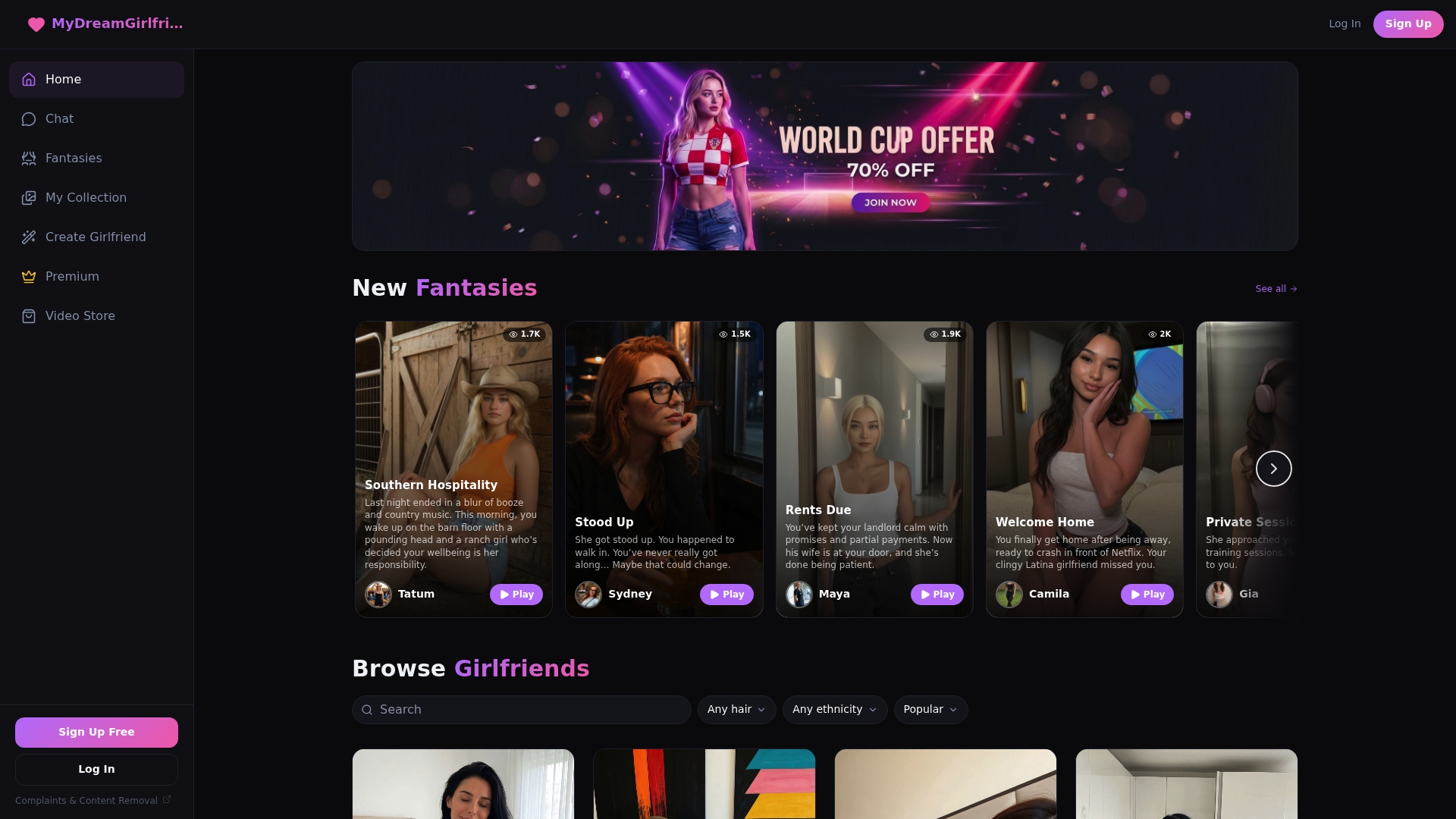
Start on the free plan, or build a girlfriend from scratch in the creator.
A quick routine to make her warmer this week
If you want a simple plan, try this for seven days:
- Day 1: Set the persona and paste in three example lines of how she should talk to you.
- Day 2: Share one real detail about your day and ask her to follow up on it tomorrow.
- Day 3: Return to that detail. Note whether she remembers it, and gently remind her if not.
- Day 4: Try one tone prompt from the table above and keep the one that feels most like her.
- Day 5: Add a ritual, like an evening check-in about the best and worst part of your day.
- Day 6: Try a calm scene, such as a comfort or bedtime roleplay, instead of a high-energy one.
- Day 7: Review. What made her feel closest? Write that into her personality and repeat it.
By the end of the week you will have a clear picture of which levers work for you, and her replies will usually be noticeably more personal because they are built on a week of specifics.
FAQ
Why does my AI girlfriend sound generic and not affectionate?
Usually because she has little specific to respond to. Give her a defined personality, write in full sentences, share real details and refer back to them. Research on intimate AI interactions points to phrasing, self-disclosure, validation and consistency as the main factors.
Can an AI actually feel affection for me?
No. Psychiatrist Marlynn Wei told Congress in 2025 that chatbots simulate empathy by mirroring your language and tone, so the closeness can feel mutual even though it is one-way. The feelings on your side are real, though, and you can enjoy the experience while keeping that in mind.
Does memory really make an AI feel more loving?
Early research suggests it helps. In a small 2026 pilot, specific shared details made an AI seem more like it remembered the relationship than stronger romantic wording did. Mention names, jokes and events repeatedly so there is something concrete to recall.
Is it safe to share personal things with an AI companion?
Share what you are comfortable with and no more. Chatbot conversations do not carry the privacy protections of clinical care, so read the provider’s privacy policy and avoid sensitive identifiers such as your address or financial details.
Sources
- Intimacy by Design: Definition, State of Research, and more (AI & Society, 2026)
- Finding love in algorithms: deciphering the emotional contexts of close encounters with AI chatbots (JCMC, 2024)
- Can Generative AI Chatbots Emulate Human Connection? (PMC, 2025)
- The Lover Across Windows: Prompt-Based Repair of Relational Continuity (2026)
- ZifaMem: Structured Memory for Persona, Preference, and Affect (arXiv, 2026)
- Toward Natural and Companionable Virtual Agents (arXiv, 2026)
- INTIMA: A Benchmark for Human-AI Companionship Behavior (arXiv, 2025)
- Detecting and Preventing Harmful Behaviors in AI Companions (arXiv, 2025)
- Testimony of Marlynn Wei, M.D., J.D. (U.S. House, 2025)
- NUS AI Institute: AI companions are coming, privacy rules are not ready (2026)