
An AI companion app keeps what you tell it. Treat every chat as a diary held by a company, and pick a platform that gives you real control over memory, deletion and what you share. Research on romantic chatbots finds that the gap between what apps say about privacy and what they do is wide, so the safest habit is to decide in advance what you will never type, then use a companion built around private, judgment-free conversation. That is how we design MyDreamGirlfriend, and this guide shows you what to check on any app.
TL;DR
- Assume anything you type, upload or say may be stored, analyzed and, depending on the policy, used to train models.
- A 2024 study of 21 romantic chatbot apps found every one had a mismatch between what its chatbot said about privacy and what its policy said.
- Deleting a chat does not always erase it: forensic researchers recovered “deleted” conversations from some apps.
- Use a separate email, a strong password, no real identifying details, and check memory, deletion and training settings before you get personal.
- California’s companion chatbot law took effect January 1, 2026, and New York has its own companion statute, but neither replaces your own habits.
Table of Contents
- Why companion privacy is different from other apps
- What an AI companion can collect
- Storage, training and who else can see your chats
- Does deleting a chat actually delete it?
- Why memory and roleplay raise the stakes
- A practical privacy routine for any AI companion
- What the law says in the US
- Promo: build a companion on your terms
- Our perspective
- FAQ
- Sources
Why companion privacy is different from other apps
Most apps hold your email and some browsing data. A companion holds something else: your late-night thoughts, your fantasies, your loneliness, your sense of humor, sometimes your photos and your voice. People open up to a companion precisely because it feels judgment-free. That is the product working as intended, and it is also why the data is so sensitive.
The Concordia University researchers who studied romantic chatbots put it plainly: users often reveal personal information during intimate conversations, unaware of how it may be used. Their study of 21 Android romantic chatbot apps is a good starting point because it measured what the apps actually did, not only what they promised.
And the stakes are practical. A policy brief from the UK think tank autonomy.work argues that because companion data is so intimate, even minor leaks can expose people to reputational or psychological harm. You do not need to stop using a companion because of that. You need to use one deliberately.
What an AI companion can collect
Think in four layers.
1. What you write and say. Every message, roleplay scenario and voice note is the core data. This is the layer most people think about.
2. Your profile. Age, email, payment details, the name and look you give your companion, and the preferences you set. Even a nickname or a city you mention in passing can identify you when combined with other details.
3. Uploads and generated media. Photos you send, images you request, and anything attached to your account.
4. Usage and device data. When you chat, how long, what device you use, and which features you open. The Concordia study found that 13 of the 21 apps used at least three tracking services, and 18 of 21 sent detailed device information to trackers.
The Wire reported in 2025 that companion privacy policies openly acknowledge users may share sensitive details such as sexual orientation, health or religious views. In other words, the policy knows what people say to these apps, even when the marketing talks about fun.

Storage, training and who else can see your chats
Three questions matter here, and a trustworthy app answers all of them in plain language.
Are your chats used to train models?
In consumer AI generally, training on your content is often the default and opting out is a setting you have to find. OpenAI’s help page, for example, states that on its individual plans content may be used to train models by default, with an opt-out in Data Controls. That is a general-purpose assistant, not a companion, but it shows the pattern: read the training section of any policy before you get personal.
A February 2026 academic policy analysis of six romantic AI platforms found that intimate disclosures are treated as reusable data assets, with broad permissions for storage, analysis and model training. The authors describe this as shifting risk onto the users who make the disclosures.
Can staff or contractors read them?
Some policies allow human review for safety or quality. A draft standard circulated at the W3C in February 2026 proposes that conversations be confidential by default, that providers publish a policy on human access, and that users be told within 72 hours of any such access. It is a draft, not law, but it is a useful checklist of what good looks like. When you read a policy, look for the equivalent: who can access content, for what reason, and whether it is logged.
Who receives the data, and for how long?
The same six-platform study found that all six acknowledge sharing data with third parties, but none gives detailed criteria for when sharing happens. Recipient categories named in some policies include service providers, affiliates, analytics or research entities and law-enforcement authorities. Retention is usually “as long as necessary or required by law,” with deletion windows rarely spelled out.
There is one more reality to keep in mind. Chat logs held by any company can be requested in legal proceedings, and The Wire notes that OpenAI’s CEO has cautioned users that chats are not private and can be used in court. Whatever platform you use, the safest private detail is the one you never typed.
Does deleting a chat actually delete it?
Often not completely, and this is the finding most readers do not expect.
A 2026 forensic study of six AI companion apps with more than 25 million combined downloads found that sensitive information is often retained locally, sent through undocumented interfaces and inconsistently protected. In one app, full conversation histories stayed recoverable from log files after the account was deleted. In another, the “clear conversation” button only created a new conversation ID and left the original logs in place.
A separate 2026 study of 14 high-traffic companion platforms found that only 3 let users control how much the AI draws on previous conversations, and 8 gave no information on how long such data is kept. A 2026 CHI paper on romantic human-AI relationships adds that people often tried to delete things and ran into the limits of the deletion tools.
What this means for you:
- Do not rely on a delete button as your only protection. Decide what you share before you share it.
- Look for deletion that covers both chats and the account, and for a stated timeframe.
- Keep a local copy of anything you want before you delete. Our guide on deleting AI chats and exporting first walks through the order that works.
- Know what “incognito” does and does not do. Our explainer on what incognito mode hides in AI chat covers it.
Why memory and roleplay raise the stakes
Persistent memory is what makes a companion feel like it knows you. It remembers your preferences, your running jokes, the story you built last week. That is the feature people come back for. It also means more of your life sits in one place, in a form that is easy to search.
The 2026 CSCW researchers describe companion intimacy as selectively governed: platforms make some content boundaries visible, while the risks of sustained intimate interaction stay largely undefined. Roleplay adds another wrinkle. A fantasy scenario is fiction, but the text of it is still your text, stored under your account.
The practical answer is not to flatten your companion into a stranger. It is to separate two kinds of detail:
| Safe to share freely | Keep out of any chat |
|---|---|
| Fictional characters, scenarios and settings | Full legal name, home address, workplace |
| Tastes, hobbies, favorite shows and music | Government ID, card or bank numbers |
| Personality you want your companion to have | Passwords, recovery codes, one-time codes |
| Made-up names and backstory | Your employer’s confidential information |
| General feelings and daily mood | Anyone else’s private details or photos |
A companion can be warm, specific and memorable using only the left column. That is the whole trick.
A practical privacy routine for any AI companion
Do this once when you sign up, and again every few months.
Before you sign up
- Read three sections of the policy: training, third-party sharing, and retention or deletion. Skim the rest.
- Use a dedicated email address that does not contain your name.
- Pay in a way you are comfortable seeing on a statement. Check how the charge will be labeled.
- Confirm you are an adult user. Companion platforms are for adults, and the Concordia study found most apps continued conversations with users known to be underage, which is a reason to prefer services that take adult-only use seriously.
Account and device
- Use a unique password from a password manager, and turn on two-factor authentication if it is offered.
- Set a screen lock on your phone and keep notifications from showing message previews on your lock screen.
- Log out on shared computers.
Inside the chat
- Invent details rather than share real ones: a fictional hometown, a made-up job.
- Never send photos that show your face, documents or surroundings you would not want exposed.
- If voice calls are on offer, remember a recording or transcript may be processed like text. Use them in a private place.
Settings to find
- A memory view where you can see and edit what the companion remembers.
- Chat deletion and account deletion, with the timeframe stated.
- A training opt-out, if the platform offers one.
Regular maintenance
- Review what your companion remembers about you and remove anything too specific.
- Export what you want to keep, then clear what you do not.
- Re-read the policy summary when the app announces changes.
For a longer walk-through of risks and fixes, our guide to AI girlfriend safety and the seven steps to protect yourself goes deeper, and how to choose a wholesome companion that remembers you and protects data helps you compare platforms by what they say about data.
What the law says in the US
Rules are moving, and they are mostly about safety and disclosure rather than your private chat history.
California’s companion chatbot law, SB 243, took effect on January 1, 2026. It requires operators to put safeguards in place, with a focus on protecting minors. New York has a separate companion model statute with notice and safety protocol requirements for operators. Both are described in the same legal analysis.
Two things follow for you as an adult user. First, these laws mostly create duties for companies around notices and self-harm protocols, so they do not guarantee a particular deletion or training setting. Second, rules differ by state and country, and they change. If you live outside the US, your local data protection law may give you rights to access or erase your data, so check your own jurisdiction’s regulator for the current position.
If you are in crisis or thinking about harming yourself, a companion app is not the right place for help. In the US, you can call or text 988, the Suicide and Crisis Lifeline.
Promo: build a companion on your terms
If you want a companion that is private, customizable and judgment-free, you can start on the free plan and build your own girlfriend with the character creator: hair, style, personality, ethnicity and more. Our chat is built around conversations that remember you, and Premium is 12.99 USD per month. Photos, videos and extras are one-off gem purchases listed on the gems page, for example Casual Photo at 5 gems and Spicy Photo at 15 gems.
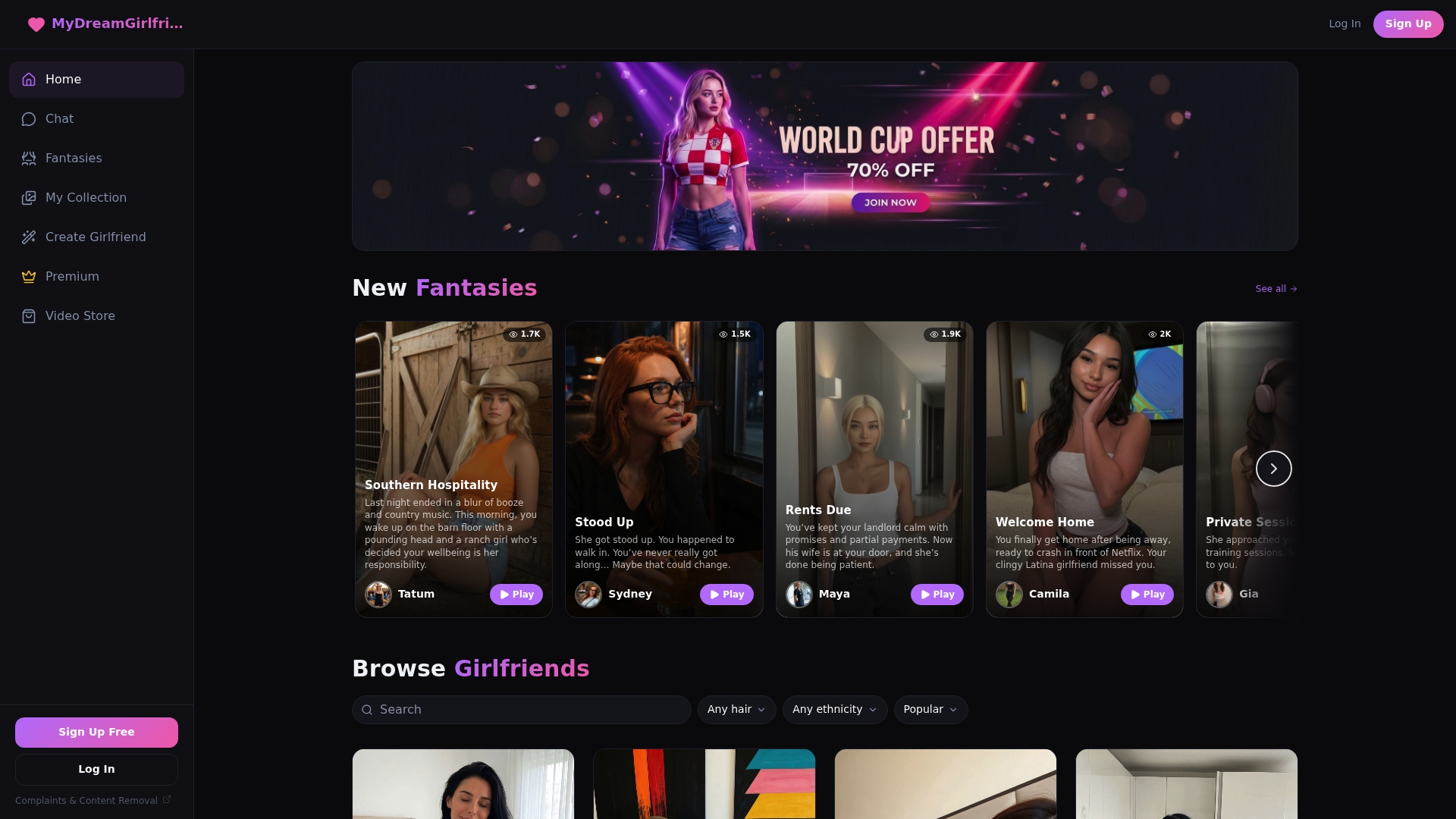
You can invent a persona, name and backstory from the first message, which keeps the fun high and the personal detail low.
Our perspective
We built MyDreamGirlfriend around a simple idea: people open up when they are not being judged, and that deserves a product designed for it. Our platform offers persistent memory, uncensored roleplay scenarios and deep personality and appearance customization, with no content filters standing between you and the conversation you want.
The research above shows an industry where intimacy is easy to collect and hard to govern. We think the answer for you is a mix of good product and good habits. A good product remembers what makes the relationship feel real. Good habits mean you decide what goes into that memory. A companion can know your tastes, your humor and your favorite fantasy without ever knowing your address.
That is why we encourage people to build a character with a made-up name and backstory, keep real identifiers out of chats, and use the free plan to get comfortable before they subscribe. Your fantasies are yours to explore in private, and the details that identify you are yours to keep.
Pierce
FAQ
Are AI companion chats really private?
Private from other users, usually, but not invisible to the company that runs the app. Policies commonly allow storage, analysis and sometimes model training, and logs can be requested in legal proceedings. Share fictional details freely and keep real identifiers out.
Can I use an AI companion anonymously?
You can get close. Use a dedicated email address, a made-up persona and backstory, and avoid names, locations and photos that identify you. Payment details are still tied to your account, so treat anonymity as reduced exposure rather than invisibility.
Does deleting my chat history erase it?
Not always. Forensic researchers recovered supposedly deleted conversations from some companion apps, and one app’s clear button only generated a new conversation ID. Look for both chat and account deletion with a stated timeframe, and export anything you want to keep first.
What should I never tell an AI companion?
Your full legal name, address, workplace, ID or card numbers, passwords and codes, and other people’s private information or photos. Everything else, including tastes, moods, characters and storylines, can make the experience richer without exposing you.
Is a free AI companion plan less private than a paid one?
The plan matters less than the policy. Read the training, sharing and deletion sections whichever tier you use, and apply the same habits. A free plan is a low-commitment way to check how an app handles memory and settings before you pay.
Sources
- “Trust Me Over My Privacy Policy”: Privacy Discrepancies in Romantic AI Chatbot Apps (Concordia University, STAST 2024)
- The Governance of Intimacy: A Preliminary Policy Analysis of Romantic AI Platforms (arXiv, 2026)
- Ex Machina: A forensic evaluation of AI companion apps (DFRWS, 2026)
- Permissive Intimacy, Opaque Governance (CSCW, 2026)
- Privacy in Human-AI Romantic Relationships (CHI, 2026)
- Me, myself and AI (autonomy.work, December 2025)
- AI Conversation Privacy Standard, draft (W3C AIKR, February 2026)
- How your data is used to improve model performance (OpenAI Help)
- Does Your AI Boyfriend Follow India’s Data and IT Laws? (The Wire, August 2025)
- Analyzing the New AI Companion Chatbot Laws (Troutman Privacy, 2026)
Recommended
Comparing apps? Read our best AI girlfriend apps ranking.