
In text and AI chat roleplay, “commands” are mostly conventions, not slash codes: quotation marks for speech, asterisks for actions, brackets or parentheses for out-of-character notes, and short plain-language directions like “slow down” or “skip to the next morning.” Learn those few moves and you can start, steer and pause almost any scene. Server commands such as /pt invite belong to game servers and Discord bots, which is a different thing. This guide covers the chat kind.
TL;DR
- Speech goes in quotation marks, actions in asterisks, and out-of-character (OOC) notes in parentheses or brackets.
- To steer a scene, write a short OOC line or a plain instruction: what you want, in one sentence.
- Agree on a pause word before things get intense, and use it the moment you need it.
- Pick one texting style (short first-person messages, action tags or long-form prose) and keep it consistent.
- On MyDreamGirlfriend you can use all of this in plain language, and your companion’s memory carries the setup forward.
Table of Contents
- What roleplay commands mean in chat
- Formatting cheat sheet: dialogue, actions, thoughts, OOC
- Commands to start a scene
- Commands to steer a scene
- Commands to pause, redirect and set boundaries
- Texting styles for roleplay
- Prompts that work for AI companions
- Perspective
- Build your own companion and try it
- A starter kit to copy
- FAQ
- Sources
What roleplay commands mean in chat
On a game server, a command is code the software executes. In a conversation with another person, or with an AI companion, a command is a habit of writing that both sides understand. Nothing breaks if you format it “wrong”; the point is clarity.
Three kinds of line do almost all the work:
- In-character (IC) lines: what your character says, does or thinks.
- Out-of-character (OOC) lines: you, the real person, talking about the scene.
- Direction lines: a short instruction that moves the story (a time skip, a change of place, a mood shift).
Everything below is a variation on those three.
Formatting cheat sheet: dialogue, actions, thoughts, OOC
Communities differ, so treat this as the common baseline. One published formatting template specifies dialogue in quotation marks, actions and narration in asterisks, thoughts in double slashes and OOC in parentheses, and it asks players to keep OOC comments minimal and move longer discussion elsewhere. A tabletop-style guide describes the same split: dialogue in quotes, IC actions and thoughts often in italics, and OOC to signal what a player is informing another player to do. It also warns that too much OOC in a short stretch can interrupt the flow.
| What you mean | Common way to write it | Example |
|---|---|---|
| Speech | Quotation marks | “You’re late.” |
| Action | Asterisks or italics | She slides the menu across the table. |
| Thought | Italics, or // marks | //He still hasn’t texted back.// |
| OOC note | (( )) or [OOC: ] | [OOC: can we move this to the rooftop?] |
| Scene direction | Brackets or a plain sentence | [Skip to the next morning.] |
| Pause | A plain word, agreed in advance | “Pause.” |
Some communities bend these rules. One wiki, for example, italicizes thoughts without quotation marks and marks telepathy with a symbol. If you play in a shared community, read its formatting page first. In a private one-on-one chat, you set the rules.
Commands to start a scene
A good opening gives four things: where you are, who is who, what the mood is, and what happens first. You can say it as a single OOC line and then switch to character.
Setup lines you can copy:
[OOC: Setting is a rainy night in a small bookstore. You're the owner closing up. I'm a customer who lost track of time. Slow, flirty, a little teasing.][Scene: rooftop party, late summer. We've just met. Start with you noticing me from across the room.][OOC: Let's keep this playful and low-pressure. You open.][Setup: you're my coworker, we're the last two in the office. Keep it subtle at first.]
Then begin in character:
I knock on the glass door, holding my umbrella like an apology. “Please tell me you’re still open.”
If you’d rather not write a setup from scratch, a ready-made scenario does the framing for you. Our mood-based roleplay ideas give starting points by feeling, and fantasies like Stood Up or Extra Credit arrive with the scene already set.
Commands to steer a scene
Once you’re in, you’ll want to change pace, location or tone without breaking the mood. Keep these short.
Pacing
[Slow down. Stay in this moment for a few more lines.][Time skip: the next morning.][Speed this up, less description, more dialogue.]
Tone
[Make it more playful.][Softer, more tender.][Add some tension, she's hiding something.]
Scene and character
[Change location: we're now in the car.][Introduce a new character: her roommate walks in.][Stay in character, she wouldn't say that.]
Memory and continuity
[Remember: I told you I hate mornings.][Recap what's happened so far in two lines, then continue.]
The recap line is worth knowing for longer stories. We wrote a separate guide on building stateful sessions for longform roleplay with a worked example.
Commands to pause, redirect and set boundaries
This is the part people skip, and it matters most. A scene works because both sides trust they can stop it.
Tabletop communities use simple verbal tools for this. One widely shared safety tool describes calling “Pause” so that everyone stops game activity until the caller asks to resume. The same idea works in a chat.
Lines that work:
- Pause:
[OOC: Pause. I need a minute.]Stop the story and check in. - Redirect:
[OOC: I'd rather take this in a different direction. Can we go back to the dinner scene?] - Rewind:
[Rewind to before she opened the door.] - Limit:
[OOC: That's off the table for me. Keep it flirty, not explicit.] - End:
[OOC: Ending the scene here. Thanks, that was fun.]
Decide your limits before you start, not mid-scene. If you want a longer walkthrough, see our guide on how to set boundaries in AI chat. After an intense scene, give yourself a few minutes to settle; our piece on roleplay aftercare with AI covers how to wind down.
If a roleplay ever leaves you feeling distressed rather than entertained, stop and talk to someone you trust or a licensed mental health professional. Chat is entertainment, not treatment.
Texting styles for roleplay
Formatting is one question. Style is another: how long your messages are, which person you write in, and which tense.
1. Short first-person texting. Quick messages in the present tense, like real texts. “I can’t stop thinking about last night.” Best for flirting and banter.
2. Action-tag roleplay. Speech in quotes, actions in asterisks, usually third person. He leans against the doorframe. “Did you miss me?” This is the most common style in AI chat.
3. Script format. One wiki describes a script format where each line starts with the character’s name and a colon, with actions in parentheses or asterisks and speech in plain text. It’s fast and easy to scan.
4. Novel or long-form format. The same wiki describes a novel format in paragraphs, with actions detailed out and speech in quotation marks, and notes that most novel-format posts use past tense, in third person. Best when you want atmosphere and slow build.
| Style | Message length | Person and tense | Best for |
|---|---|---|---|
| Short texting | 1 to 2 lines | First, present | Flirting, daily chat |
| Action tags | 2 to 5 lines | Often third | Scenes, romance |
| Script | 1 to 3 lines | Name plus colon | Quick back-and-forth |
| Novel | Full paragraphs | Third, often past | Longform stories |
A quick example of the same moment in two styles:
- Texting: “Come over. I made too much pasta and I’m not sharing it with anyone else.”
- Novel: She stood in the kitchen doorway, sleeves pushed to her elbows, a wooden spoon in one hand. “I made too much pasta,” she said, as if it were an accident.
Match your partner’s format
Most awkward sessions come from two people writing in two different styles without noticing. The simplest fix: read their last message and answer in the same shape. If they send one-line texts, don’t reply with five paragraphs. If they write in asterisks, use asterisks. With an AI companion, the reverse also works: your style sets the pattern she follows, so write the way you want to be answered. If you want to change it, say so in one OOC line: [OOC: Longer replies, please, with more description.]
With a human partner, agree on three things before you start: format, content limits and a pause word. Our partners at 1985 Games have a useful take on roleplay etiquette at the table, and the same manners carry over to text.

Prompts that work for AI companions
With an AI companion you don’t need a special syntax. A language model reads plain requests well, so the best “commands” are clear sentences. A good prompt has four parts: who, where, mood, first move.
- Weak: “Roleplay with me.”
- Better: “Tonight you’re my neighbor, we’re on the balcony, it’s late, and you’re a bit teasing. You start.”
Other habits that help:
- Say what you want more of, not just what you don’t. “More banter, less narration” beats “stop being boring.”
- Correct in character when possible. “She would roll her eyes here” keeps momentum.
- Use OOC for real changes, such as a new setting, a new rule or a stop.
- Restate key facts now and then in long stories, even with memory.
If you want a different personality mid-story, our guide on switching AI personalities without losing the chat shows how.
Perspective
Here is what we see from our side. People arrive looking for a list of commands, and what they really want is a companion who follows them without effort. That is how we think about MyDreamGirlfriend. Our platform is built around persistent memory, deep personality and appearance customization, and uncensored, private roleplay, so the setup you write once is meant to stay with her instead of being repeated every session.
The best “command” is still a clear sentence. Say what you want, set your limits first, and use a pause line when you need it. A judgment-free space works best when you stay in charge of the pace.
Pierce
Build your own companion and try it
If you’d rather practice with a companion shaped around you, MyDreamGirlfriend lets you create one from scratch: hair, style, personality, ethnicity and more, in our AI girlfriend creator. Chat is flirty, romantic or playful, on your terms. You can start on the free plan, and Premium is $12.99 per month. Extras like photos and videos are bought with gems, listed on the gems page, where a Casual Photo costs 5 gems and a Spicy Photo 15 gems.
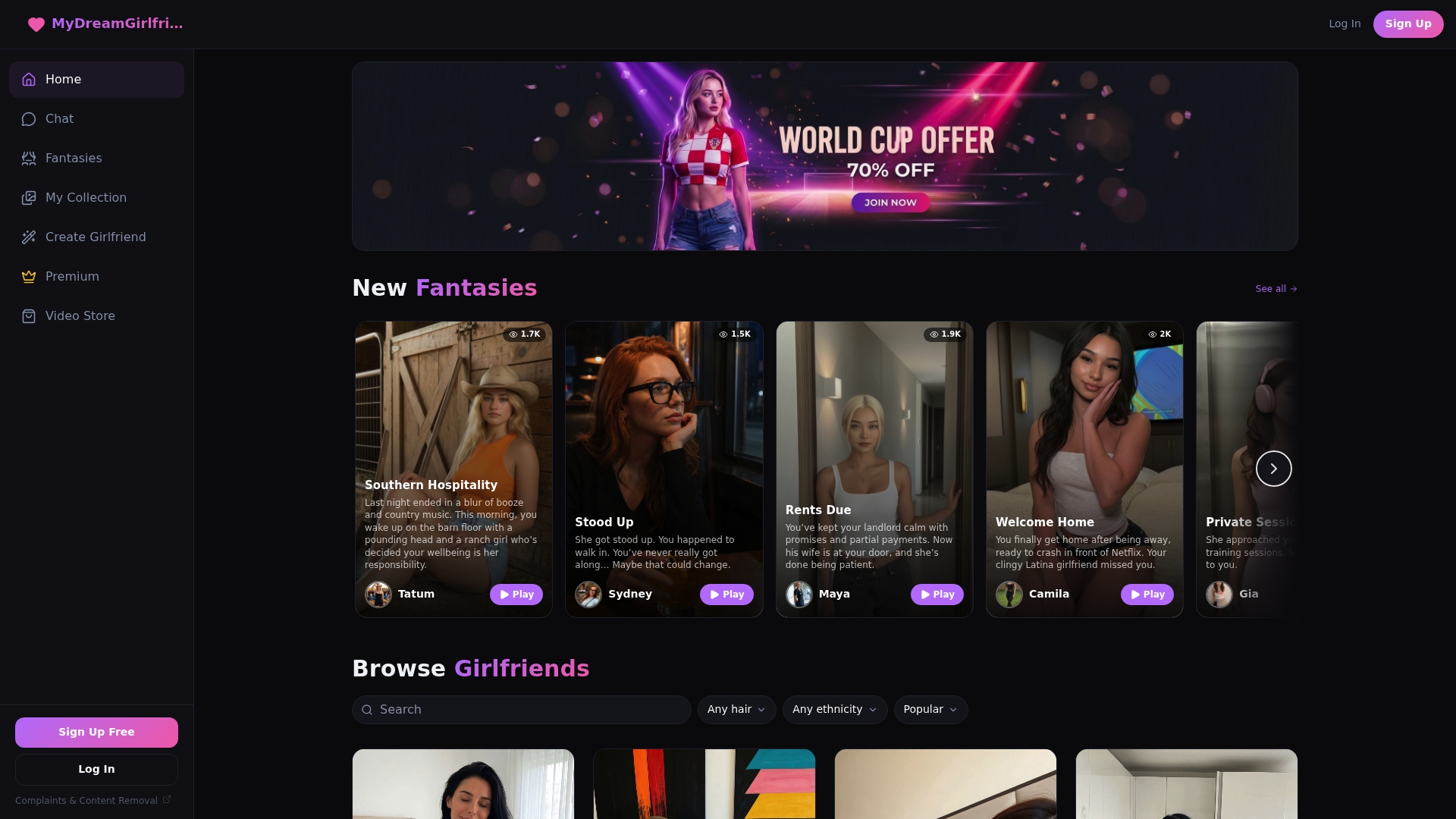
For a ready-made scene, try Private Session or 7 Minutes in Heaven, or browse our roleplay features.
A starter kit to copy
Paste this at the start of a new chat and edit the brackets:
[OOC: Setup: [place], [time of day]. You are [role/personality]. I am [role]. Mood: [playful / tender / tense]. Style: action tags, 3 to 5 lines per reply. If I write "pause", stop the scene and check in. You start.]
Then keep a short toolbox of steering lines nearby: slow down, time skip, change location, more banter, rewind, pause, end scene. Seven lines cover most situations.
FAQ
What is the difference between IC and OOC?
IC means in character: anything your character says, does or thinks. OOC means out of character: you speaking as yourself, usually in parentheses or brackets. Keep OOC brief so the story doesn’t lose momentum.
Do AI roleplay chats have official slash commands?
Many chat apps don’t need them, because you can type instructions in plain language. Slash commands are common on game servers and Discord bots, which are a different setup. On MyDreamGirlfriend, a clear sentence is the way to steer.
How do I stop a scene I’m not comfortable with?
Write an OOC line such as “[OOC: Pause. I want to change direction.]” or end the scene outright. Decide your limits before you begin, and if the chat leaves you upset, step away and talk to someone you trust.
Which texting style should I use?
Use short first-person messages for flirting and banter, action tags for scenes, and long-form prose for slow, atmospheric stories. Match your partner’s format, or tell your companion which one you prefer.
Sources
- TRP Guide, Ouroboros
- Roleplay Formatting Rules Template, RPGINI Docs
- Formatting a Post, Split-World wiki
- Master roleplay etiquette for better tabletop RPG fun, 1985 Games