
The winning setup for longform roleplay AI is a stateful session architecture: an editable memory layer, a lorebook of locked facts, and periodic checkpoints you can roll back to. Success looks specific, not vague. Your character’s voice stays recognizable at message 400, the plot points you set up in session one still matter in session ten, and picking the story back up after a week away takes seconds instead of a paragraph of re-explanation.
TL;DR:
- Building a longform roleplay setup requires editable memory, pinned facts, a lorebook, and checkpoints for effective session management.
- Using short, clear system prompts, a structured lorebook, and frequent checkpoints helps maintain consistency and prevent story drift over time.
- Re-injecting persona traits and running end-of-scene summaries are vital to keeping character voices stable through extended sessions.
- Managing memory by pinning key facts with context, pruning irrelevant chatter, and branching support ensures the story stays coherent and reversible.
- Platforms like Mydreamgirlfriend integrate these features for easier long-term roleplay, emphasizing persistent memory and structured scenarios.
Table of Contents
- What Features Should a Longform Roleplay Platform Have?
- How Do You Build a Session Architecture for a Long Campaign?
- What Prompting Techniques Keep a Character Consistent?
- How Do You Manage Memory Without Losing the Story?
- How Does Mydreamgirlfriend Put This Into Practice?
- When Should You Commit to a Longform Arc?
- Try Longform Roleplay on Mydreamgirlfriend
- Sources
- FAQ
What Features Should a Longform Roleplay Platform Have?
Most roleplay tools handle a good first conversation. Few handle the fortieth session with the same character, where a name gets misremembered or a betrayal from three weeks ago quietly vanishes. The difference almost always comes down to five features.
- Editable, inspectable memory panels. You need to see what the AI thinks it knows, and fix it when it’s wrong. A memory you can’t inspect is a memory you can’t trust.
- Pinning. Not every detail deserves equal weight. Pinning locks the facts that must never drift: a character’s real name, a hidden motive, a promise made in chapter two.
- A lorebook or worldbook. This is a structured reference the model checks against, separate from the flowing chat log. Platforms like Reverie build world books specifically to hold setting rules and backstory that would otherwise get buried under hundreds of messages.
- Branching or forking. The ability to split a timeline lets you test an alternate outcome (what if she said yes?) without overwriting the canon version of the story.
- Multi-character scene support with persona isolation. Group scenes fail fast when characters start borrowing each other’s memories or voices. Isolation keeps each persona’s knowledge and speech patterns walled off from the others.
- Versioned system prompts and exportable state. When you tweak a character’s core instructions, you want a history of what changed and when, plus a way to take your campaign elsewhere if you need to.
Reverie’s approach to editable memory and world books shows how inspectable memory materially cuts down on drift. When facts are explicit and correctable rather than buried in a token window, the model has something solid to check against instead of guessing from a foggy chat history.
How Do You Build a Session Architecture for a Long Campaign?
Treat your roleplay less like a chat and more like a living document. That single mental shift, borrowed from how developer tools like TracyHill RP structure long campaigns, changes everything about how you set one up. TracyHill RP stores a state seed, a system prompt, a lorebook, and a version history as separate, persistent objects rather than letting them dissolve into an endless scroll of messages.
Here’s a workable blueprint you can adapt to almost any platform:
- Write a compact system prompt. Define voice, tone, and hard limits in a few sentences. Overloaded system prompts get ignored past a certain length. Shorter, sharper instructions survive longer sessions.
- Build your lorebook before you start roleplaying, not after. Index characters, locations, and unresolved plot threads as short, labeled entries the model can retrieve when relevant, rather than one long paragraph it has to parse every time.
- Set a checkpoint cadence. Snapshot state at natural breaks: end of a scene, after a major decision, before anything risky or experimental. A checkpoint is your undo button for an entire storyline.
- Use rolling summaries to manage context limits. Every 30 to 50 messages, compress what happened into three or four sentences and feed that back in, rather than relying on the model to remember the raw transcript.
Pro Tip: Name your checkpoints by story beat, not by date, like “before the confession” or “after the ambush.” You’ll find the right one to restore to in seconds instead of scrolling through a timestamp list.
This document based mindset also explains why self-hosted tools separate campaign state from the ephemeral chat window in the first place: it makes version control and safer state management possible in a way a single continuous conversation never allows.
What Prompting Techniques Keep a Character Consistent?
Voice drift is the single most common failure in text-based roleplay AI, and it rarely happens all at once. It creeps in over dozens of exchanges until a sarcastic character starts sounding earnest, or a formal character starts dropping slang. A handful of prompting patterns keep that drift in check.
- Use a scene header plus action pattern. Open each new scene with a short header (location, time, mood) followed by the triggering action. This gives the model a predictable frame to respond within, instead of guessing tone from scratch.
- Write a persona seed and re-inject it periodically. A persona seed is a short block covering key traits, speech markers, and boundaries. Re-inject it every 40 to 60 messages, or right after a long gap, rather than assuming the model still “remembers” who the character is.
- Run end-of-scene reports. Community threads on techniques for longform roleplay consistently point to writing a short summary report after each scene. It keeps the story focused and gives you a clean anchor point if things wander off track.
- Use corrective micro-prompts instead of full resets. If the model gets a detail wrong, a quick one-line correction (“she’s actually left-handed”) usually fixes it faster than restarting the whole scene.
Pro Tip: Keep a running “voice sheet” for each character: three or four speech habits, one thing they never say, and one physical tic. Paste it back in whenever a character starts sounding generic.
Multi-character interplay needs its own discipline. When two or more AI-driven characters share a scene, cross-contamination is the biggest risk: one character starts finishing another’s sentences in the wrong tone, or “remembers” something only the other character was told. Isolating each persona’s knowledge base, and reintroducing their individual seeds separately rather than as one combined block, keeps the conversation from collapsing into a single voice wearing different names.
How Do You Manage Memory Without Losing the Story?
Good memory hygiene is less about remembering everything and more about deciding what deserves to be remembered. Treat memory like an editor treats a manuscript: cut ruthlessly, but never cut the thing the plot depends on.
- Pin facts with provenance. Don’t just pin “she’s a spy.” Pin “she’s a spy, revealed in scene 14, unknown to her sister.” The context matters as much as the fact.
- Prune conversational noise regularly. Small talk, filler reactions, and abandoned tangents pile up fast. Archive or delete them so the active memory stays lean enough for the model to actually use.
- Fork before you experiment. Branching support, the kind Reverie and similar platforms build in, lets you test a risky plot turn on a copy of the timeline. If it doesn’t work, you didn’t just damage months of canonical continuity.
- Export or replay state when you need portability. Whether you’re moving a campaign to a new platform or turning a chat log into actual prose, having an exportable state seed saves you from reconstructing a story from scratch.
Editable memory and forked branches together mean “what if” play stays safe and reversible. That single capability, more than raw model size, is often what separates a platform built for one good conversation from one built for a hundred.
How Does Mydreamgirlfriend Put This Into Practice?
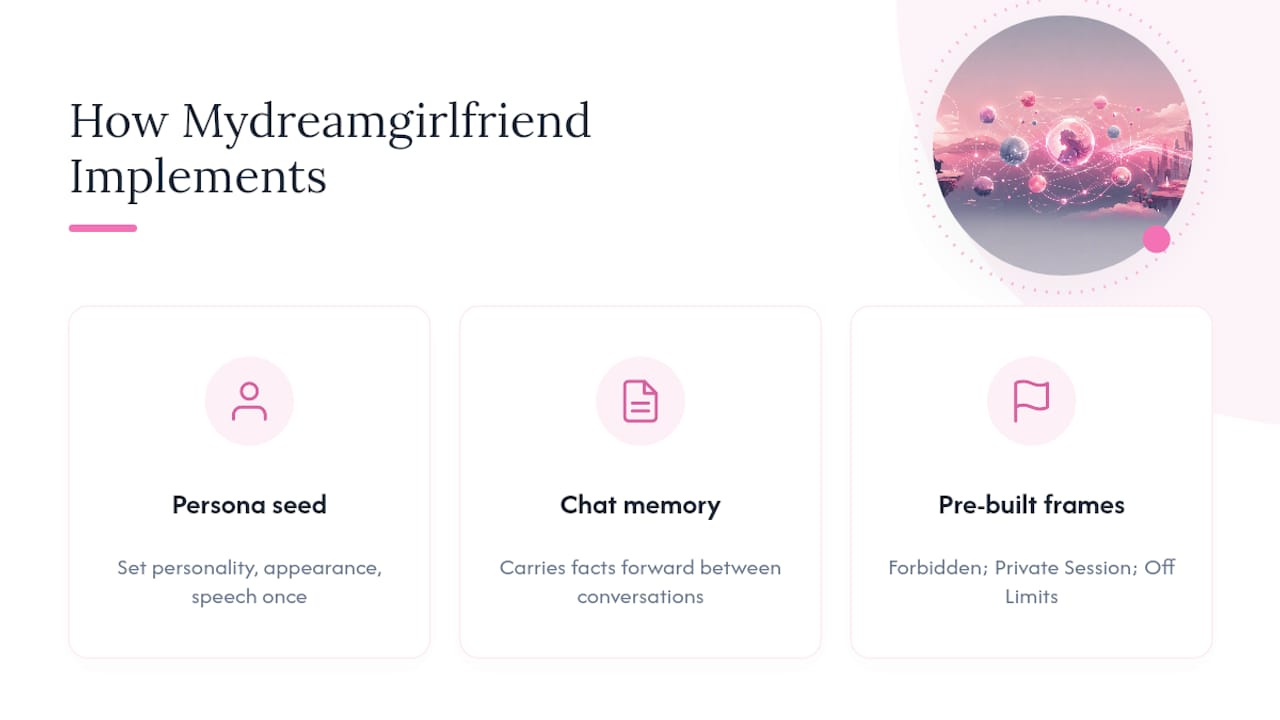
Mydreamgirlfriend’s character creator works as a persona seed generator: you set personality, appearance, and speech tendencies once, and that profile anchors the voice across every future session. The AI chat with memory feature carries facts forward between conversations rather than resetting with each login, which is the core requirement for any longform arc.
For readers who want to see session architecture applied to specific scenarios, Forbidden, Private Session, and Off Limits fantasies each function as pre-built campaign frames: a defined setting and tone you can pin facts into rather than building a lorebook from zero.
When Should You Commit to a Longform Arc?
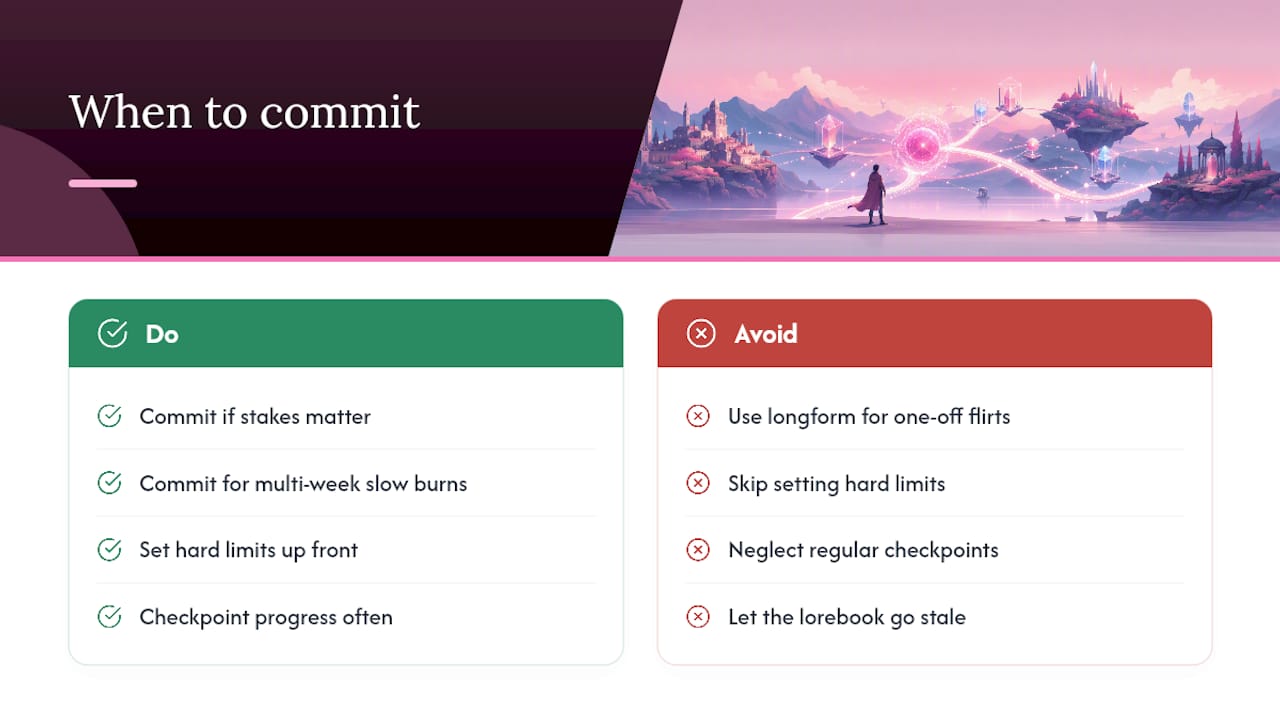
Long arcs pay off when a character or plot thread has real stakes worth protecting. A one-off flirty exchange doesn’t need a lorebook. A slow-burn story spanning weeks does.
The recurring pitfalls are drift, runaway invention, and blurred boundaries around what the AI should and shouldn’t introduce. Mitigate all three the same way: set hard limits up front, checkpoint often, and keep a lorebook current. Skip any one of those and the story eventually gets away from you.
— Pierce
Try Longform Roleplay on Mydreamgirlfriend
You’ve now got the architecture: persona seed, lorebook, checkpoints, pinned facts. A platform may put all of that behind a few clicks instead of a spreadsheet. Building your own campaign document by hand works, but most people would rather start talking to a character today than configure one for a weekend.

Start with three features in order: the character creator to set your persona’s traits and voice, a themed scenario like Private Session to give the arc a frame, and AI chat with memory to carry it forward. For your first session, pin some key facts you never want forgotten, interact for a series of messages, then step away and come back later to see how much actually held. If it holds, you’ve got your longform setup. Browse the full roster of AI girlfriends to find the personality that fits the story you want to tell.
Sources
For readers who want to go deeper into the mechanics covered here:
FAQ
What Is Longform Roleplay AI?
It’s sustained, multi-session AI-driven roleplay that depends on persistent memory and consistent character voice rather than a single standalone conversation.
How Do I Stop My AI Character From Drifting Off Character?
Re-inject a short persona seed every 40 to 60 messages, pin core traits, and use quick corrective prompts instead of full resets when the model gets a detail wrong.
What’s a Lorebook and Why Does It Matter?
A lorebook is a structured set of facts and rules the AI checks against, kept separate from the flowing chat log, which is what platforms like Reverie use to prevent memory degradation over long arcs.
Can Mydreamgirlfriend Handle Longform Roleplay Sessions?
Yes. Its character creator sets a persistent persona seed, and its AI chat with memory carries facts across sessions instead of resetting them.
How Often Should I Checkpoint a Longform Roleplay Session?
Snapshot state at natural breaks, such as the end of a scene or right before a major decision, so you always have a clean point to restore or branch from.