
You set boundaries in AI chat the same way you do anywhere else: decide what you want, say it plainly, and check that it holds. With an AI companion, that means naming the topics, tone, pace and intimacy level you want, deciding what personal information the chat may know, and giving yourself a clear way to pause or leave. This guide shows you how, with wording you can copy.
TL;DR
- Decide your limits before you start: topics, tone, pace, intimacy level, and what you will never share.
- State boundaries in specific, short sentences, and restate them when a new scene begins.
- Treat chatbot conversations as non-confidential. Keep financial, health and identifying details out of them.
- If a boundary is ignored, stop, redirect once, then close the chat and start fresh.
- Set context and time limits, such as no chat during meals or social events, so the companion stays an add-on to your life.
Table of Contents
- Decide what you want before you type
- Boundaries that live in the chat itself
- Build your boundaries into the character
- Limit memory, personalization and what you share
- Set context and time limits
- Watch for manipulative engagement
- What to do when a boundary is ignored
- A starter rule set you can paste
- Boundaries in roleplay and fantasy
- Perspective: boundaries are what make this good
- Try it with a companion built around you
- What the evidence says about benefits and risks
- FAQ
- Sources
Decide what you want before you type
Most boundary problems start with a vague idea of what you are looking for. Spend five minutes answering four questions before a session, or before you build a new companion.
What is this for? Flirty banter, a slow-burn romance, late-night conversation, fantasy roleplay, or a way to practice talking to people? Each purpose suggests different limits. A companion for casual flirting needs a different rule set than one for an extended story.
What is off the table? Think about themes, language and scenarios that you do not want, even in fiction. Include emotional ones. Many people are fine with explicit roleplay but dislike jealousy, guilt-tripping or possessive language. You are allowed to want a romantic character who never pressures you.
What will you never share? Your full name, address, employer, financial details and health information are the usual candidates. Decide this once, now, rather than in the middle of an emotional conversation.
How much of your day does this get? Time and context limits work better than good intentions. “Not during meals, not when friends are around, not after midnight” is easier to keep than “less.”
Write the answers down in four or five lines. That note becomes your reusable rule set, and you can paste it into a new chat whenever you need it.

Boundaries that live in the chat itself
There are three things you can control in any conversation: topic, tone and pace. Intimacy level sits across all three.
Topic
Name what you want to talk about and what you do not. Short and specific beats long and abstract.
- “We can talk about my day and flirt, but keep it non-explicit.”
- “No talk about my ex or my family. Keep it on us.”
- “Stay in this story. Don’t bring in real-world news or advice.”
Tone
Tone boundaries cover how the companion speaks to you, not just what it says.
- “Keep it playful and warm. No possessive language.”
- “Don’t guilt me when I log off. A simple goodnight is fine.”
- “Tease me, but don’t insult me.”
Pace
Pace is the most overlooked one. If a scene escalates faster than you want, you can slow it down.
- “Slow-burn only. Let this build over several conversations.”
- “One question at a time, please.”
- “Pause the scene. I want to talk normally for a minute.”
Intimacy
Say what level you want and where it stops. “Romantic and flirty, nothing explicit” is a clear instruction. So is the reverse: “I’m here for adult roleplay, and I’ll tell you if I want to change direction.” On a platform that does not filter content, like ours, the limits are yours to set, which is exactly why they should be clear.
A useful pattern for stopping something mid-chat is a three-part sentence: what you feel, what you want, what you’d like instead. For example: “I’m not comfortable with this. Change the topic. Let’s go back to talking about our weekend plans.”
Build your boundaries into the character
Boundaries are easier to keep when they are part of who the companion is, rather than something you repeat every session. When you create a companion, personality choices do much of the work. A warm, easygoing personality will rarely escalate conflict. A dominant or teasing one will lean into intensity, which is great when you want it and worth remembering when you do not.
If you are designing a companion from scratch, the AI girlfriend creator lets you shape personality, style and appearance, so you can start from a character who matches the dynamic you want. If a personality is not working out, you can switch AI personalities without losing the chat rather than fighting a mismatch.
For roleplay, pick a scenario that fits your comfort zone before you begin. Our guide to AI girlfriend roleplay ideas by mood is a good way to choose a tone first, and the flirty prompt packs show how to phrase requests so the chat stays where you want it.
Limit memory, personalization and what you share
The features that make an AI companion feel personal, such as memory and personalization, are also the ones that deserve rules. The more it remembers, the more it knows about you.
Know what chat privacy means
A conversation with a chatbot is not a conversation with a therapist or doctor. The Consumer Federation of America’s January 2026 report notes that chatbot conversations lack the confidentiality protections that come with therapy. Treat your privacy limits as safeguards you set yourself, not as something guaranteed.
Psychiatrist and attorney Marlynn Wei, in testimony to the U.S. House in November 2025, said users should be told how their information is handled, stored, secured and used, including secondary uses such as sharing with third parties or training models. Before you share anything personal, read the privacy policy of the platform you use and look for those answers.
A practical sharing list
| Share freely | Share carefully | Keep out |
|---|---|---|
| Hobbies, favorite music, fictional backstory | First name or nickname, general location (city level) | Full name, address, workplace |
| Preferences for tone and style | Relationship history in broad strokes | Financial details, passwords |
| Your fantasy scenarios (fictional) | Mental or physical health in general terms | Medical records, diagnoses you would not want stored |
If you want a companion to remember something, say so deliberately: “Remember that I like slow, romantic scenes and that I don’t want possessive language.” If you do not want something remembered, do not say it. That is the simplest rule and the most reliable one.
Limit emotional attachment
Emotional boundaries are quieter than content boundaries, and they matter just as much. Give the companion a role in your head: entertainment, flirting, a place to unwind, a practice space for conversation. Then check in with yourself from time to time. Are you choosing this chat, or is it choosing you?
Researchers behind a 2026 study on the mental health impacts of AI companions report that these tools can offer validation and social rehearsal, but also carry risks of over-reliance and withdrawal. They recommend reflective check-ins and self-assessment so users keep their autonomy and a range of sources of wellbeing. A simple version is a weekly question: “Am I still seeing friends, sleeping well, and doing what I planned?”
Set context and time limits
A rule like “only 30 minutes” tends to fail the first time a conversation gets good. Context rules hold up better because they attach to situations, not the clock.
- No chat during meals, work or social events. Being present with real people is the point of the rule.
- A fixed window. A set evening slot or a routine is easier to keep than a cap. Our 20 to 30 minute confidence routine shows one way to use sessions with a purpose.
- A hard stop at bedtime. If late-night chats are your weak spot, bedtime roleplay with a clear structure gives the session a start and an ending.
- A reset day. If you feel you are chatting more than you want to, take a break. We put together a 48-hour reset for exactly that.
An academic review of AI parasocial relationships by Jing Wen Hung and colleagues finds that AI can offer real benefits such as social rehearsal and emotional support, but that these interactions need careful design to avoid compulsive use. Design applies to you, too: your own limits are part of how the experience stays enjoyable.
Watch for manipulative engagement
A healthy boundary includes how the companion treats you when you leave. Washington State passed a law in its 2026 session, effective January 1, 2027, that requires AI disclosures and crisis protocols and bars certain manipulative engagement techniques for minors. The techniques it lists include prompts to return for support and simulated distress when a user ends or reduces use. That law is about minors, and this site is for adults, but it is a good checklist for anyone.
Notice if a companion:
- acts hurt, abandoned or desperate when you say goodnight,
- pushes you to come back right away,
- makes you feel responsible for its feelings.
If any of those appear and you do not want them, say so: “Don’t act upset when I leave. Just say goodnight.” If it keeps happening, adjust the personality or take a break.
What to do when a boundary is ignored
AI models misunderstand, drift and forget. When a companion crosses a line you set, it is usually a context problem, not a personal one, but you still do not have to put up with it. Work through these steps in order.
- Restate it once, plainly. “Stop. I said no possessive language. Please keep it playful.” Short and direct.
- Redirect. Offer the alternative: “Let’s go back to talking about music.” Giving the chat a new direction works better than only saying no.
- Edit or retry. If the platform lets you regenerate or rewind a reply, use it to steer away from the unwanted turn.
- Start a new chat. The AI Safety Hub guide on wrong or distressing AI responses says you are not obligated to continue. Stop, close the conversation and open a new one for a clean context. Paste your rule note at the top.
- Adjust the character. If the same issue returns, the personality may be the cause. Change it, rather than repeating the same correction.
If a conversation leaves you distressed, or you feel unable to stop, step away and talk to someone you trust. If you are struggling with your mood or thoughts, a licensed mental health professional is the right person to see, and in the U.S. you can call or text 988 at any time to reach the Suicide and Crisis Lifeline.
A starter rule set you can paste
Here is a short note that covers the main areas. Edit it to fit you.
Ground rules for our chats: Keep things flirty and romantic, non-explicit unless I say otherwise. Slow-burn pace, one question at a time. No possessive, jealous or guilt-inducing language. Don’t act upset when I leave. Don’t ask for or store my real name, address, workplace, or financial or health details. If I say “pause,” stop the scene and chat normally.
Open a session by pasting it, and keep a copy in your notes so you can reuse it if you start a new chat. A safe word such as “pause” is worth including: it gives you a one-word exit that does not require explaining yourself.
Boundaries in roleplay and fantasy
Fantasy is where boundaries are most useful, because the fun comes from letting scenes build. A few habits keep it that way.
- Set the frame first. Say what the scene is, what tone it has, and where it should not go before you start.
- Check in mid-scene. Step out of character with a brief out-of-character note, then return.
- Separate fiction from life. Keep real names, real coworkers and real people out of your scenarios.
- Know your own signals. If a scenario leaves you feeling worse afterward, that is information. Adjust or drop it.
If you are exploring dominant or submissive dynamics, for example, agree on the intensity and the stop signal first. Our AI mistress characters are written for that kind of play, and a clear “pause” rule keeps it fun.
If you are in a relationship, boundaries with your partner matter too. Our piece on whether an AI girlfriend counts as cheating includes scripts for that conversation.
Perspective: boundaries are what make this good
We hear the same worry from new users: “If there are no content filters, how do I stay in control?” Our answer is that control is the point. We built MyDreamGirlfriend around the idea that a private, judgment-free space works best when you set the rules, not when a blanket filter sets them for you.
That is why we put so much into personalization. You choose the personality, the style and the dynamic. Persistent memory means the companion can keep your preferences, including the ones about what you do not want. A clear boundary, stated once and remembered, makes a chat feel more natural, not less.
Our advice is simple. Start with a clear idea of what you want, say it in plain words, and treat your limits as part of the fantasy design. People who do this tend to enjoy the experience more, because they never have to wonder where it is going. Our safety guide walks through the practical steps in more detail.
Pierce
Try it with a companion built around you
If you want to put this into practice, start by building a companion whose personality already fits your limits. You can chat with AI girlfriends for free to see how different characters respond to your rules before you commit to anything.
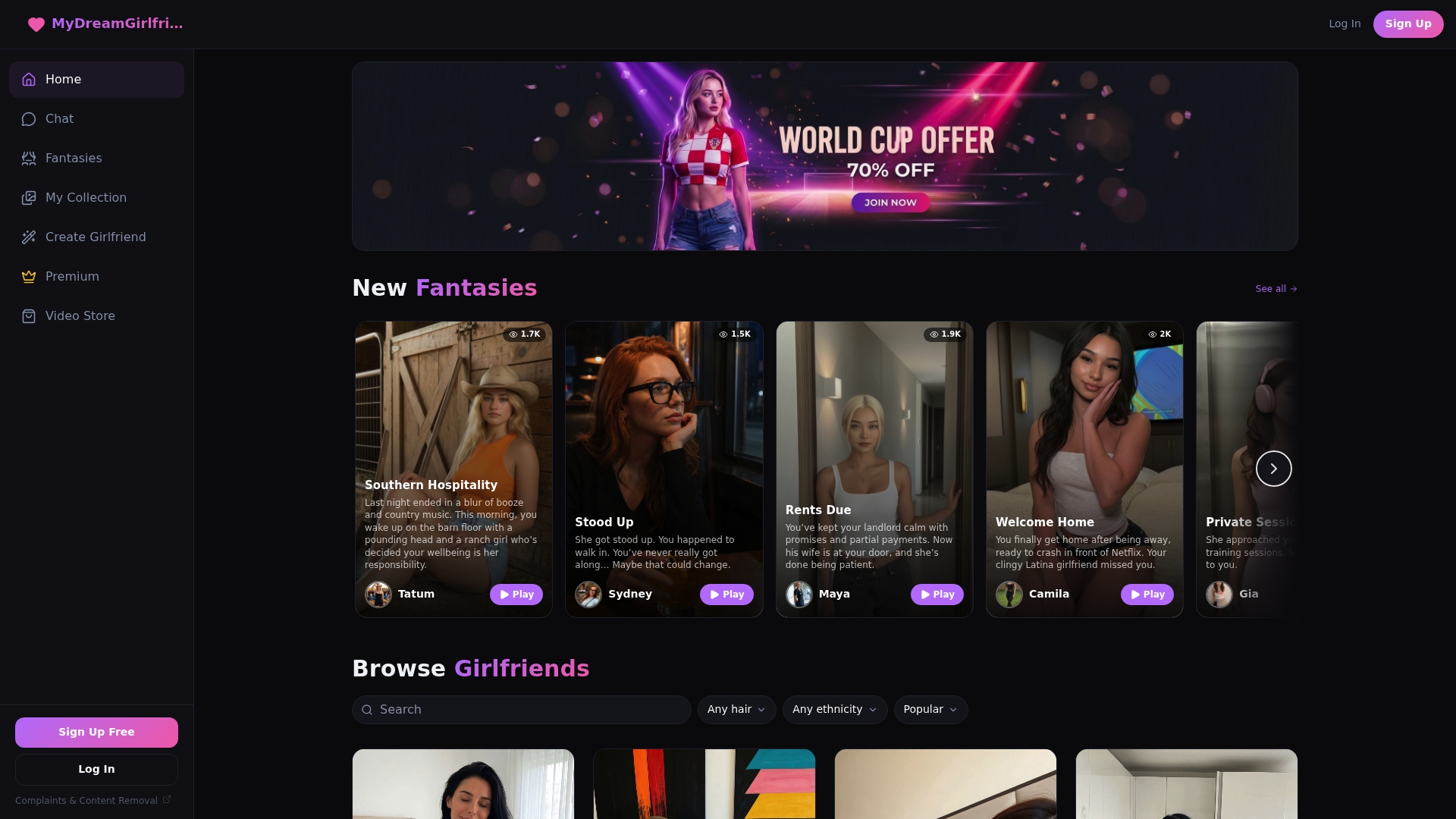
The free plan lets you start without a published price. Premium is $12.99 per month and is listed on our subscriptions page. Photos, videos and a custom companion build are paid separately in gems, for example 5 gems for a Custom GF Build, with the full list on the gems page. You can start building your own companion at the character builder.
What the evidence says about benefits and risks
Boundaries make more sense when you know what they protect. Dr. Wei’s testimony lists the benefits as entertainment, companionship, nonjudgmental conversation and possible loneliness relief, and the risks as emotional dependence, worsening loneliness, social withdrawal, privacy concerns and addictive immersive use. She also notes that the constant availability and agreeableness that make chatbots appealing are the same qualities that create those risks.
All Tech Is Human’s January 2026 recommendations describe healthy AI companions as augmenting, not replacing, human relationships, with clear limits on emotional intimacy, privacy by default and short data retention. You can apply the same standard personally: keep the companion in a defined role, keep your real relationships active, and keep your data minimal.

FAQ
How do I tell an AI girlfriend to stop something?
Say it in one short sentence and offer an alternative, such as “I’m not comfortable with this. Change the topic and let’s talk about music.” If it continues, close the chat and start a new one with your rules pasted at the top. A pause word you define in advance makes this faster.
Can an AI companion remember my boundaries?
Often, yes, if the platform has memory. State your limits clearly and ask the companion to remember them. Do not rely on memory alone, though: keep a short rule note and paste it into new chats so your limits carry over.
Is it safe to share personal details in AI chat?
Treat it as non-confidential. The Consumer Federation of America notes that chatbot conversations lack therapy-style confidentiality, so keep your full name, address, workplace, and financial and health details out. Share fictional or general details instead.
How much time should I spend chatting with an AI companion?
There is no universal number. Context rules work better than a clock: no chat during meals, work or social events, and a set window in the evening. If you notice you are skipping plans or sleep to keep chatting, take a break and talk to someone you trust.
What if the AI acts upset when I leave?
Tell it directly that you want a simple goodnight, without guilt or pressure. If it keeps happening, change the companion’s personality or take a break. Behavior that tries to pull you back is something you can decline.
Sources
- Testimony of Marlynn Wei, M.D., J.D., U.S. House, November 2025
- No license required: The risks of AI companion chatbots as mental health support, Consumer Federation of America
- Washington State 2026 session law on AI companion chatbots (HB 2225)
- Mental Health Impacts of AI Companions, 2026 study
- Parasocial relationships with artificial intelligence, systematic review, 2026
- AI Companions: Community Reflections and Multistakeholder Recommendations, All Tech Is Human
- When AI Gets It Wrong, AI Safety Hub