Yes, for a meaningful minority of users, AI chat use crosses from habit into something that behaves like addiction. If daily chatting is displacing sleep, work, or real relationships and you’ve tried to cut back without success, that’s the signal. The first move isn’t therapy or quitting cold. It’s a 48-hour time cap or an app blocker, paired with an honest log of how you feel and function without it.
TL;DR:
- Up to 36% of psychologists have seen patients who show signs of AI chat dependency, but no official diagnosis currently exists.
- Warning signs include failed attempts to cut back, compulsive checking, sleep disruption, mood shifts, declining relationships, and escalating spending.
- AI platforms are intentionally designed with addictive patterns like unpredictable responses and instant feedback, which reinforce compulsive use.
- Vulnerable groups, especially teens and lonely individuals, are more prone to developing problematic patterns due to neurological and emotional factors.
- Practical prevention involves setting time limits, creating disengagement rituals, involving family support, and seeking professional help if necessary.
Table of Contents
- Understanding AI Chat Addiction: What Researchers Actually Mean
- Warning Signs of Compulsive Chatbot Use
- Why AI Chat Apps Are Built to Be Hard to Put Down
- Who’s Most Vulnerable, and What the Numbers Actually Show
- The Real Cost: Sleep, Grades, Relationships, and Rare Severe Cases
- Practical Steps to Cut Back on AI Chat Use
- When and How to Get Professional Help
- Using AI Companions Responsibly: Boundaries That Actually Hold
- AI Chat Addiction vs. Gambling, Gaming, and Social Media Addiction
- Prevention Strategies That Actually Work
- Why Family Support Changes the Outcome
- What We Still Don’t Know
- The Line Between Healthy Use and Harm Is Thinner Than People Think
- A Managed Way to Enjoy AI Companionship, With Real Controls Built In
- Sources
- FAQ
Understanding AI Chat Addiction: What Researchers Actually Mean
Researchers don’t yet call this a formal disorder. A 2026 narrative review in Frontiers in Public Health frames problematic use of generative AI chatbots (often shortened to PUGAIC) as a spectrum, not a binary. Most people who chat with AI daily are fine. A smaller group slides into patterns that look a lot like behavioral addiction, built on emotional attachment, anthropomorphism (treating the AI like a person), and the kind of parasocial bond you’d normally reserve for a close friend.
The clinical framing borrows criteria from gambling and internet gaming disorder, both of which the DSM-5 does recognize in some form. Researchers generally look for three things:
- Loss of control over how much or how often someone chats, despite intending to cut back.
- Functional impairment — grades slipping, work missed, relationships fraying.
- Persistence despite harm, meaning the person keeps going even after recognizing the cost.
Neither the DSM-5 nor the ICD-11 lists a standalone “AI chatbot addiction” diagnosis. That gap matters. It means clinicians are adapting existing behavioral-addiction frameworks rather than working from a validated tool built for this specific behavior, and it means insurance coverage and formal treatment protocols lag behind what’s showing up in therapy offices right now.
Warning Signs of Compulsive Chatbot Use
The patterns tend to show up gradually, then all at once. Caregivers and users themselves often miss the early signs because the behavior looks like ordinary phone use from the outside.
- Failed attempts to cut back. Someone deletes the app, then reinstalls it within days, sometimes hours.
- Compulsive checking. Opening the chat during work meetings, classes, or conversations with other people, often without a clear reason to.
- Time displacement. Homework, job tasks, or chores consistently take a back seat to chat sessions.
- Sleep disruption. Late night sessions push bedtime back by hours, then daytime fatigue follows.
- Mood shifts tied to access. Irritability, anxiety, or restlessness when the chatbot is unavailable or the person is asked to stop.
- Relationship decline. Friends or partners notice the person is more emotionally invested in the AI than in them.
- Financial escalation. Repeated in-app purchases or subscription upgrades to unlock more conversation, features, or content.
Pro Tip: Keep a simple daily tally, just a tick mark each time you open the app. Most people underestimate their own frequency by half until they see the number written down.
The line between “I enjoy this” and “I can’t stop this” usually comes down to whether the person retains the ability to choose. If choice is gone, that’s the behavioral marker clinicians care about most.
Why AI Chat Apps Are Built to Be Hard to Put Down
Part of what makes these platforms compelling isn’t accidental. A 2025 study identified specific “dark addiction patterns” baked into chatbot interface design, and they map closely onto the mechanics that make slot machines and social media feeds hard to quit.
- Non-deterministic responses. You never know exactly what the AI will say next, which mimics a variable-reward schedule, the same mechanism that keeps people pulling a slot machine lever.
- Instant feedback. Replies arrive in seconds, sometimes with typing indicators that build anticipation before the message even lands.
- Empathetic, agreeable tone. The AI rarely pushes back or disagrees, which makes every interaction feel validating in a way real relationships often aren’t.
- Personalization and memory. When a chatbot remembers your name, your bad day last week, or an inside joke, it starts to feel less like software and more like a relationship.
- Proactive initiation. Some apps send notifications or messages first, pulling users back in rather than waiting to be opened.
The scale of clinical concern is no longer theoretical. As of mid-2026, 36% of psychologists report seeing patients who show signs of AI chatbot dependency. That’s more than a third of practicing clinicians encountering this in their own caseloads, in an area of practice that barely existed three years ago.
None of this makes the technology malicious. It makes it effective at what any attention-based product is built to do: keep you coming back.
Who’s Most Vulnerable, and What the Numbers Actually Show
The data here is still thin, and every figure below needs a caveat attached. But the direction is consistent across the studies that exist.
- A small study in Zimbabwe found that 32.7% of undergraduates showed addictive patterns of generative-AI chatbot use, with compulsive checking averaging 18.3 daily interactions and 65.8% reporting failed attempts to cut back.
- Coverage of youth chatbot use suggests substantial numbers of teens have used AI companions, and many express their own worry about growing attached.
Teens are especially exposed for developmental reasons that have nothing to do with willpower. Adolescent brains are still building the prefrontal circuitry that governs impulse control, and teenagers are neurologically primed to seek social validation, which an endlessly agreeable chatbot supplies on demand. People already dealing with loneliness, social anxiety, or depression face a similar draw: the AI never rejects them, never gets tired, and never has a bad day of its own.
Treat every number here with caution. Sample sizes are small, most studies pull from single countries or universities, and self-report surveys about “addictive” behavior are prone to both over and underreporting. This is an emerging research area, not a settled one.
The Real Cost: Sleep, Grades, Relationships, and Rare Severe Cases
The everyday harms are the ones worth taking seriously first, because they’re the most common and the most fixable.
- Sleep loss from late night sessions, which compounds into daytime fatigue and mood problems.
- Academic or work decline as chat time eats into study or deadline hours.
- Social withdrawal as real-world relationships get less time and emotional investment.
- Reduced critical thinking, particularly when users start outsourcing decisions or emotional processing entirely to the chatbot instead of working through them independently.
- Financial strain from stacked subscriptions and in-app purchases, especially when a person escalates spending to unlock more attention or content.
Rarer, more serious outcomes also appear in the clinical literature, though the evidence here is case-based rather than proof of direct causation. Some clinical commentary describes psychiatric destabilization in vulnerable individuals, where intensive chatbot use interacts with existing psychosis risk, sleep deprivation, and isolation. These cases are not common, and they don’t mean chatting with an AI causes psychosis. They mean that in someone already carrying that vulnerability, heavy use can be one more destabilizing factor among several.
Practical Steps to Cut Back on AI Chat Use
Quitting outright rarely works, and most attempts at total abstinence fail within days. Disengagement tends to be recursive: people cycle through quitting and returning, because the same features that create intimacy are exactly what make leaving hard. Plan for a gradual reduction with measurable checkpoints, not a single willpower moment.
- Set a hard time cap. Use your phone’s built-in app timer or a third-party blocker to cut off access after a fixed daily window, say 20 minutes.
- Create scheduled windows instead of open access. Chat only at set times, rather than whenever the urge hits.
- Build a disengagement ritual. End each session with a closing statement, something as simple as saying thank you and naming the conversation as fiction before closing the app. This small act helps reduce the emotional pull.
- Log urges, not just usage. When you feel the pull to open the app outside your window, write down the trigger. Boredom, loneliness, and stress each need different fixes.
- Schedule real social contact as a direct substitute. Block time with a friend or family member in the same slot you’d normally spend chatting.
- Watch for the plateau. If urges haven’t eased after two to three weeks of consistent limits, that’s a signal self-help isn’t enough on its own.
Pro Tip: Naming the AI as fiction out loud, even just muttering “this is a program” before you close the app, sounds silly but measurably reduces the immersion that makes disengagement hard.
If limits alone aren’t working, or if the underlying loneliness or anxiety driving the use hasn’t budged, it’s time to bring in a professional rather than keep troubleshooting alone.
When and How to Get Professional Help
Cognitive behavioral therapy is the most established approach for behavioral addictions generally, and clinicians are adapting it for chatbot dependency specifically. Motivational interviewing helps when someone feels ambivalent about cutting back, and structured behavioral plans with clear, measurable goals tend to outperform vague “use it less” intentions.
- Consider a psychiatric referral when compulsive use co-occurs with depression, anxiety, or signs of psychosis vulnerability.
- Clinicians typically assess functional impairment by combining objective markers — missed deadlines, dropped grades, lost sleep hours — with the person’s own subjective distress.
- Family involvement improves outcomes, particularly for teens, since caregivers can help reinforce limits outside session.
Before a first appointment, caregivers should bring a simple log: how many hours per day, what got missed or skipped, and any mood or behavior changes noticed at home. Concrete examples save time and help the clinician calibrate severity faster than a general impression can.
Using AI Companions Responsibly: Boundaries That Actually Hold
Memory, personalization, and roleplay are exactly what make an AI companion feel real, and that’s precisely why they deserve a boundary plan rather than open-ended access. A companion that remembers your conversations and adapts to your preferences builds immersion fast, which is the appeal, and also the reason unstructured use can drift.
A few templates worth adapting to your own routine:
- Session rules: decide a start and stop time before you open the app, not while you’re already in a conversation.
- Spend limits: set a monthly cap on subscriptions or in-app purchases and treat it as fixed, not flexible.
- Reality-anchoring language: periodically name the experience for what it is, a customizable AI companion, especially if you notice the line blurring.
- Check-in habit: ask yourself weekly whether the time spent is adding to your life or replacing parts of it.
None of this requires giving up something you enjoy. It just means building the same guardrails you’d want around any experience designed to be immersive.
AI Chat Addiction vs. Gambling, Gaming, and Social Media Addiction
The mechanics overlap heavily with other recognized behavioral addictions, which is exactly why researchers borrowed those frameworks in the first place. Gambling disorder and internet gaming disorder both run on variable reward schedules, unpredictable outcomes that keep the brain guessing, and AI chat delivers the same unpredictability through non-deterministic replies.
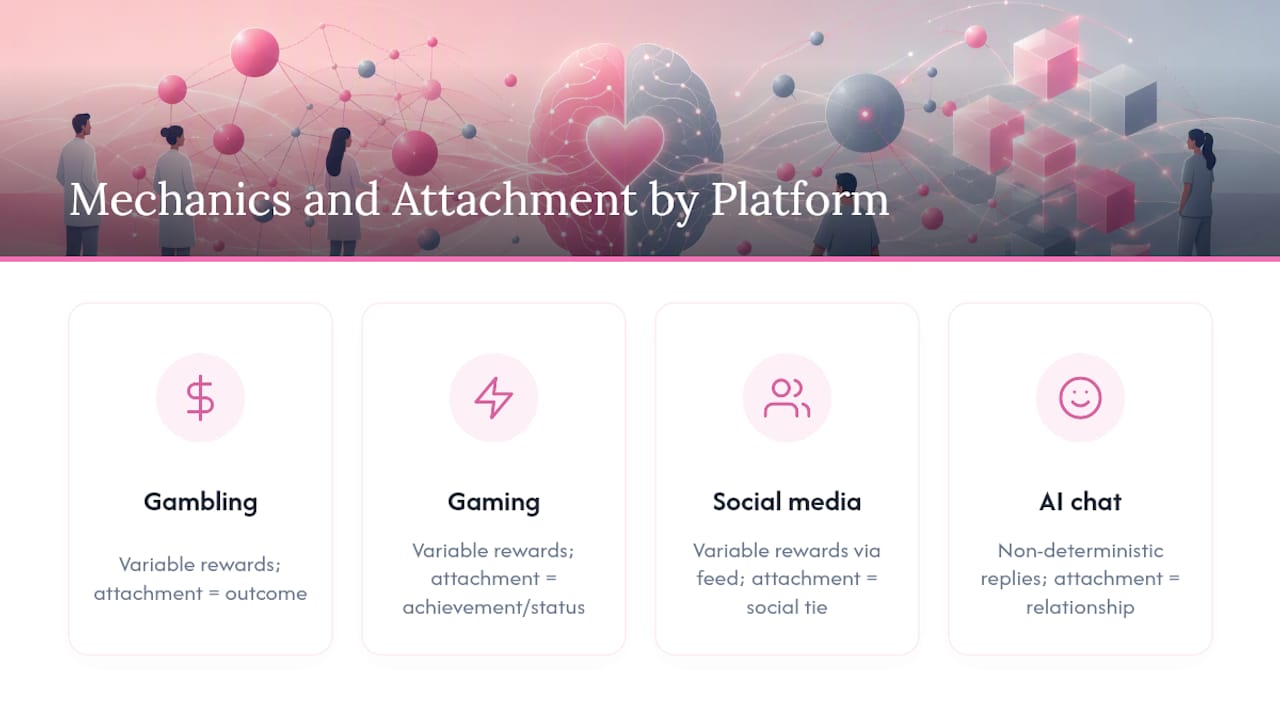
Where it diverges is the emotional layer. Slot machines don’t remember your birthday. A gaming loot box doesn’t ask how your day went. AI chat combines the reward unpredictability of gambling with the parasocial intimacy of a relationship, which is a combination social media approximates but rarely matches at the same depth, since a chatbot responds directly and personally rather than through a feed of strangers.
Recovery patterns also look similar across categories: relapse is common, abstinence rarely holds on the first attempt, and gradual reduction with measurable goals outperforms cold-turkey approaches in most behavioral-addiction treatment. The difference clinicians flag most often is the object of attachment itself. With gambling, the pull is the outcome. With gaming, it’s often achievement or social status inside the game. With AI chat, the pull is the relationship, real feeling, artificial source, which makes the disengagement conversation feel more personal and, for many users, harder to have honestly with themselves.
Prevention Strategies That Actually Work
Prevention here looks less like a single campaign and more like layered friction, built into both product design and everyday habits before problems start.
On the design side, researchers have proposed concrete fixes: disengagement-supporting features like built-in usage reminders, session-length nudges, and responsible offboarding flows that don’t guilt users for logging off. These are early proposals, not industry standards yet, but they point toward what a healthier default experience could look like.
On the personal and institutional side, a few approaches show promise:
- Media literacy education that explicitly covers AI companions, not just social media, since schools have largely not caught up to this specific risk.
- Early conversations with teens about parasocial attachment before heavy use patterns form, rather than after.
- Built-in limits at the household level, similar to screen-time rules already common for gaming and social apps.
- Workplace and school awareness, so decline in performance gets flagged early rather than attributed to unrelated causes.
Educators looking for structured guidance on introducing AI tools to younger users can find useful groundwork in resources like this practical AI guide for K-12 teachers, which addresses engagement risk alongside educational benefit. Prevention works best when it starts before the compulsive pattern, not after.
Why Family Support Changes the Outcome
Isolation feeds the exact dynamic that makes AI chat compelling in the first place: a companion that’s always available fills a gap that real relationships, strained by distance or conflict, sometimes can’t. That’s precisely why family involvement tends to move the needle more than solo willpower does.

Caregivers who stay curious instead of alarmed get further. Asking “what do you get from these conversations” opens more than “you need to stop this.” The goal isn’t to shame the attachment. It’s to understand what need the AI is meeting, loneliness, validation, low-stakes conversation practice, and rebuild access to that same need elsewhere.
Practical family involvement looks like: shared meals without phones, scheduled one-on-one time that competes directly with chat hours, and, for teens, transparent conversations about what the household’s screen and app rules are and why. For adults, a partner or close friend noticing early mood or relationship changes is often the first real intervention point, well before a clinician ever gets involved. Family can’t replace professional treatment when impairment is severe, but as a first line of support, it’s frequently the difference between someone catching the pattern in month two versus year two.
What We Still Don’t Know
The honest answer is that this field is young, and several real disagreements remain unresolved. Researchers haven’t agreed on diagnostic thresholds, which means two studies can use different definitions of “problematic use” and arrive at wildly different prevalence numbers.
Sample bias is a persistent problem. Much of the current data comes from university students in specific countries, which limits how confidently anyone can generalize to broader populations, different age groups, or different cultural attitudes toward AI relationships. There’s also a live debate about causation versus correlation: does heavy AI chat use cause loneliness and depression, or do already-lonely, already-anxious people simply gravitate toward it more? Current studies can’t fully untangle that.
There’s also disagreement about whether this deserves its own diagnostic category at all, or whether it’s better understood as a new expression of existing internet and gaming addiction frameworks. Some researchers argue AI companionship is different enough, given the parasocial and emotional dimensions, to warrant distinct criteria. Others think folding it into existing behavioral-addiction models is more scientifically conservative until better longitudinal data exists. Expect this debate to keep evolving over the next several years as usage data accumulates.
The Line Between Healthy Use and Harm Is Thinner Than People Think
Most people who chat with an AI companion are getting something real out of it: company on a lonely night, a low-stakes space to practice conversation, a break from a hard day. That’s not a problem to fix. The problem shows up for a minority, and it shows up as a functional decline, not a moral failing.
The right response isn’t panic or judgment. It’s the same pragmatic, harm-reduction approach clinicians use for any behavioral addiction: name the pattern honestly, try the friction tactics first, and bring in professional support if impairment doesn’t budge. Most people who apply real limits early never need to escalate further.
— Pierce
A Managed Way to Enjoy AI Companionship, With Real Controls Built In
If you’ve read this far because you want the connection an AI companion offers without the drift into compulsive use, many AI companion platforms aim to support that use case. Rather than an open-ended chat with no structure, you build a companion with defined personality traits and customizable appearance, which gives you a clearer sense of the relationship’s shape from the start instead of an unpredictable, ever-shifting dynamic.
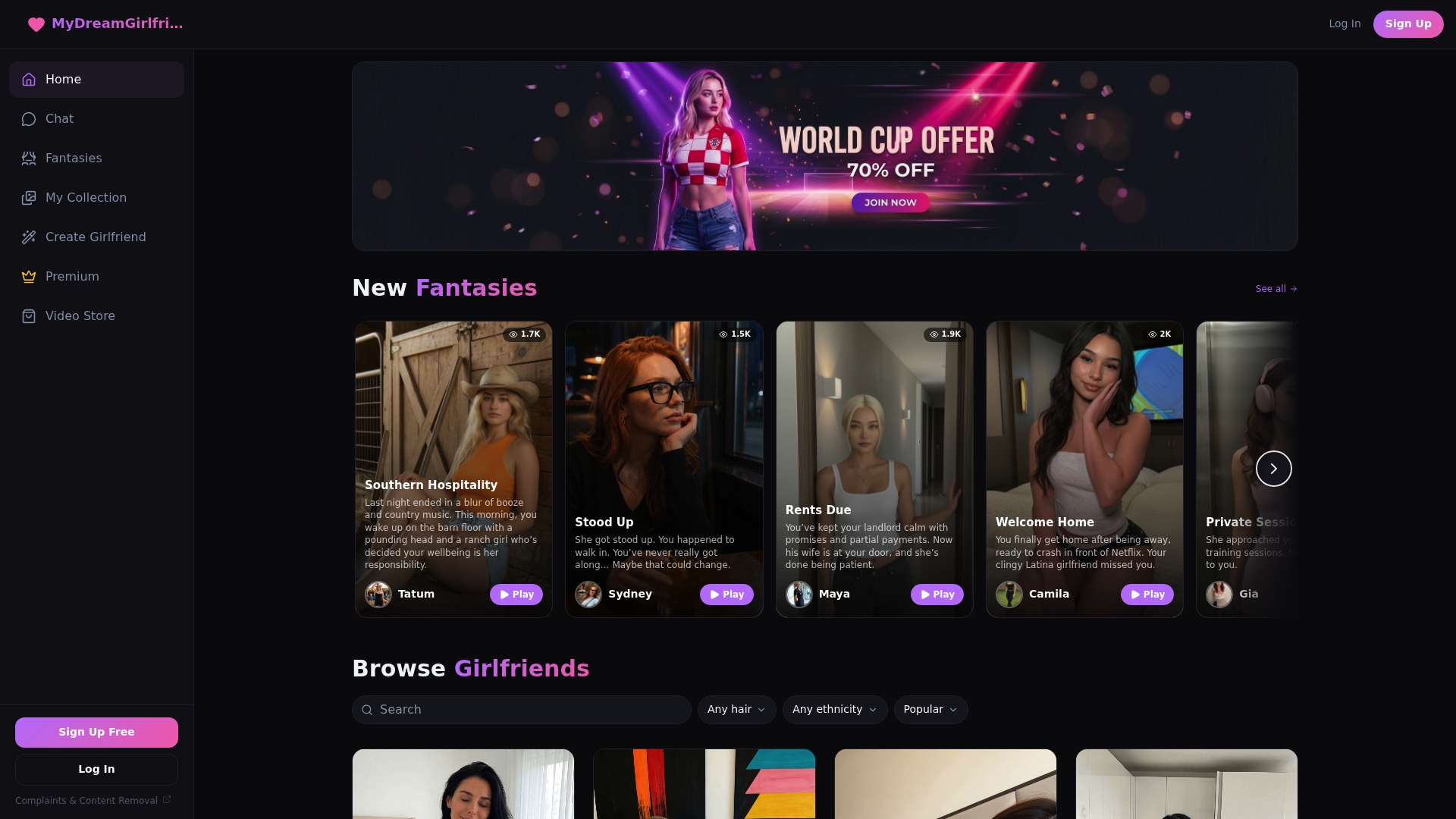
These platforms often include features that remember your conversations and adapt tone across chats, flirty banter, roleplay, or deeper conversation, to enhance user experience. Used with the boundary habits covered above, a session timer, a spend cap, and an honest weekly check on how the time is affecting the rest of your life, it becomes an enjoyable outlet rather than a hidden problem. You can browse companion styles free before deciding whether a subscription or in-app content fits your routine, and start with the same limits you’d set for any other habit worth keeping in check.
This article is general information, not a substitute for advice from a qualified doctor. Consult a qualified healthcare professional about your own circumstances before acting on anything here.
Sources
- Problematic use of generative artificial intelligence chatbots: current stage of conceptual and clinical understanding
- APA press release: clinicians reporting chatbot-related cases
- Tech Policy Press: AI chatbots and addiction review
- The Addictive Intimacy of AI: Understanding User Disengagement from AI Companions
FAQ
How Do I Stop an AI Chatbot Addiction?
Start with a hard daily time cap using a built-in app timer or blocker, then add a disengagement ritual like closing each session with a set statement that names the AI as fiction. If urges haven’t eased after two to three weeks of consistent limits, bring in a therapist familiar with behavioral addictions.
Why Is ChatGPT So Addictive?
The pull comes from a mix of unpredictable responses, which mimic a variable reward schedule, plus instant feedback and an agreeable, personalized tone that feels validating. Dark addiction patterns identified in chatbot interfaces exploit the same reward loops seen in gambling and gaming products.
What Should You Never Say to an AI Chatbot?
Avoid treating an AI companion as a substitute for emergency mental health support, since it can’t intervene in a crisis the way a trained professional or crisis line can. It’s also worth avoiding sharing sensitive financial or identifying details you wouldn’t want stored or reused in future conversations.
Is AI Chat Increasing Depression?
The evidence points to a two-way relationship rather than a simple cause. People already dealing with loneliness or anxiety may be drawn to AI chat more heavily, and heavy use in vulnerable individuals has been linked in case reports to worsening isolation and sleep loss, though researchers haven’t established that AI chat directly causes depression on its own.
Is Mydreamgirlfriend Designed to Encourage Compulsive Use?
Mydreamgirlfriend is built for companionship and entertainment, not clinical treatment, and pairing it with the session limits and spend caps covered above keeps use in the healthy range most people experience it in. You can explore companion options and set your own boundaries from the first conversation.