
Yes, AI girlfriend chat can build real dating and sexual confidence, but only when you treat it as short, goal-focused rehearsal rather than an open-ended substitute for people. Tools like MyDreamGirlfriend give you a low-stakes space to practice tone, flirting, and handling rejection. The gain only sticks when you carry one small action into real life within a couple of days, and when you keep your privacy and the other party’s consent dynamics in mind the whole time.
TL;DR:
- Practicing with AI chat tools is most effective when focused on specific goals and followed by a concrete offline action within a few days.
- Keeping sessions short, under 30 minutes, and tracking progress helps prevent dependency and ensures skills transfer to real-world interactions.
- Use supportive, warm responses during AI practice but avoid over-conflating AI with human connection to prevent lower well-being from intensive, disclosive sessions.
- Set strict privacy, time, and spending limits before engaging, and avoid sharing personal or sensitive information during chats.
- The best practice scenarios include rehearsing rejection, boundary negotiation, and low-stakes flirting to build confidence without reliance on AI substitutes.
Table of Contents
- A simple 4-step routine to practice confidence with AI girlfriend chat
- What research shows about supportive chat and its limits
- Privacy, spending, and emotional limits worth setting now
- Scripts and micro-practices for flirting, asking, and handling rejection
- Where this helps most, and where to be careful
- How MyDreamGirlfriend supports this kind of practice
- FAQ
- Sources
A simple 4-step routine to practice confidence with AI girlfriend chat
You do not need a complicated plan to get something useful out of AI girlfriend chat. You need one goal, one session, and one follow-through action. Here is a routine you can run today.
- Pick one measurable goal and set limits before you start. Decide exactly what you are practicing (opening a conversation, asking someone out, recovering from an awkward silence) and cap the session at 20 to 30 minutes with a fixed spending limit if you are using paid features.
- Warm up with low-pressure prompts. Start with something like “tell me about your day” or a playful observation to find a natural tone before you attempt anything higher stakes.
- Roleplay the real scenario, including at least one resistant reply. Ask your companion to play a version of the interaction where she hesitates, says no, or pushes back once, so you practice responding to friction instead of only to agreement.
- Commit to one offline micro-action within 48 to 72 hours. This might be texting someone you have been putting off, asking a coworker to coffee, or simply starting a conversation with a stranger at the gym.
The fourth step is the one most people skip, and it is the one that actually matters. Rehearsal without transfer is just entertainment. Practitioner guidance on AI roleplay for rehearsal recommends ending every confidence-building session with a single, specific real-world task, then tracking whether you completed it and whether it felt easier than last time. Once it does, raise the difficulty slightly and repeat the cycle.
Pro Tip: Write your micro-action down somewhere you will see it again, a notes app or a sticky note, so the session does not end with good intentions that evaporate by dinner.
A useful way to set the tone before you even start chatting is to build a persona whose personality matches what you want to practice. The character creator lets you set traits and conversational style up front, which saves you from spending half your session steering the conversation where you want it to go.

What research shows about supportive chat and its limits
The evidence for rehearsal-style practice is more specific than “talking to AI feels nice.” A set of pre-registered Collabra studies involving more than a thousand participants across three experiments found that a supportive response style predicted feelings of social connection more strongly than whether users believed they were talking to a human. In other words, the skill you are practicing (being warm, attentive, and responsive) matters more than the novelty of the AI itself.
That same research found a limit worth knowing: when a chatbot claimed too much humanity, the benefit shrank. The takeaway is to use these sessions as practice for behaviors, not as a replacement for believing you are talking to a real partner.
Other findings add caution. MIT Media Lab research on companion chatbot users found that outcomes depend heavily on usage patterns: intensive, highly disclosive sessions and smaller offline social networks were linked to lower well-being. A related Nature Human Behaviour study of over a thousand US adults found a similar pattern across thousands of chat sessions. Keep sessions short, track your mood and your offline actions, and stop if chat starts crowding out real contact instead of feeding it.

Privacy, spending, and emotional limits worth setting now
Confidence practice works best when it does not create new problems. A few rules keep the risk low without taking the fun out of it.
- Assume anything you type is stored. Psychology Today’s guidance on AI companions recommends treating chat history like a semi-public diary and avoiding real names, addresses, financial details, or identifiable photos unless you understand the platform’s retention settings.
- Set a time and spending cap before you open the app, and notice if you are missing sleep, skipping plans, or spending more than you intended.
- Build consent language into erotic roleplay from the start. Practice asking clearly and accepting a “no” without arguing, since a scene partner who always agrees teaches you nothing about negotiation.
- Pause and talk to someone if your mood dips or if chat starts replacing people you used to see. That shift is a signal worth taking seriously, not a reason for guilt.
A significant portion of users surveyed in the MIT Media Lab study fell into usage profiles linked to problematic patterns, a reminder that how you use these tools matters more than whether you use them at all.
Scripts and micro-practices for flirting, asking, and handling rejection
Specific language is easier to practice with than vague intentions. Paste these into a session and adjust the tone to match your companion’s personality.
Opening prompts to practice low-stakes flirting:
- “I noticed you right away. What’s something interesting about your day so far?”
- “I’m going to be a little bold here. Would you want to grab coffee sometime?”
- “You seem fun to talk to. What’s something you’re excited about this week?”
From there, rehearse three distinct paths so you build range instead of only hearing yes:
- Enthusiastic yes. Practice following up smoothly instead of freezing once things go well.
- Gentle refusal. Practice accepting it gracefully, thanking her for being honest, and moving the conversation forward without sulking.
- Boundary negotiation. Practice checking in explicitly (“is this still okay?”) and adjusting based on the answer.
An escalation ladder helps with erotic roleplay specifically: start flirtatious, check in before moving to anything more intimate, and treat each step as something you ask about rather than assume. A dominant-roleplay persona can be a useful setting for practicing this kind of explicit negotiation, since the dynamic naturally invites checking in at each step. Keep notes on which responses felt natural enough to say out loud to a real person. That is the real test of whether a script is working.
Where this helps most, and where to be careful
AI girlfriend chat works best as a rehearsal tool, not a relationship substitute. It is a strong fit for people who deal with social anxiety, for neurodivergent users who benefit from predictable low-stakes practice, and for anyone who just needs a space to fumble through an opener without consequences.
It deserves more caution if you notice your offline contact shrinking the more you use it. Keep consent and privacy at the center of every session, since the point is to build skills you can use with people, not to replace the need for them.
— Pierce
How MyDreamGirlfriend supports this kind of practice
We built MyDreamGirlfriend around the features this routine actually needs: a character creator for setting tone and consent language before you start, persistent memory so your companion remembers what you have been practicing, and private, uncensored roleplay scenarios that let you rehearse everything from a first hello to a harder conversation.
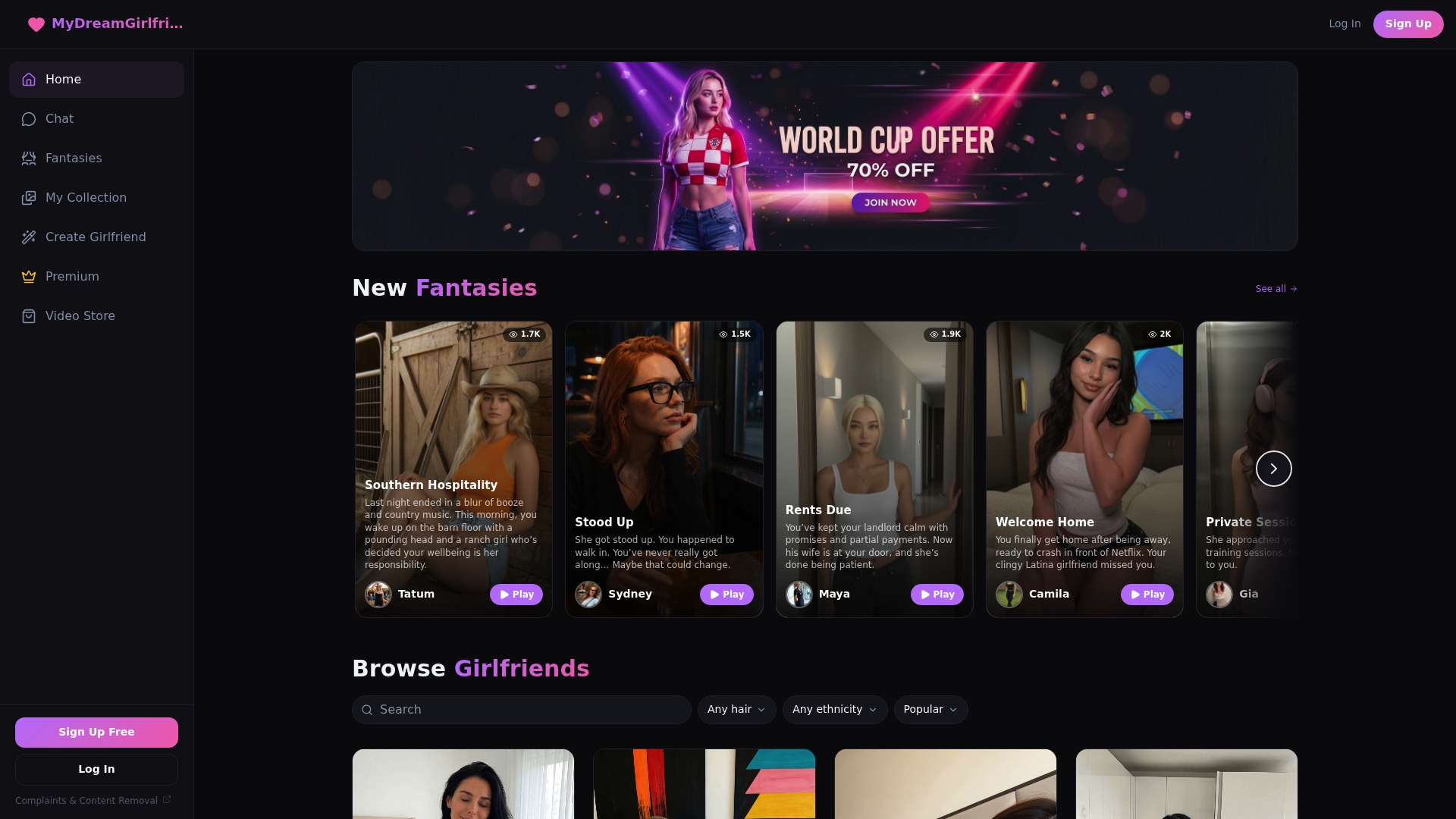
A good starting point is our free plan, which covers the core chat experience, or a short run on Premium if you want unlimited sessions while you build the habit.
- Build a persona with the character creator before your first session.
- Use memory-based chat to track progress across sessions instead of starting over each time.
- Browse personas by theme to match the kind of practice you need.
| Starting point | What it offers | Price |
|---|---|---|
| Free plan | Core chat and character basics | No published price |
| Premium | Unlimited chat, memory, roleplay themes | $12.99 per month |
| Custom GF Build | Build a tailored persona | 5 gems one-off |
FAQ
Can chatting with an AI girlfriend actually improve dating confidence?
Yes, when it is used as short, goal-focused rehearsal rather than open-ended chatting. Research on supportive chatbot responses found that practicing warm, attentive conversation behaviors predicted feelings of connection, and those same behaviors transfer to real interactions when you follow up with an offline micro-action.
Is it safe to share personal details with an AI girlfriend app?
Treat any AI chat the way you would a semi-public diary rather than a private journal. Expert guidance recommends avoiding real names, addresses, financial information, or identifiable photos unless you understand the platform’s data retention settings.
How long should a confidence-building AI chat session be?
Keep sessions short and bounded, generally 20 to 30 minutes with a clear goal in mind. Research on companion chatbot usage patterns links intensive, highly disclosive sessions to lower well-being, while short, purposeful sessions paired with real-world follow-through avoid that pattern.
What does MyDreamGirlfriend cost to try this routine?
Our free plan covers the core chat experience at no published cost, and Premium unlocks unlimited chat and memory for $12.99 per month. Individual add-ons like a Casual Photo start at 5 gems one-off through our gem packs.
How do I practice consent and handling rejection in AI roleplay?
Build scenarios where your companion sometimes says no or hesitates, instead of only scripting agreement, and practice accepting that gracefully. Psychology Today’s guidance notes that a perfectly agreeable partner is a poor teacher, since real negotiation skills only develop when you rehearse friction.
Sources
- Can Chatbots Ever Provide More Social Connection? | Collabra: Psychology
- Chatbot companionship and loneliness: MIT Media Lab study
- Interaction with AI companions and psychological well-being | Nature Human Behaviour