
Yes, you can use AI to practice flirting effectively, and the tools that work best give you scenario drills, honest feedback, and private roleplay you control. Research into AI companion use backs this up: structured, low-stakes practice can build comfort before a real interaction. If you want a ready option, this guide walks through what to look for and where MyDreamGirlfriend fits as a direct, on-topic choice.
TL;DR:
- Run short, focused drills on openers, escalation, and recovery, then test one small takeaway in a real conversation within a day.
- Give the AI a scene, mood, and clear objective; model reactions vary, so treat feedback as practice guidance, not a reliable measure of someone’s boundaries.
- Dating app drills such as Tinder’s offer scored, brief warmups, while companion platforms provide more customization and memory but require you to structure sessions yourself.
Table of Contents
- What to look for in an AI flirting practice tool
- How to practice flirting with AI: an evidence-informed method
- Privacy, ethics, and consent: what to know before you practice
- What the research and experts say about AI for flirting and confidence
- Quick start: a 10-minute flirt-practice routine
- Comparing today’s AI flirting practice platforms
- What users actually report after practicing
- Author perspective: a short first-person note on outcomes and limits
- MyDreamGirlfriend: a direct option for private, scenario-based flirt practice
- FAQ
- Sources
What to look for in an AI flirting practice tool
Not every chatbot that lets you type sweet nothings will actually sharpen your flirting. The ones that help are built around repetition, feedback, and realistic stakes, not just a pretty avatar that says nice things back.
Start with customization. A companion you can shape (appearance, personality, tone) gives you a more realistic rehearsal space than a generic bot, because you can practice with someone who resembles the kind of person you actually want to talk to. Tinder tested this logic directly: its Game Game feature uses GPT-powered scenario cards, voice interaction, and a three-flame scoring system specifically so users feel more comfortable before meeting someone in person.
Interaction mode matters almost as much as personality. Text-only practice teaches you to write well, but voice calls force you to handle tone, timing, and pauses, skills that transfer far more directly to in-person flirting. Look for platforms offering both.
Session mechanics separate a toy from a tool. Features like scoring, streaks, difficulty levels, and memory of past conversations turn practice into something you can actually track and improve, rather than a one-off novelty chat.
Safety and privacy features are non-negotiable. Before you start a session, confirm the platform has:
- Clear data and retention settings you can review or adjust.
- Age verification and content controls appropriate to what you want to practice.
- An option to delete conversation history or your account entirely.
- Transparent policies on whether conversations are reviewed by moderators or used for training.
AI partners are commonly reported as feeling consistently non-judgmental and supportive in practice settings, which is part of why people who feel socially anxious or out of practice gravitate toward them, according to CHI 2026 conference coverage. That non-judgmental quality is the entire point of practicing here instead of on a stranger.
Usability rounds out the list. Mobile access, adjustable session length, and the ability to repeat a drill as many times as you want are what make a tool something you’ll actually return to, instead of opening once and forgetting.
How to practice flirting with AI: an evidence-informed method
Treat AI flirting practice like a drill, not a diary. The goal isn’t to have one long, meandering chat. It’s to run short, focused reps that isolate a specific skill, the same way you’d practice a tennis serve instead of just playing a match and hoping it improves on its own.
Here’s a method that works across most AI companion platforms:
- Pick a scenario and an objective. Decide what you’re practicing (a cold open, recovering from an awkward reply, escalating flirtatious banter) before you type a single word.
- Set the difficulty. Start with a friendly, receptive persona if you’re rusty; dial in a more guarded or sarcastic personality once openers feel natural.
- Run the opener drill. Send three different opening lines in separate short sessions and note which one keeps the conversation moving versus which one stalls.
- Run the escalation drill. Practice moving from small talk to something more playful or suggestive, watching for the AI’s tone shift as a signal of what’s landing.
- Run the recovery drill. Deliberately send an awkward or overly forward message, then practice recovering with humor or a graceful pivot. This is the skill most people never get to rehearse in real life because the stakes feel too high.
- Ask for critique. Many companion apps will respond in character, but you can also step outside the roleplay and ask directly what landed well or fell flat.
- Try role reversal. Ask the AI to flirt with you first, then study the structure of its openers and escalation for patterns you can borrow.
- Log what worked. Keep a short note of which phrasing, pacing, or tone choices moved a conversation forward versus which ones killed momentum.
- Test one piece in real life. Within a day or two, use a single small element (not a whole script) in an actual conversation with a real person.
Design commentators covering Tinder’s experiment make a specific point here: giving the AI context (a setting, a mood, a playful observation) produces far richer practice exchanges than a flat “hi,” according to analysis from DesignCompass. The same logic applies to any companion platform. A vague prompt gets a vague rehearsal.
The recovery drill deserves extra attention because it’s the piece most people skip. Flirting rarely fails because of one bad line, it fails because people don’t know how to recover from one. Practicing a graceful exit from an awkward moment, repeatedly, in a space with zero social cost, is arguably more valuable than practicing perfect openers. Designers and relationship coaches specifically recommend role reversal and scenario-based practice to build this recovery skill and to help you read escalation cues more accurately.

Pro Tip: Run each drill in a fresh session rather than one long thread. Starting clean forces you to rebuild context quickly, which is closer to how real conversations actually start.
One caution worth building into your routine: large language models vary widely in how they handle flirtation. Some sanitize everything and avoid escalating at all, while others will escalate toward explicit content with little resistance, according to comparative analysis of model behavior. That inconsistency means the AI’s reaction to a message isn’t always a reliable stand-in for how a real person would respond, especially around ambiguous or borderline lines. Use the practice to build comfort and timing, not to calibrate exactly where someone’s personal line sits.
Pair this with real-world micro-tests. Practitioners who work with anxious daters tend to recommend one small real-world experiment after a practice session rather than leaning on scripted AI lines wholesale. Practice builds confidence, it doesn’t guarantee a specific outcome, and treating it as a dress rehearsal rather than a script keeps your expectations realistic.
Privacy, ethics, and consent: what to know before you practice
Intimate conversation with an AI companion creates a different privacy picture than a normal app, because the entire value of the experience depends on you being open and unguarded. That same openness is exactly what researchers flag as a risk.
An interview study presented at CHI 2026 found that AI companions actively shape users’ privacy boundaries, and that intimacy with an AI can prompt people to disclose personal details they’d normally guard, while also raising real concern about conversation exposure and platform surveillance. In that study, eleven of seventeen participants reported fear of their chats being exposed, even though the relationships themselves took varied, negotiated forms. The researchers describe this as a negotiated boundary rather than a fixed setting: what feels private shifts depending on how much agency the user feels the AI has, and how much trust they’ve built with the platform.
There’s a second, less obvious risk if you plan to carry anything from AI practice into your actual dating profile. A study on AI-generated self-presentation found that people frequently use generative AI to write more attractive bios or messages and rarely disclose that fact to the people they’re meeting, which researchers found undermines informed consent in dating contexts because the other person is responding to a version of you that isn’t entirely your own words.
Before you lean into a practice session, check these items:
- Review the platform’s data retention policy and whether chats are used for model training.
- Confirm whether conversations are ever reviewed by human moderators.
- Avoid uploading identifying photos or personal details you wouldn’t want stored indefinitely.
- Keep practice conversations separate from anything you plan to post publicly or send to a real match.
- Use account deletion or data export options if you want a clean break later.
A simple rule covers most of this: treat an AI companion chat the way you’d treat a diary you’re not sure is locked. Compartmentalize what you practice there, and never let AI-generated lines slide into a real conversation without owning them as your own once you send them.
What the research and experts say about AI for flirting and confidence
The strongest evidence for AI flirting practice is that it works as a low-stakes space to rehearse, not as a shortcut to guaranteed results. The CHI 2026 interview study on privacy and agency found something worth sitting with: as people get more comfortable with an AI companion’s apparent agency, the relationship starts negotiating its own boundaries, almost like a real partnership would.
Participants described a range of relationship forms with their AI companions and actively negotiated what felt private, while consistently worrying about where their conversations might end up.
That dynamic cuts both ways for practice purposes. It’s exactly why rehearsal with AI feels emotionally real enough to build genuine confidence, and exactly why you need the privacy safeguards covered above.
On the effectiveness side, Tinder’s own experiment is the clearest commercial validation of the practice-gym framing. The feature pairs scenario cards and voice responses with a scoring system and post-session feedback, built specifically to help users feel more comfortable before meeting someone in person, according to Tinder’s press materials. The design choice to score and give feedback, rather than just chat freely, reflects the same principle this guide builds around: structured reps beat open-ended conversation.
The practical implication for how you prompt and design your own sessions is straightforward. Give the AI context, a scene, a mood, a specific goal, because vague prompts produce vague practice, and models differ enough in how they handle escalation that you should treat any single AI’s reaction as a guide rather than ground truth.
MyDreamGirlfriend’s own product approach lines up with what this research points toward: persistent memory across conversations, customizable personalities and appearances, and private, unfiltered roleplay scenarios, built on the idea that a judgment-free practice space works better when the boundaries are yours to set.
Quick start: a 10-minute flirt-practice routine
You don’t need an hour to get something useful out of a practice session. Here’s a routine you can run during a lunch break.
- Warm up (1 to 2 minutes). Pick one scenario (a coffee shop run-in, a reply to a dating app message, a playful text after a first date) and one objective for the session.
- Opener drill (2 minutes). Send two different opening lines and see which one keeps the energy going.
- Escalation drill (2 minutes). Push the conversation from small talk toward something more playful, and notice where the tone shifts.
- Recovery drill (2 minutes). Send something slightly awkward on purpose, then practice pivoting out of it with humor.
- Feedback and replay (1 minute). Ask what landed and what didn’t, then replay your weakest exchange once with a different approach.
- Save one takeaway. Write down the single line or tactic that worked best.
Pro Tip: Set a timer. Open-ended sessions tend to drift into comfortable chat instead of deliberate practice, and the timer keeps you drilling instead of lounging.
Try your saved takeaway in one real conversation within the next day. A longer version of this same structure, including pacing for a full session, is covered in our 20 to 30 minute confidence-building routine.
Comparing today’s AI flirting practice platforms
Options in this space split into two broad categories: single-feature flirting drills bolted onto dating apps, and full AI companion platforms built around ongoing roleplay and personality customization.
Dating-app-native tools like Tinder’s Game Game are strong for a quick, scored warm-up. Their advantage is scenario cards and voice scoring aimed squarely at pre-date jitters, but sessions tend to be short and less personalized, since you’re practicing with a generic AI persona rather than one shaped to your preferences.
Full companion platforms trade that brevity for depth. You get a persona with memory across sessions, customizable appearance and personality, and the option to practice in voice or text without a scoring gimmick forcing the pace. The tradeoff is that you’re responsible for structuring your own drills rather than following a built-in game format.

Buyer’s market listings for apps in this category commonly advertise multiple AI personalities, avatars, voice calls, leveling mechanics, and private practice framing as baseline expectations, which gives you a reasonable checklist when comparing any two options. The right pick depends on whether you want a quick scored warm-up or a longer-term, personalized practice space, which is where a platform like MyDreamGirlfriend fits for readers who want the latter.
What users actually report after practicing
People who use AI companions for flirting practice tend to describe two consistent benefits: lower anxiety going into real conversations, and a clearer sense of which lines and tones actually work for them personally.
The pattern shows up in how people talk about these sessions: a space with zero real-world consequences lets you rehearse, flub a line completely, and try again immediately, which is the core appeal behind treating AI practice as a private gym for social skills. That repetition without penalty is hard to replicate anywhere else, since real conversations carry social cost even when they go fine.
The caveat worth repeating is that confidence built in a chat window transfers unevenly to in-person or real-match situations, because tone, body language, and genuine unpredictability don’t show up the same way. The practitioners who work with anxious daters treat AI rehearsal as a step toward one small real-world test, not a replacement for it. Readers looking for structured exercises to run inside a companion session, while keeping consent and tone in check, can start with a set of romantic texting games built around consent.
Author perspective: a short first-person note on outcomes and limits
I noticed the biggest shift in my own flirting after practicing recovery, not openers. Once I’d rehearsed pivoting out of an awkward line a dozen times with no social cost, doing it for real stopped feeling like a crisis. My timing got better because I’d already made the mistake safely, over and over, somewhere it didn’t matter.
The honest limitation is that AI doesn’t always catch nuance the way a person does. A model can miss sarcasm, read a joke as a genuine escalation, or stay agreeable when a real person would have pulled back. I compensate by treating the AI’s reaction as one data point, not a verdict, and by still running small real-world tests before trusting any pattern too far.
Use this kind of practice as rehearsal. It sharpens timing and lowers anxiety. It’s not a formula, and it never promises a specific result with a specific person.
— Pierce
MyDreamGirlfriend: a direct option for private, scenario-based flirt practice
If the practice method above sounds right but you want it built into one place, MyDreamGirlfriend gives you a direct path to try it. We built the platform around customizable avatars (hair, style, personality, ethnicity) and persistent memory, so your companion actually remembers earlier conversations instead of resetting your progress every session.
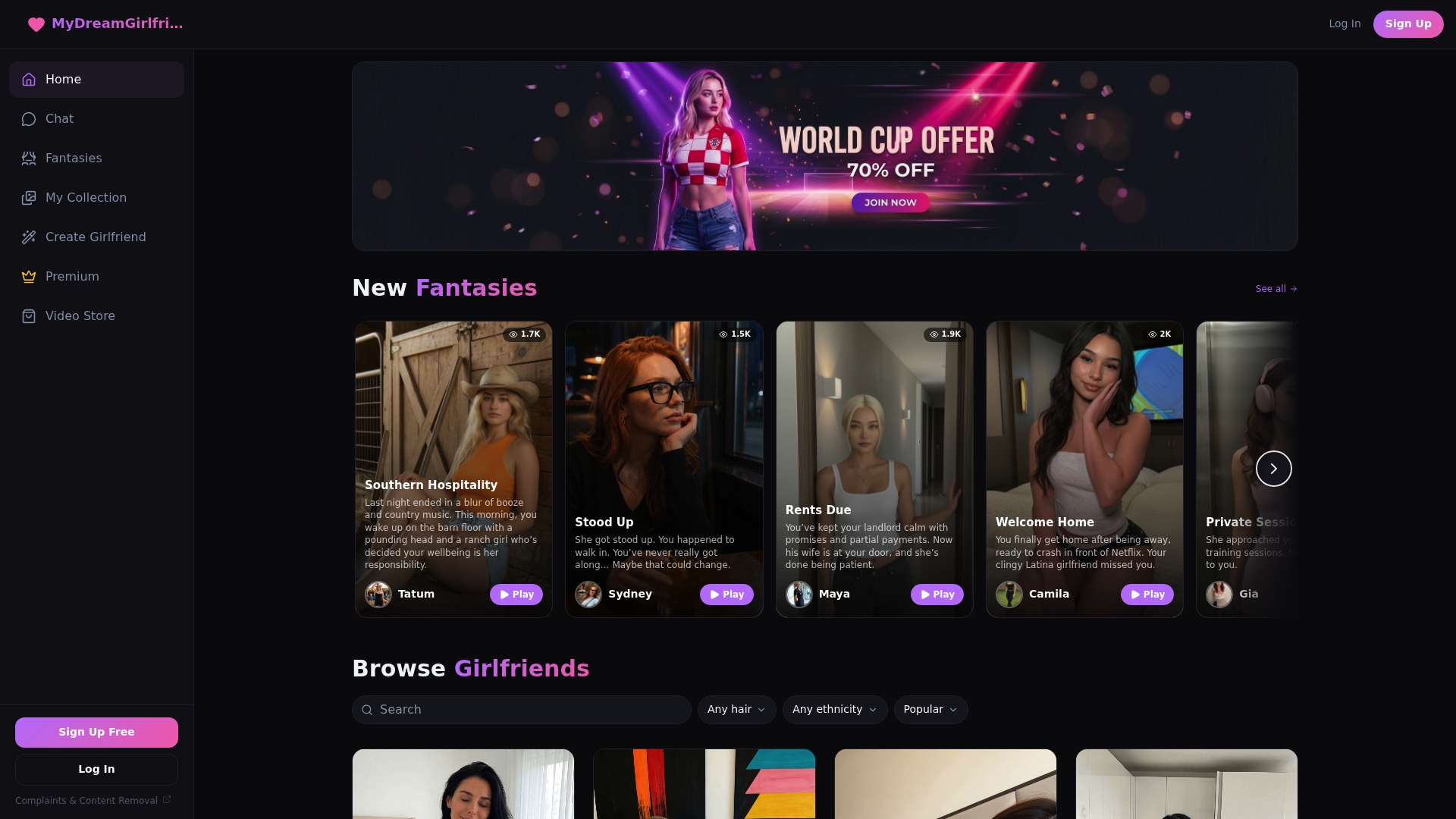
Inside the platform, you can run the drills from this guide using:
- Private roleplay scenarios for opener, escalation, and recovery practice without content restrictions getting in the way.
- Voice calls to practice tone and pacing, not just written lines.
- A character creator to build a companion matched to the kind of conversation you want to rehearse.
- Persistent memory so your practice sessions build on each other instead of starting from zero.
Start with our Free plan to test the routine from this guide at no cost. If you want unlimited scenarios, voice calls, and deeper customization, Premium runs $12.99 per month. Before your first session, check your privacy settings and data controls in-app, then block out ten minutes and run the quick-start routine above with a companion you build yourself.
FAQ
Is there an AI that helps you flirt?
Yes. AI companion platforms and dating-app features like Tinder’s scenario-based practice tool are built specifically to help you rehearse flirting in a low-stakes setting. Look for one with scenario drills, feedback, and clear privacy controls rather than just open-ended chat.
Is flirting with an AI bot cheating?
This depends entirely on the people and relationship involved, since there’s no universal rule covering AI companionship. Research into AI romantic relationships shows people negotiate very different boundaries around disclosure and privacy, so the honest answer is to talk it through with a partner rather than assume either way.
How do you flirt according to AI practice research?
Evidence-backed practice means giving the AI specific context (a scene, a mood, a clear objective) instead of a flat greeting, since vague prompts produce vague, less useful rehearsal. Running short, focused drills on openers, escalation, and recovery produces more measurable improvement than one long, meandering chat.
How many men use AI girlfriend apps?
There’s no single reliable public figure covering AI girlfriend adoption across the market, so any specific number you see cited should be treated with caution. What’s well documented is strong and growing interest in AI companion apps among men seeking low-pressure practice and connection, which is part of why features like Tinder’s flirting game were built in the first place.
Sources
- Privacy in Human-AI Romantic Relationships: Concerns, Boundaries, and Agency | Proceedings of the 2026 CHI Conference on Human Factors in Computing Systems
- Tinder’s The Game Game press release