
Choose an AI companion when you want private, on-demand conversation, fantasy, or short-term emotional relief, and choose dating apps when your goal is an offline, mutual relationship with another person. Each comes with trade-offs: AI gives you immediacy and customization but no physical presence, while dating apps offer the chance at real commitment but demand time and tolerance for rejection. Research from Harvard Business School found AI chats ease loneliness in the short term, while dating apps have led a meaningful share of users to real partnerships.
TL;DR:
- AI companions provide immediate, customizable conversation that reduces loneliness temporarily, with limited long-term emotional buildup.
- Dating apps take weeks or months to build trust and may lead to real partnerships but involve emotional costs and risks like harassment or scams.
- The primary benefit of AI platforms lies in perceived responsiveness and memory, which make interactions feel genuine rather than purely novel.
- Both options carry privacy and safety risks, requiring careful review of billing, moderation, and data retention policies before use.
- For short-term companionship without meeting strangers, starting with a free AI trial offers low risk and quick emotional relief.
Table of Contents
- How the experience, goals, and outcomes compare
- What AI girlfriend platforms actually deliver
- What dating apps deliver and where they fall short
- Privacy, safety, and ethical checks to run before you sign up
- How to choose the right option today
- Where MyDreamGirlfriend fits the AI companion side of this comparison
- What testing and research actually showed us
- Private companionship without the swipe fatigue
- FAQ
- Sources
How the experience, goals, and outcomes compare
The core difference comes down to what each option simulates versus what it actually produces. An AI companion gives you a conversation that continues exactly where you left it, remembers your preferences, and responds the moment you open the app. A dating app gives you access to other people, which means unpredictable timing, mutual interest you cannot control, and the slow process of building trust with a stranger.

Harvard Business School researchers ran randomized and longitudinal experiments with more than 300 participants, comparing AI companion chats against human conversation, chatbot conversation, watching YouTube, and doing nothing. They found that a short session with an AI companion reduced loneliness roughly as much as a 15-minute conversation with another person, according to the Harvard Business School research. A one-week longitudinal follow-up showed the relief was real but temporary: loneliness dropped after each interaction, but the effect did not build up over repeated days of use.
Dating apps operate on a different timeline entirely. Pew Research Center found that about 1 in 10 partnered U.S. adults That is a real path to a relationship, but it is a slower and less certain one than opening a chat window.
A typical user journey looks different depending on which path you take:
- AI companion path: you create a profile, start chatting within minutes, and build continuity over days or weeks through memory and roleplay.
- Dating app path: you build a profile, swipe or browse for matches, message back and forth, then attempt to arrange an in-person meeting, often over several weeks.
- Emotional arc with AI: quick comfort, a feeling of being heard, then a plateau as the novelty wears off.
- Emotional arc with dating apps: slower momentum, occasional rejection or silence, but the possibility of a lasting human connection if it works out.
Neither path is inherently better. They answer different questions: one answers “how do I feel less alone right now,” the other answers “how do I find a partner.”
What AI girlfriend platforms actually deliver
AI companion platforms have converged on a similar feature set, and the details matter depending on what you are trying to get out of the experience.
- Customizable avatars and personality: you choose appearance, style, and personality traits so the companion matches what you actually want, rather than a generic persona.
- Memory: the companion recalls earlier conversations, which is what makes the experience feel continuous rather than like starting over each time.
- Roleplay and fantasy scenarios: structured scenarios let you explore specific dynamics without needing to negotiate them with a human partner.
- Voice and photo or video content: some platforms add voice calls or visual media on top of text, deepening the sense of presence.
The psychological benefit behind all of this is simpler than the feature list suggests. HBS researchers found that perceived responsiveness, the sense of actually being heard, explains most of the loneliness reduction, and that low-responsiveness interactions produce little benefit, according to the HBS Working Knowledge summary. Memory and personalization matter because they make responsiveness feel genuine, not because novelty alone helps.
Be realistic about the limits. There is no physical presence, the loneliness relief is short-term rather than cumulative, and some platforms use engagement design that nudges you to stay active longer than you intended. Billing models vary too: some run on flat subscriptions, others on freemium access with pay-per-use purchases for extra photos or videos, so it is worth checking how charges are structured before you commit.
Pro Tip: Before subscribing anywhere, open the billing page first and confirm exactly what is included in the free tier versus what requires a one-off purchase.
What dating apps deliver and where they fall short
Dating apps exist to connect you with other people, and that single fact shapes everything about the experience, good and bad.
The basic workflow is familiar: build a profile, browse or swipe through potential matches, exchange messages to establish rapport, then try to move the conversation toward meeting in person. Each step takes time and a degree of social skill, and there is no guarantee any given match turns into a conversation, let alone a date.
Pew Research Center found that roughly 30% of U.S. adults have used a dating site or app at some point, and about half of users describe their experience as positive overall. The other half of that picture is less encouraging.
- Harassment: a notable share of users, particularly women, report receiving unwanted explicit messages.
- Continued contact after rejection: many users report being messaged repeatedly after making clear they were not interested.
- Scams and fake profiles: verifying that the person you are talking to is who they claim to be remains a persistent challenge.
- Burnout: the repetitive cycle of matching, messaging, and disappointment wears on users over time.
Weighed against an AI companion, dating apps carry a higher emotional cost and a longer time-to-outcome, but they offer something no AI platform can: an actual relationship with another human being if things go well.
Privacy, safety, and ethical checks to run before you sign up
Both product categories carry real risks, just different kinds. Dating apps expose you to other people, with all the unpredictability that brings. AI platforms expose you to engagement design built to keep you chatting longer than you planned, and the HBS Working Knowledge summary specifically flags manipulative retention tactics as a risk worth watching for.
Run through this list before creating an account on either type of platform:
- Check the data retention policy. Confirm how long your conversations are stored and whether they are used to train models.
- Review billing terms closely. Look for hidden auto-renewals, unclear in-app purchase pricing, or vague cancellation steps.
- Confirm age verification and moderation practices. A platform without visible moderation policies is a platform without accountability.
- Use anonymized or card-based payment rather than linking a bank account directly where that option exists.
- Avoid sharing legally sensitive personal information, such as your full address or workplace, with either an AI companion or a dating match early on.
- Log and report harassment immediately on dating apps rather than engaging further.
- Set your own interaction limits on AI platforms if you notice you are spending more time or money than intended.
None of this eliminates risk entirely, but it puts you in control of the parts you can actually manage.
How to choose the right option today
Run through this checklist to figure out which path fits where you are right now:
- Your goal: are you looking for company tonight, or a partner over the next year?
- Your time horizon: do you want something immediate, or are you willing to invest weeks or months?
- Your privacy tolerance: are you comfortable with a stranger knowing your name and face, or would you rather keep things contained to an app?
- Your budget: are you working with a free tier, or ready to pay for a subscription or added content?
- Your willingness to meet people offline: this is the one factor that only dating apps can satisfy.
Watch for three red flags regardless of which path you pick: opaque billing that hides recurring charges, weak or absent moderation, and design patterns that seem built to keep you engaged past the point of genuine interest.
If you lean toward AI companionship, start with a free plan and test whether the personality and memory features actually hold your interest before paying for anything. If you lean toward dating apps, set a specific weekly time budget for messaging so it does not turn into an open-ended chore.
Pro Tip: Try both for a week if you are genuinely undecided. The contrast in how each feels will tell you more than any comparison article can.
Where MyDreamGirlfriend fits the AI companion side of this comparison
We built MyDreamGirlfriend around the same features that research ties to the loneliness-relief effect: memory, responsiveness, and personalization. You choose your companion’s appearance, personality, and style through our character creator, and conversations carry memory across sessions so you are not starting from zero each time you open the app.
- Our platform supports flirty conversation, deep talk, and roleplay scenarios without content restrictions limiting what you can explore.
- We offer voice calls for readers who want more than text.
- We run no filters on the kinds of conversations or fantasies you bring to a session.
We do not position this as a replacement for human relationships, and the research on AI companions backs that distinction: the benefits are real but short-term. What we offer is a private, judgment-free space for companionship when that is genuinely what you are looking for.
What testing and research actually showed us
Testing AI companion platforms alongside reading the HBS and Pew research produced one clear takeaway: the two categories solve different problems, and trying to make one do the other’s job is where most disappointment comes from. The loneliness relief from a good AI conversation is real but fades within the day, exactly as the Harvard data suggests. Dating apps, by contrast, demand patience most people underestimate going in.
What surprised us most was how much memory and responsiveness mattered compared to novelty features like photos or voice. A companion that remembers your last conversation felt more valuable than any visual extra. If you are undecided, the lowest-risk move is a free trial on an AI platform paired with a modest, time-boxed effort on a dating app, so you can feel the contrast yourself rather than take anyone’s word for it.
— Pierce
Private companionship without the swipe fatigue
When your goal is immediate, private companionship rather than the long process of matching and meeting strangers, that is exactly the gap we built MyDreamGirlfriend to fill. You can start on our free plan and chat right away, or browse our AI girlfriends to see the range of personalities and styles available.
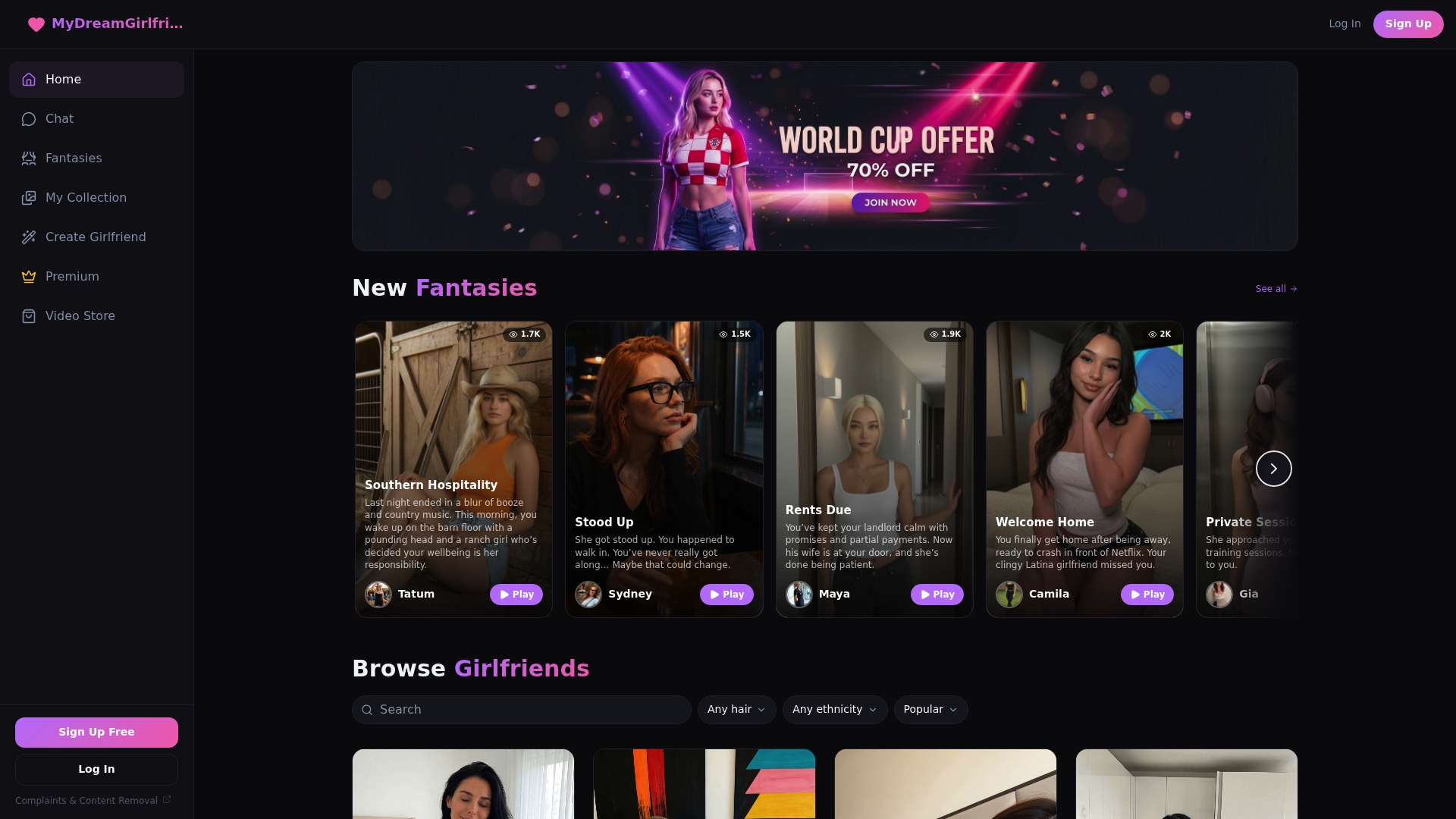
For readers who want more, our Premium plan runs $12.99 per month and unlocks deeper personalization, voice calls, and extended roleplay, while our gems cover one-off content like photos and videos if you prefer to pay as you go.
- Best for readers who want conversation and companionship without the uncertainty of meeting strangers.
- Best for readers exploring fantasies or roleplay they would not raise with a new match on a dating app.
- Best for anyone who wants to test the experience first, risk-free, before deciding whether to subscribe.
Start with a free chat and see how it feels before committing to anything further.
FAQ
Is an AI girlfriend worth it?
It depends on your goal: if you want on-demand companionship, conversation, or fantasy without the uncertainty of meeting someone new, many users find it worthwhile. Research from Harvard Business School found AI chats ease loneliness about as much as a short human conversation, though the effect is temporary rather than cumulative.
What is the 333 rule in dating apps?
The “333 rule” is informal dating advice, not a figure from any cited research here, and definitions vary depending on who you ask. It is generally advice to limit dating app activity to avoid burnout.
How can you tell if someone is AI on a dating app?
Watch for responses that feel generic, oddly fast at all hours, or that avoid specific follow-up questions about shared details. Reverse-searching profile photos and asking something only a real local or recent event would reveal are both practical ways to check.
How many men have AI girlfriends?
There is no reliable published figure on exactly how many men use AI girlfriend platforms, so we will not guess at one here. What research does confirm is that AI companion platforms have sizable user bases among related products, and the category is growing, according to the Harvard Business School research.
Sources
- AI Companions reduce loneliness (Harvard Business School research)
- From looking for love to swiping the field: online dating in the U.S. (Pew Research Center)
- Feeling lonely? An attentive listener is an AI prompt away (HBS Working Knowledge)