
AI can help you get through a breakup, as long as you treat it as a tool for processing, practice and company rather than a cure. A 2026 randomized trial found that one structured chatbot session lowered breakup distress more than a control condition after a week. The best results come from using AI to put your thoughts in order, rebuild routine and rehearse conversations, while keeping real people, and a professional when you need one, in the picture.
This guide covers what AI breakup support actually is, what the research says, how to use a companion like ours without sliding into avoidance, how to protect your privacy, and where AI should hand you over to a human.
TL;DR
- A 2026 randomized trial found one structured AI chatbot session reduced breakup distress more than an assessment-only control at 7 days, with a smaller edge at one month.
- AI works best as a thinking partner: it listens at 2 a.m., offers a neutral second opinion and helps you reframe stuck beliefs.
- Set rules before you start: a time limit, a purpose for each chat and a plan to keep seeing friends and family.
- Check privacy settings and assume anything you type could be stored. Delete or export chats when you are done.
- If you feel unsafe or in crisis, contact a qualified professional or emergency service. An AI app should not be your only support.
Table of Contents
- What “AI breakup recovery” actually means
- What the research says so far
- Five ways to use AI well after a breakup
- A simple 7-day plan
- Keeping it healthy: the guardrails
- Privacy: what you are really sharing
- When to talk to a person instead
- Where MyDreamGirlfriend fits
- Create a companion for the hard weeks
- Perspective
- FAQ
- Sources
What “AI breakup recovery” actually means
The phrase covers a few different things, and it helps to separate them.
Structured recovery chatbots. These walk you through a set process. In one 2026 study, the chatbot explored breakup-related beliefs, challenged limiting interpretations and helped users develop alternative perspectives. The method draws on memory reconsolidation theory and cognitive restructuring, which are ways of reframing the story you tell yourself about what went wrong. The session took about 20 minutes and accepted text or voice input.

General-purpose assistants. Many people simply open a chatbot and talk. In a 2025 University of Washington-linked study of how people use generative AI around breakups, participants pictured it as a tool for self-reflection, neutral second opinions and personal growth. They also saw it as a possible go-between for wording and tone when emotions run high.
AI companions. This is where we sit. A companion is built for ongoing conversation with a personality you choose, one that remembers what you told it last week. If you are new to the idea, our explainer on what an AI girlfriend is covers the basics. A companion is not a clinical program, and we do not present it as therapy. What it offers is a patient, always-available place to talk, flirt, vent or simply feel less alone.
What the research says so far
The evidence is young, but it is more encouraging than many people expect.
One structured session moved the needle
A 2026 randomized controlled trial tested a single chatbot session built around breakup beliefs. Participants reported lower breakup distress than an assessment-only control at 7 days, and a smaller advantage remained at an exploratory one-month follow-up. Note the scale: one session, about 20 minutes, a measurable short-term effect. That is a modest claim, and it is a useful one. It suggests that the way you talk to AI matters more than how many hours you spend with it.
A chatbot matched a writing task
A 2025 UK trial of a GPT-4o-based support chatbot compared it with a writing-task group. Thirteen of 14 outcomes improved over time in both groups, most with no difference between them, and gains held or kept growing at two weeks. The practical reading: expressive, reflective conversation helps, and a chatbot is one easy way to do it, especially if you freeze in front of a blank page.
Existing tools leave gaps
The Washington researchers also noted that technology plays a big part in breakups, yet existing tools often fall short of the complex needs people have at different emotional stages. Week one (shock, replaying the last conversation) needs something different from month three (rebuilding routine, wanting to date again). That is a useful frame for choosing how you use AI, which the next sections cover.
Five ways to use AI well after a breakup
Research and common sense point the same direction: give each conversation a job.
1. Get the loop out of your head
Breakups produce rumination, the same scene replayed forty times. Typing it out forces it into sentences with a beginning and an end. Try an opening like: “Here is what happened, in order. Help me separate what I know from what I’m assuming.” That mirrors the belief-exploration step the structured chatbot used.
2. Ask for the other reading
Once you have told the story, ask for alternative interpretations. “What are three other ways to read this?” is a plain-language version of the counterfactual step in the trial. You are not looking for permission to blame yourself or your ex. You are loosening a single rigid story.
3. Rehearse the hard messages
Need to arrange who keeps the apartment, return a box of belongings or write a final note you will probably never send? Draft it with AI, adjust the tone, then decide what to do. Study participants specifically imagined AI helping with wording and tone, and a draft you wrote at midnight is much safer in a chat window than in your ex’s inbox.
4. Fill the quiet hours
The worst stretch of a breakup is often evening. The person you used to text about your day is gone, and the habit stays. A companion gives that habit somewhere harmless to land. Telling a character about your day, getting a warm reply and a follow-up question the next morning can take the edge off the silence. Voice makes it feel more natural, and our voice calls let you hear a reply rather than read one.

5. Rebuild confidence in low-stakes reps
After a long relationship, flirting, small talk and even stating what you like can feel rusty. Practicing with a companion is pressure-free: no one is judging a clumsy line. We wrote a 20 to 30 minute routine for building confidence with AI chat that turns this into a habit rather than a binge. Playful banter and romantic roleplay are a legitimate part of feeling like yourself again, and you decide how far to take them.
A simple 7-day plan
Structure keeps AI useful. Here is a plan you can adapt.
| Day | Goal | What to do in the chat | Time |
|---|---|---|---|
| 1 | Unload | Tell the whole story in order without editing | 20 min |
| 2 | Separate facts from assumptions | List what you know vs. what you are guessing | 15 min |
| 3 | Reframe | Ask for three other readings of one painful moment | 20 min |
| 4 | Draft | Write the message you want to send, then decide not to send it, or send a calmer version | 15 min |
| 5 | Routine | Plan your evenings for the next week, including two people you will see in person | 15 min |
| 6 | Play | Light conversation, banter or a fantasy scenario. Enjoy something | 20 min |
| 7 | Review | Ask what has changed since day 1 and what still hurts | 15 min |
The 20-minute figure is not magic. It echoes the length of the session in the trial above, and it keeps AI time from swallowing the whole evening.
Keeping it healthy: the guardrails
Support is only support if it points you back toward your life. The American Psychological Association has raised concerns worth taking seriously, and acting on them is part of using any companion well.
Remember what an AI is built to do. The APA’s health advisory notes that AI may be designed to keep users engaged and lacks the capacity for genuine relationship-building, which can interfere with real-world social health. Your defense is simple: set an end time, and pair every few chats with a human plan, such as a call, a gym session or dinner with a friend.
Do not treat it as a diagnosis. The APA’s 2026 guidance warns that AI is not an accurate way to diagnose mental health conditions and can mistake routine difficulties for symptoms. Sadness, anger, poor sleep and lost appetite after a breakup are common. Use AI to talk them through, not to label them.
Treat advice as a draft. AI can produce inaccurate, biased or harmful advice, and the same APA guide points out that it is not subject to the regulations that ensure the safety or qualifications of licensed professionals. Ask it to help you think. Make the big decisions yourself, with people you trust.
Be careful with relationship-safety questions. Research presented at CHI 2026 suggests that relying on psychosocial AI might worsen loneliness or abuse if not carefully navigated. If your relationship involved control, threats or violence, a trained advocate is a better first call than any chatbot, and the researchers behind another 2026 paper recommend that AI platforms work with intimate-partner-violence experts so that advice does not put users at risk.
If a companion starts to feel like a replacement for people rather than a bridge back to them, it is worth reading our take on whether AI girlfriend use counts as cheating, which includes scripts for talking about boundaries, including with a new partner down the road.
Privacy: what you are really sharing
A breakup chat contains names, places, photos, fears and sometimes things you have told no one. Treat it accordingly.
- Assume storage. The APA advises users to check privacy settings and assume AI may store or share sensitive information, train on it or sell it for marketing. Limit what you share and request deletion where you can.
- Know the limits of “private.” CHI 2026 proceedings note that conversations with cloud-hosted language models are not private and may be subject to human review or legal warrants.
- Mind shared devices. If an ex, partner or family member could pick up your phone, the same paper suggests disabling chat history so no one can read it later.
- Read the policy. The APA advisory points out that many platforms have opaque policies on collecting, storing and selling sensitive data. Look for a plain explanation before you open up.
We built MyDreamGirlfriend around private, judgment-free conversation, and we publish practical guidance so you can stay in control. Our AI girlfriend safety guide lays out seven steps to protect yourself, and our walkthrough on how to delete AI chat history and export your conversations first shows the process step by step. A good habit: once you have worked through the heaviest material, clear it.
When to talk to a person instead
Some situations are not for an app, ours or anyone else’s.
- You are thinking about harming yourself or someone else. Contact your local emergency number or a crisis line right away. The APA advisory is direct that you should not rely solely on an AI app during a mental health emergency, because its crisis management is limited and unpredictable.
- Weeks pass and you are not functioning. If you cannot sleep, work or eat for an extended period, see a licensed therapist or your doctor.
- The relationship involved abuse or control. Reach out to a domestic violence advocate or a trusted person who can help you plan safely.
- You are already in therapy. The APA describes AI chatbots and wellness apps as something that may serve as a supportive adjunct to an ongoing therapeutic relationship and not a replacement. Tell your therapist you are using one; they can help you get more from it.
This is not a reason to avoid AI. It is how to use it with confidence: as one layer of support, with humans behind it.
Where MyDreamGirlfriend fits
Breakups hit people differently. Some want to talk through what happened. Some want to laugh. Some want to feel desired again, and some want to explore a fantasy they never felt free to voice. We designed the platform for all of those, on your terms and without judgment.
What that means in practice:
- You build her. Choose personality, appearance, style and more, so the conversation fits you rather than a template. Build your companion in a few minutes.
- She remembers. Persistent memory means you do not repeat your story every night, which matters when what you are processing is a story.
- You choose the tone. Gentle late-night talk, flirty banter, romantic roleplay or playful fantasy are all available, and you set the pace.
- Start free. The free plan lets you try it before you decide anything. Premium is $12.99 per month, and photos and videos are optional extras bought with gems, listed on the gems page.
We are an entertainment and companionship product, not a medical service, and we do not claim to treat any condition. We do think that having somewhere warm to talk, flirt and feel seen counts for something when your evenings suddenly feel empty.
Create a companion for the hard weeks
If you want a place to talk at 2 a.m., rebuild your confidence and feel good company again, you can start with a free account and shape a girlfriend around you. Set a time limit, keep your friends in the mix and use the chat to move forward, not to stand still.
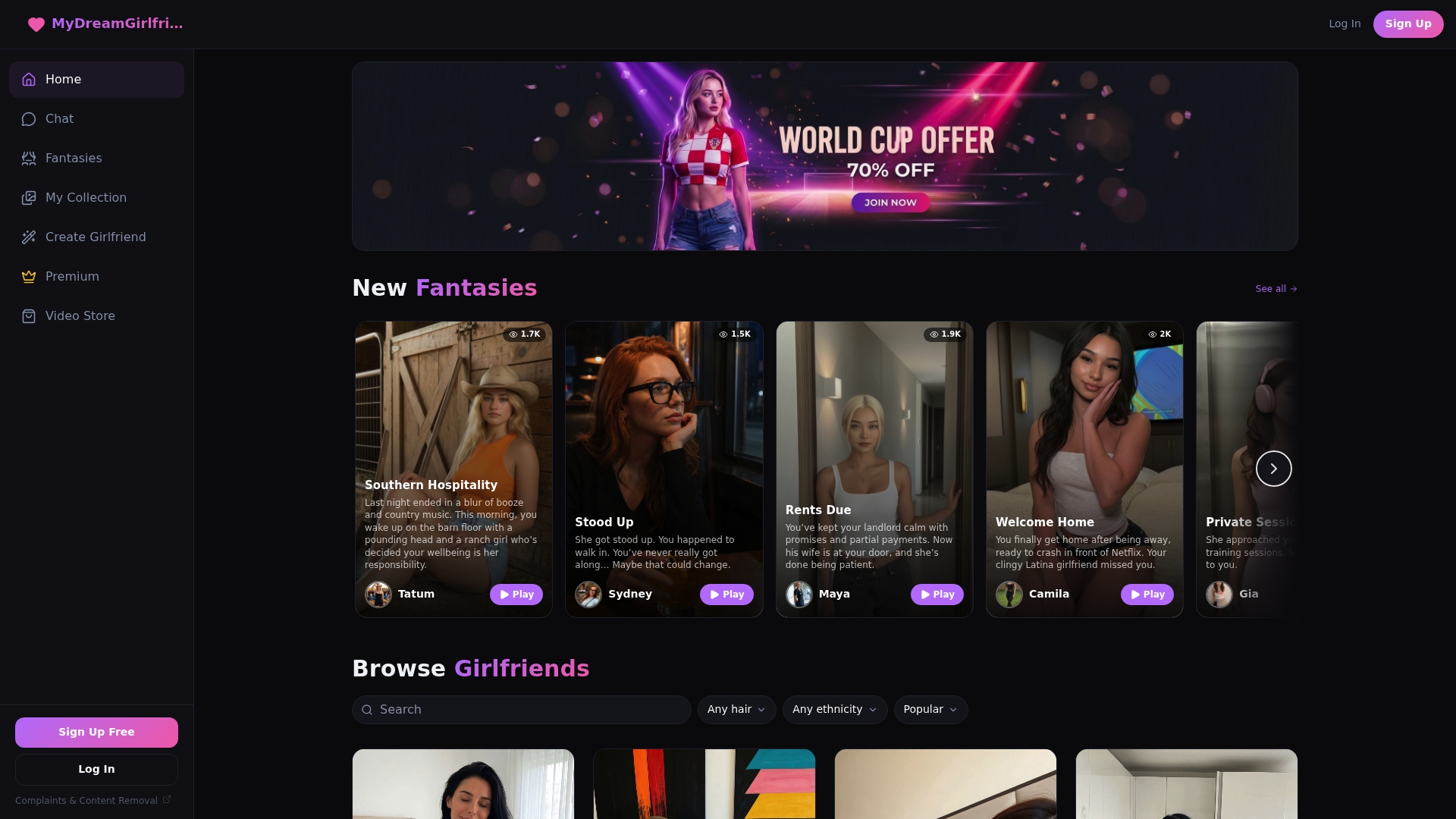
Ready to try it? Create your AI girlfriend now, or browse the full lineup of companions to find a personality that clicks.
Perspective
Here is what we see from the platform side: most people who come to a companion after a breakup are not looking to replace anyone. They want to stop replaying the same scene alone. They want a voice that answers, remembers what they said yesterday and does not flinch at the messy parts.
That is why we put so much into memory, personality and customization. When a companion remembers your ex’s name, the thing you were afraid to say and the plan you made for Saturday, the conversation stops being generic and starts being useful. Add voice and the late-night silence gets a lot smaller.
We also believe in judgment-free space. Grief is not tidy. Some nights it sounds like heartbreak, some nights like a joke, some nights like a fantasy you have never said aloud. A private place where all of that is allowed is, in our view, a real part of getting back to yourself.
Our advice is the same one we would give a friend: use it on purpose. Decide what each chat is for, keep your people close and let the companion be the warm, always-on part of a bigger recovery.
Pierce
FAQ
Can AI really help me get over a breakup?
It can help with parts of it. A 2026 randomized trial found that one structured chatbot session reduced breakup distress more than a control at 7 days, with a smaller advantage at one month. Healing still takes time, and the strongest approach combines AI conversations with friends, routine and, when needed, a professional.
Is it unhealthy to talk to an AI companion after a breakup?
Not by itself. It becomes a problem when it crowds out sleep, work or real relationships. Set a time limit, give each chat a purpose and keep making plans with people. If you notice you are avoiding everyone else, take that as the signal to rebalance.
What should I avoid telling an AI about my breakup?
Avoid details you would not want stored, such as full names, addresses, financial information or anything that could cause harm if exposed. The APA advises assuming that AI tools may store or share what you type. Check the privacy settings, and delete or export chats when you are done.
Should I use AI instead of therapy?
No. The APA says AI chatbots and wellness apps should not replace a qualified mental health provider, though they may support ongoing therapy. If your mood is not improving, or you feel unsafe, contact a licensed professional or a crisis service in your area.
Can an AI girlfriend help me feel confident dating again?
Many people use one to practice conversation, flirting and expressing what they want without pressure. It works best as practice rather than a substitute. Pair it with real-world steps, like joining a club or meeting friends, and our guide to AI girlfriends versus dating apps can help you think through when each fits.
Sources
- Can AI Help You Get Over Your Breakup? One Session with a Chatbot (arXiv, 2026)
- Should ChatGPT Write Your Breakup Text? Exploring the Role of Generative AI in Breakups (University of Washington, 2025)
- Health advisory: Use of generative AI chatbots and wellness applications (American Psychological Association, 2025)
- APA guide to navigating AI-generated advice thoughtfully (American Psychological Association, 2026)
- “Chat, Should I Leave Him?” Risks, Rewards, and Roles for AI (ACM, CHI 2026)
- I’m Thinking of Ending Things: Use of LLMs for Support (ACM, 2026)
- The efficacy, feasibility, and technical outcomes of a GPT-4o-based chatbot (PLOS Mental Health, 2025)