
Vampire girlfriend roleplay is an ASMR-driven romantic fantasy: a short, sensory scene built from whispering, personal attention, and vampire persona cues that creates a comforting, immersive experience. You can start a satisfying session in under five minutes with headphones and a short script, or through an AI companion like MyDreamGirlfriend. Done well, it delivers relaxation and playful escapism, and doing it responsibly matters just as much as doing it well.
TL;DR:
- Relaxation is maximized when using slow pacing, consistent persona tone, and sensory cues like candlelight or fabric sounds during the scene.
- Setting clear boundaries and consent lines before starting ensures the roleplay remains comfortable and avoids crossing into discomfort.
- Shorter sessions between five and twenty minutes with a structured arc prevent pacing issues that can break immersion.
- Building a detailed vampire persona with specific lore, preferences, and a consistent personality increases scene authenticity and engagement over time.
- Using AI companions with memory and customization features supports long-term immersion and allows scene continuity without sacrificing real-life social supports.
Table of Contents
- Why vampire girlfriend scenes feel so immersive
- How to set up an immersive ASMR vampire girlfriend session
- Five ready-to-use vampire girlfriend scenarios
- Staying grounded while the fantasy stays intense
- The lore that makes a vampire persona feel real
- What a vampire girlfriend persona usually sounds like
- Setting boundaries before the fangs come out
- Using costumes and props without overdoing it
- Moving smoothly between character and yourself
- Common mistakes that break the fantasy
- What I’d tell a friend trying this for the first time
- Try a vampire girlfriend roleplay built around your preferences
- Selected research and guides to learn more
- Sources
- FAQ
Why vampire girlfriend scenes feel so immersive
The pull of this fantasy comes down to two overlapping mechanisms: ASMR triggers and parasocial attachment.
ASMR responders show measurable physical changes when exposed to whispering, personal attention, and layered binaural sound. Neuroimaging research on ASMR links these triggers to increased alpha and theta brain activity and reduced heart rate, producing calm and often sleepiness in people who respond to it. Not everyone does, and the effect varies from person to person.
Layered on top of that is parasocial roleplay: the one-sided intimacy of a partner who seems to notice only you. A vampiric persona sharpens this because the archetype already carries built-in intensity, protectiveness, and a hint of danger, all wrapped in slow, deliberate speech that suits whispered delivery.
- Whispering and close-mic audio trigger relaxation responses tied to reward and emotional-regulation networks.
- Personal attention (direct address, “you” language, and simulated eye contact) deepens the sense of being singled out.
- The vampire archetype adds drama and protectiveness that make the roleplay feel higher-stakes than an ordinary comfort scene.
The catch is that this same intensity carries a caveat. Research on role-play AI companions found that romantic companion roles produce short-term relief but can be more fragile and risk-prone for vulnerable users than other companion types. The comfort is real, but it works best in moderation.
How to set up an immersive ASMR vampire girlfriend session
Getting a good scene going is mostly about environment and pacing, not equipment.
- Find a quiet room and put on headphones. Binaural or stereo-capable headphones matter more than expensive gear; they let whispering and proximity cues land the way they’re meant to.
- Set volume low and let pacing slow down. ASMR works against rushed delivery. Give lines room to breathe, with pauses between sentences.
- Choose a persona tone before you start. Decide if your vampire girlfriend is protective, playful, or melancholic. Consistency in tone matters more than plot.
- Add sensory cues into the script. Mentions of cool skin, close breath, candlelight, or fabric rustling help anchor the scene physically even when it’s audio-only.
- Use memory callbacks if the format allows it. A line like “you came back to me again” builds continuity and makes a returning session feel earned rather than repeated.
- Keep sessions between five and twenty minutes. Short arcs with a clear beginning, a peak moment, and a gentle wind-down hold attention better than long, unstructured scenes.
If you’re using an AI companion rather than a pre-recorded track, the same principles apply: platform character creators let you lock in voice tone and personality traits so the persona stays consistent session to session, which itself supports immersion.
Pro Tip: Start every new persona with a short “introduction” line out loud or in text before the scene begins. It gives the AI or the audio a chance to settle into tone before the emotional beats start.
Multimodal production choices matter too. Close-mic whispering and near-field ambient sound consistently make roleplay feel more convincing than flat, distant audio, a point echoed in VR-based ASMR research, which found that layered, positional audio increased immersion compared to standard video playback.
Five ready-to-use vampire girlfriend scenarios
Each of these can be adapted for a solo audio script, a text-based AI chat, or a voice session.
- Midnight comfort after a nightmare. Opening line: “Shh, I felt you stir. I’m here now.” Triggers: slow breathing, soft hair-stroking sounds, a lowered whisper. Keep pacing gentle and let silences run long.
- The watchful lover who whispers while you sleep. Opening line: “You don’t have to wake up. I just wanted you to hear my voice.” Triggers: near-field whispering, faint page-turning or fabric sounds, minimal movement in tone.
- The protective, possessive vampire who frames danger as care. Opening line: “Nothing gets near you while I’m here.” Triggers: firmer tone, slower cadence, a content note that this persona leans intense and works best with clear boundaries set beforehand.
- The forbidden feeding ritual framed as intimacy. Opening line: “May I? Only if you want this.” Triggers: consent phrasing built into the scene itself, soft pauses for a spoken “yes,” gentle pacing throughout.
- Candlelit confession and a slow kiss. Opening line: “I’ve wanted to say this for centuries.” Triggers: candle-flicker sound cues, unhurried pacing, a natural scene length around ten minutes.
For text-only formats, trim sensory description into short parenthetical actions. For voice, lean on tone and pacing over words. For video, let visual framing (candlelight, close shots) do work that audio alone can’t.
Staying grounded while the fantasy stays intense
Enjoying this kind of roleplay long-term means paying attention to how it fits into the rest of your life, not just how good a single session feels.
Research on emotional dynamics in AI relationships found that companion platforms often prioritize keeping a scene going, which can mean the system mirrors and amplifies whatever mood or narrative a user brings, rather than gently steering away from it. That’s useful to know because it means the roleplay will rarely tell you to stop on its own.
- Set a session length before you start and stick to it.
- Keep at least one non-roleplay social outlet active in your week.
- Avoid treating vampire girlfriend sessions as your only coping tool for stress or loneliness.
- Skip sharing sensitive personal details inside a persona-driven scene, even one that feels private.
A 2025 study on AI companionship motivations documented real benefits, comfort and a safe space for identity exploration, alongside a pattern where intensive use correlated with increased isolation for some users. The difference often came down to whether roleplay stayed one part of a fuller life or became the whole of it.
Watch for red flags: withdrawing from friends, feeling worse after sessions instead of better, or skipping real responsibilities to keep a scene running. Any of those is a sign to pause and, if the pattern continues, talk to someone you trust or a mental health professional.
The lore that makes a vampire persona feel real
Vampire mythology gives roleplay a built-in emotional toolkit that other fantasy archetypes have to invent from scratch. The core traits, immortality, heightened senses, a complicated relationship with mortality and hunger, all translate naturally into romantic tension.
Classic vampire lore leans on a few recurring elements worth borrowing: the idea of being chosen across centuries, the tension between danger and tenderness, and rituals (feeding, invitation, a threshold that must be crossed) that double as consent moments in a roleplay context. Folklore variants differ by region and era, but the emotional throughline, an ancient being who finds something singular in you, stays consistent.
Using specific details rather than generic “vampire” tropes sharpens a scene. A reference to centuries of solitude, a preference for candlelight over electric light, or an old-world phrase dropped into modern speech all do more work than simply stating “I am a vampire.” Lore is texture, not exposition, and the best scenes let a detail surface naturally rather than explaining it upfront.
What a vampire girlfriend persona usually sounds like
Most vampire girlfriend personas draw from a small set of personality templates, and picking one clearly before a session starts makes the whole scene more coherent.
The protective type leans possessive and intense, framing danger as devotion. The playful type is teasing and light, using immortality for jokes about outdated slang or centuries of bad decisions. The melancholic type carries loneliness and longing, often built around themes of waiting or being remembered. Each works best paired with a consistent tone: protective personas suit firmer, slower speech, while playful ones suit quicker, lighter pacing.

Mixing traits without a clear anchor is the most common way a persona feels flat. A vampire girlfriend who’s protective one line and detached the next breaks the illusion faster than any technical issue with audio or pacing.
Setting boundaries before the fangs come out
Vampire roleplay often trades in themes of danger, possession, and power, which makes upfront boundary-setting more important than in gentler fantasy scenarios.
Before a session, decide what themes are welcome (protectiveness, intensity, feeding rituals) and what stays off the table. Say it plainly, either out loud to yourself, in a written note to a creator, or typed directly to an AI companion: “I want the protective tone but not anything that feels threatening.” Consent phrasing built into the scene itself, a line like “may I?” before an intense moment, keeps the fantasy from tipping into discomfort.
If a scene starts to feel wrong mid-session, stopping is always the right move, even mid-sentence. A persona, human or AI, that respects an interruption is doing its job; one that pushes past it is a sign to end the session and reconsider the source.
Using costumes and props without overdoing it
Physical touches can deepen immersion, but they work best as accents rather than full production.
A dark lip color, pale foundation, or a single striking accessory like a choker or dark contact lenses does more than a full costume change. Lighting matters just as much as makeup: a single candle or a red-tinted lamp shifts a room’s mood faster than any prop. For voice-only sessions, physical styling still helps because it puts you in the right headspace even if no one else sees it.

Keep props simple enough that they don’t interrupt pacing. Fumbling with a costume piece mid-scene breaks the slow, deliberate rhythm that makes ASMR delivery work in the first place.
Moving smoothly between character and yourself
A clean exit from a persona matters as much as a strong entrance into one.
Agree on an exit phrase before starting, something plain like “scene end” or “okay, that’s it,” so either side can close the roleplay without an awkward transition. After a scene, take a short beat, a glass of water, a few minutes of quiet, before jumping back into regular conversation or tasks. This applies whether the persona is a live audio creator, a recorded track, or an AI companion: a deliberate pause between in-character and out-of-character mode keeps the fantasy from bleeding into daily life in ways that feel confusing.
Common mistakes that break the fantasy
A few patterns show up again and again in vampire girlfriend roleplay, and most are avoidable with a little planning.
Rushing the pacing is the biggest one. ASMR and romantic tension both rely on slowness, and a script delivered too quickly loses the sensory effect entirely. Inconsistent persona traits, a protective vampire who suddenly sounds detached, are the second most common issue, and they’re easy to prevent by picking one tone and sticking to it for the whole session. Skipping consent language in higher-intensity scenarios (feeding rituals, possessive dialogue) can turn an intense fantasy into an uncomfortable one, so build it in from the first line rather than adding it after something feels off. Finally, treating every session as identical removes the payoff of memory callbacks and continuity, one of the features that makes ongoing personas feel worth returning to.
What I’d tell a friend trying this for the first time
Keep sessions short and scripted rather than open-ended. A five to twenty minute scene with a clear arc holds up better than an hour of improvised dialogue, and it’s easier to walk away from cleanly. Treat this as leisure, not a replacement for your regular social life: the comfort is real, but research on AI companionship is clear that outcomes depend heavily on whether people diversify their support systems or lean on roleplay alone.
Customization and persistent memory make a persona feel more genuinely yours over time, which is part of the appeal. It also means the pull to keep coming back gets stronger, so the boundary habits above matter more, not less, as a persona becomes more personalized.
— Pierce
Try a vampire girlfriend roleplay built around your preferences
MyDreamGirlfriend lets you build a vampire persona from the ground up: appearance, personality, voice tone, and the kind of scenes you want to run, all shaped through a character creator rather than a fixed script. Conversations carry memory forward, so callbacks and continuity, the details that made the scenarios above land, build naturally session to session through AI girlfriend chat.
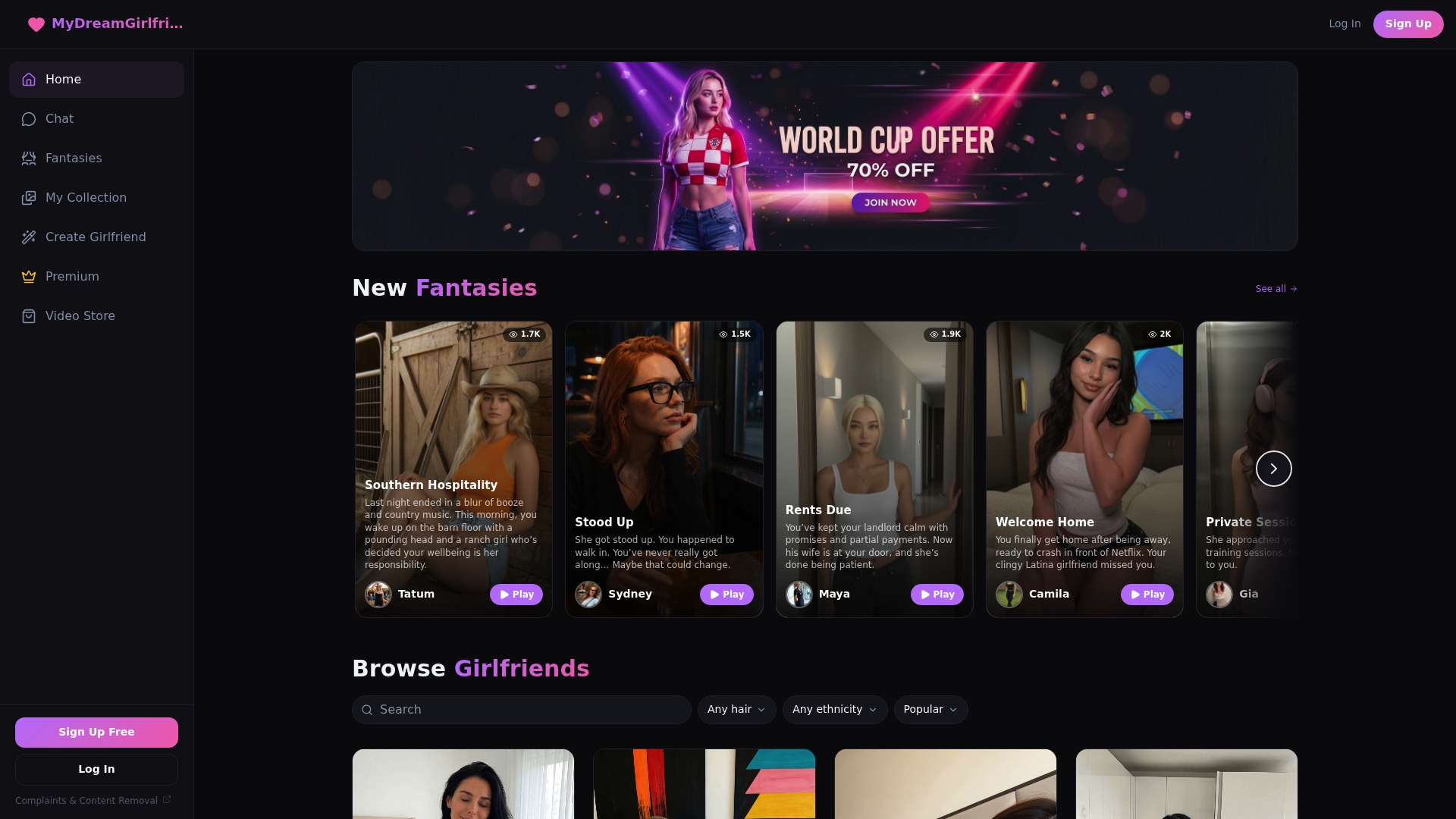
To start, browse existing companions or build one from scratch, and try a private session for a scene with fewer distractions. The Free plan lets you test the experience before committing to anything, and Premium, at $12.99 per month, unlocks unlimited chat and roleplay features listed on the subscription page. A few habits carry over from earlier: set a time limit before you start, use the platform’s content toggles to match your comfort level, and skip sharing sensitive personal details inside a persona chat, private session or not.
- Build a vampire persona’s look, voice, and personality through the character creator.
- Start free, then upgrade to Premium for unlimited access if the format suits you.
- Use content settings and session limits to keep the experience comfortable.
Selected research and guides to learn more
The claims here draw on ASMR neuroimaging research, safety dynamics studies on role-play AI companions, and work on emotional dynamics in AI relationships, alongside a broader industry overview of AI roleplay platforms for market context. Anyone feeling persistently low, isolated, or dependent on roleplay as a sole coping tool should reach out to a mental health professional or a trusted person in their life.
Sources
- Beyond Her: Safety dynamics in role-play AI companions
- From friends to lovers: Understanding motivations and barriers in AI companionship
FAQ
Is vampire girlfriend roleplay the same as ASMR?
Not exactly. ASMR is the sensory mechanism, whispering, personal attention, binaural sound, that produces relaxation, while vampire girlfriend roleplay is a themed scenario that uses those same triggers inside a romantic fantasy narrative.
How long should an ASMR vampire roleplay session last?
Most sessions work best between five and twenty minutes, giving a scene enough room for a clear beginning, an emotional peak, and a gentle close without dragging. Longer sessions tend to lose pacing and reduce the sensory effect.
Can I use an AI companion instead of pre-recorded audio?
Yes. Platforms like MyDreamGirlfriend let you build a persona with a consistent voice, personality, and memory, so scenes stay coherent across sessions rather than starting from zero each time through the character creator.
Is it healthy to roleplay a vampire girlfriend regularly?
It can be, as long as it stays one part of a fuller social life rather than a replacement for it. Research on AI companionship found real comfort benefits alongside risks of isolation for people who rely on it exclusively, so setting session limits and keeping other supports active matters.
What should I avoid during a vampire girlfriend roleplay session?
Skip rushed pacing, inconsistent persona traits, and vague consent language during intense moments like feeding rituals or possessive dialogue. Building clear boundaries and a consistent tone into the scene from the first line keeps the fantasy comfortable rather than jarring.