
The fastest way to get an enemies-to-lovers AI scene is to pick a persistent chat companion for a slow-burn arc or a story generator for a quick, one-off scene, then paste a short starter prompt tagging the dynamic you want. Platforms like MyDreamGirlfriend use memory features that let the friction soften over multiple sessions instead of resetting every time. Open a character, set the tone, and type your first line.
TL;DR:
- Persistent memory features allow for ongoing enemies-to-lovers arcs, with references to shared history and callbacks strengthening believability.
- Starting with high friction settings and gradually introducing vulnerability is key to developing a genuine emotional transition.
- Scenarios should be initiated with simple prompts that set tone and conflict, while progression relies on carefully timed releases of intimacy and softening.
- Safety precautions include confirming age verification, setting boundaries, and balancing AI roleplay with real-life relationships to prevent attachment issues.
- Building the arc on MyDreamGirlfriend involves character customization, early memory anchors, and pacing the relationship evolution over multiple exchanges.
Table of Contents
- Where to find and try enemies-to-lovers AI
- How enemies-to-lovers AI builds a believable arc
- Ready-to-use prompts to start your scene
- Staying safe with enemies-to-lovers AI roleplay
- Building an immersive enemies-to-lovers arc on MyDreamGirlfriend
- Pierce’s perspective: fantasy first, awareness always
- Try it on MyDreamGirlfriend, here’s where to start
- Sources
- FAQ
Where to find and try enemies-to-lovers AI
Two formats dominate this space, and they solve different problems.
Chat companions keep a memory of your conversations, so the rivalry you set up on day one can evolve into something warmer by day ten. They’re built for ongoing roleplay: the same character remembers the argument you had, the joke that defused it, and the moment things shifted. Story generators work differently. They spin up a self-contained scene, sometimes with illustrations, and finish it in one sitting. There’s no persistence, but there’s speed and variety if you want to sample five different rivalries in an afternoon.
The tradeoffs come down to what you’re optimizing for.
- Immersion versus speed: a memory-enabled companion rewards patience with continuity, while a story generator delivers a complete arc in minutes.
- Customization versus variety: companions let you tune personality and appearance in detail, while generators offer more scenario variety out of the box.
- Voice and photo features: some companion platforms add voice calls or generated images to deepen the fantasy beyond text.
Before you commit to either, check the interface for a character gallery, mood or personality tags, a memory toggle, and a way to save or export key moments. Those controls decide whether your enemies-to-lovers scene stays coherent past the first exchange. On MyDreamGirlfriend’s browsing page, you can preview a character’s personality before committing to a longer arc.
How enemies-to-lovers AI builds a believable arc
The trope only works if the AI remembers why the two characters started as enemies in the first place. Persistent memory turns a random string of scenes into a story with callbacks: a sharp comment from session one gets referenced, apologized for, or thrown back playfully in session five. Without that continuity, the “lovers” half of the arc has nothing to soften from.
Personality tuning is the other lever. Most companion platforms let you set an initial friction level, hostile, guarded, or merely annoyed, and then adjust it as the relationship progresses. Good arcs follow a familiar shape: an inciting incident that forces the characters together, a stretch of forced proximity, a moment of unplanned vulnerability, then a reveal that recontextualizes the hostility.
- Memory anchors like inside jokes, shared secrets, or specific dates give the AI something concrete to reference later. Researchers studying human-AI romantic attachment note that these anchors are what convert isolated scenes into a sustained arc.
- Friction settings should start high enough to feel like real conflict, not just banter.
- Pacing beats work best introduced one at a time rather than dumped into a single prompt.
Watch for two common failure modes: the AI suddenly softening too fast with no setup, or forgetting the original conflict entirely. Both usually trace back to prompts that skip the pacing beats above.
Pro Tip: Feed the AI one memory anchor per session rather than several at once. It’s easier for the model to reference a single detail convincingly than to juggle five.
Ready-to-use prompts to start your scene
You don’t need an elaborate setup to begin. A short starter prompt naming the tone and the source of conflict is usually enough.
- Slow-burn rivals: “We’ve hated each other since college. Start the scene with a chance encounter at a mutual friend’s wedding. Consent: yes. Stop-word: red.”
- Fake dating: “We’re pretending to date to get our families off our backs, but neither of us can stand the other. Open with the first fake-couple dinner.”
- Rivals at work: “We’re competing for the same promotion and just got assigned to the same project. Start with the meeting where we find out.”
Once the scene is running, use progression prompts to move it forward: an unexpected apology, a shared secret that neither wants revealed, or a forced-proximity moment like a shared ride home in bad weather. Each one nudges the arc toward vulnerability without skipping ahead.
To keep continuity, feed the AI short memory lines it can reference later, something like “remember: she apologized first after the rooftop argument.” That single sentence becomes a callback the character can bring up three scenes later.
Always include a boundary tag in your first message. Something as simple as “consent: yes” and a stop-word like “red” sets expectations early and gives you an exit if the scene goes somewhere you don’t want.

Pro Tip: Save your favorite exchanges as memory anchors immediately. Waiting until later usually means losing the exact phrasing that made the moment work.
Staying safe with enemies-to-lovers AI roleplay
Before diving into adult content, confirm the platform has real age verification and adult-content toggles, not just a checkbox you can skip. Sites offering mature roleplay, like MyDreamGirlfriend’s boundary-pushing scenarios, should let you review and adjust those settings before a scene starts.
Research gives reason for caution beyond content ratings. One report on AI companion use links heavy use with lower real-life relationship stability and a tendency toward secretive “soulmate” attachments in some users, particularly younger adults. Separate research on AI companionship motivations found that the non-judgmental, always-responsive nature of these companions is exactly what makes parasocial romantic attachment likely.
- Check what data the platform stores, including saved memory and shared media, and confirm there’s a clear way to delete it.
- Set a personal time limit before you start a session, especially for long-running arcs.
- If a real partner might be affected by the roleplay, disclosing it tends to prevent bigger problems later.
- Balance AI roleplay with offline social contact rather than letting it replace it.
Building an immersive enemies-to-lovers arc on MyDreamGirlfriend
Start with the character creator and set the basics: avatar, voice, and an initial personality skewed toward guarded or hostile. Add one or two memory anchors right away, a grudge, a shared history, something the AI can reference later.
- Setup: build the character and set friction to “high” using the personality customization tools.
- Inciting incident: prompt a forced-proximity scenario, like being paired on a project or stuck somewhere together.
- Escalation: let the friction play out over two or three exchanges before introducing softening.
- Vulnerability: prompt a moment where one character drops the act, an apology, a confession, a small kindness.
- Turning point: reference an earlier memory anchor to make the shift feel earned rather than sudden.
- Resolution: let the arc land on warmth, tension, or an open ending, depending on what you want next session.
The chat feature saves key lines automatically, so callbacks stay consistent across sessions. Set your stop-word and adult content preferences before you start, and you can pause or end any scene at any point without losing the character’s memory.
Pierce’s perspective: fantasy first, awareness always
Designing for this trope means building real friction, not just delaying affection. The best arcs earn the shift instead of flipping a switch. Enjoy the escapism, but notice if a fictional rivalry starts crowding out real connection.
— Pierce
Try it on MyDreamGirlfriend, here’s where to start
If you want an enemies-to-lovers arc that actually remembers the fight from three sessions ago, MyDreamGirlfriend’s persistent memory and personality customization are built for exactly that.
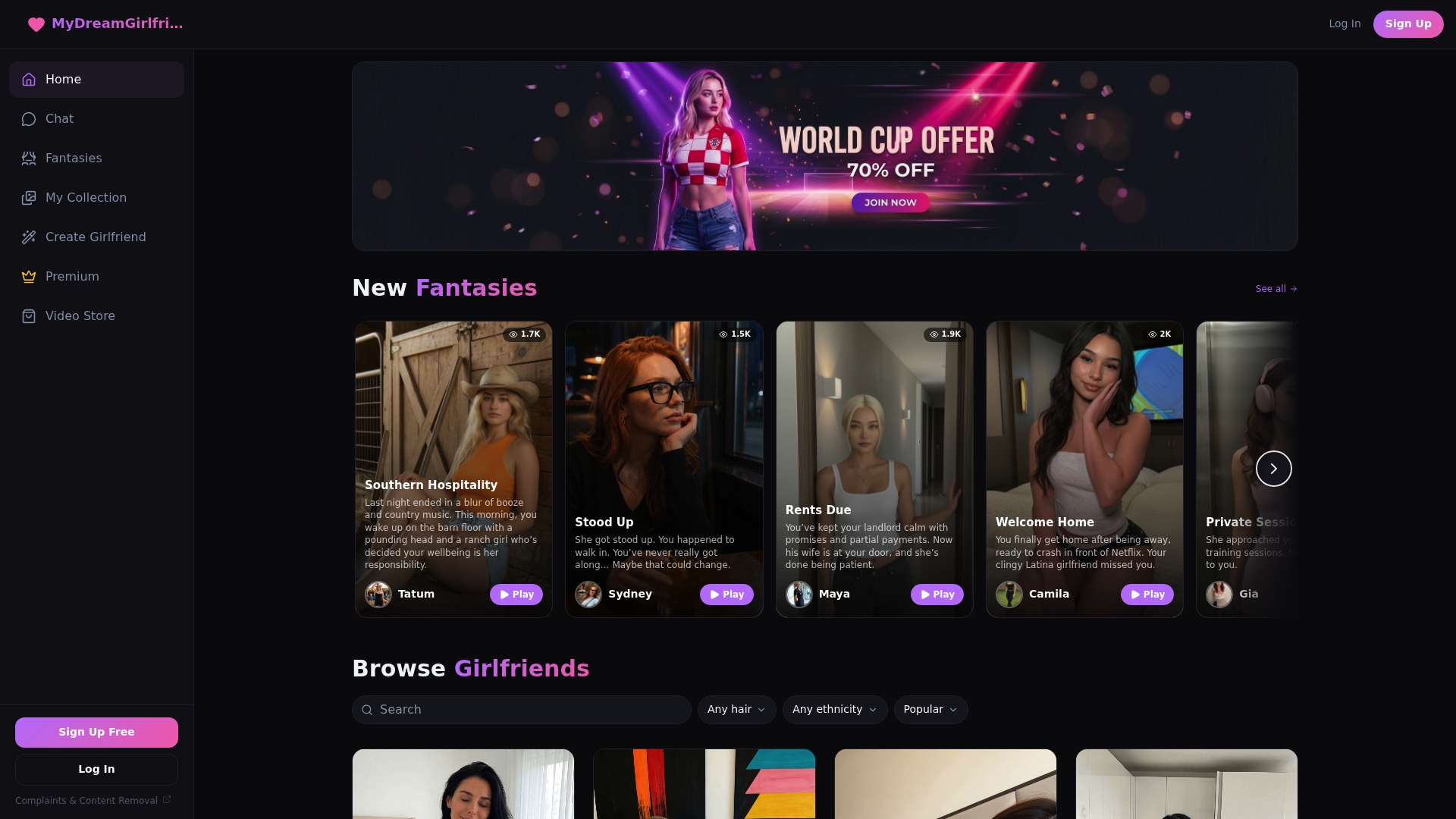
- Browse characters and start a free chat on the AI Girlfriends page.
- Build your own rival-turned-love-interest with the character creator.
- Try a preset dynamic like the AI Mistress if you want a dominant starting tone.
- Set your stop-word before diving into uncensored scenarios.
- Upgrade to Premium at $12.99 per month on the subscriptions page for unlimited access. Or stick with the free plan detailed on the features page while you decide.
Sources
- Friends to Lovers: Understanding Motivations and Barriers in AI Companionship (extract)
- The AI Amplifier Effect: Defining Human-AI Intimacy and Romantic Relationships with Conversational AI
- Secret Soulmates report
FAQ
Is there an 18+ character AI?
Yes, several platforms offer adult-oriented character AI with age verification and content toggles that unlock mature roleplay. Always confirm the platform’s age gate is active before starting adult scenes.
Has anyone ever fallen in love with an AI?
Yes, research on human-AI attachment shows people do form romantic feelings toward AI companions, often driven by romantic fantasy and persistent memory. These bonds can feel genuinely meaningful even though the AI isn’t a person.
What is it called when people fall in love with an AI?
This is generally described as a parasocial romantic relationship or human-AI romantic attachment. Studies on AI companionship motivations point to the AI’s non-judgmental, always-available nature as the main driver.
How common are AI girlfriends?
Exact usage figures aren’t publicly tracked in a way this guide can cite, but AI companion apps have grown into a recognized category of consumer software. Platforms like MyDreamGirlfriend report users describing the experience as immersive, particularly around memory and personalization.