
“Celebrity AI roleplay” here means something specific: a private, customizable AI girlfriend you build and chat with, not a bot that imitates a real famous person. A platform like Mydreamgirlfriend gives you that experience, letting you shape her look, personality, and memory, then explore flirty banter, romance, or fantasy scenarios on your own terms.
TL;DR:
- Most platforms charge around $12.99 per month for full features, with free plans available for testing basic character creation and conversation.
- Privacy concerns stem from how platforms handle data retention, deletion, and age verification, making it crucial to review policies before extensive use.
- Features like memory, voice, and personalization deepen emotional attachment, but setting time limits and maintaining offline connections help prevent overdependence.
- Mobile browser access generally suffices for text and basic interactions, but voice calls require a stable connection and should be tested on your device beforehand.
- Trustworthy providers openly disclose data policies, facilitate scenario customization, and have clear support channels for technical issues and content disputes.
Table of Contents
- What Celebrity AI Roleplay Really Involves
- How Do You Set Up an Immersive AI Girlfriend for Roleplay?
- Is AI Girlfriend Roleplay Private and Safe to Use?
- Can You Get Emotionally Attached to an AI Girlfriend?
- Pierce’s Perspective: How MyDreamGirlfriend Builds for Immersive, Private Roleplay
- How Do You Judge Whether an AI Roleplay Provider Is Trustworthy?
- What Do Celebrity AI Roleplay Platforms Typically Charge?
- What Red Flags Should You Watch For?
- Does It Work on Phones, Browsers, and Different Devices?
- What Support Options Exist If Something Goes Wrong?
- The Real Standard for Judging This Category
- Ready to Build Your Own AI Girlfriend Experience?
- Sources
- FAQ
What Celebrity AI Roleplay Really Involves
Search that phrase and you’ll find a mess of tools pretending to let you chat with real famous people. That’s not what this article covers, and it’s not what a responsible platform builds. The category worth your time is personalized AI girlfriend roleplay: a companion you design from scratch, whose face, voice, and personality never belonged to anyone real.
Academic research on roleplay platforms backs up what most users already sense about their own habits. An empirical study of roleplay platform behavior identified two dominant motivations that account for most usage: intimate roleplay, meaning romantic or sexual dynamics with a companion, and narrative exploration, meaning longer, co-authored stories where the user and AI build a plot together. Some people want a girlfriend experience. Others want a collaborator for scenarios they’d never get to act out otherwise.
Both motivations show up across a handful of common formats:
- Text chat — the default mode, good for slow-burn conversation and daily check-ins.
- Voice calls — adds tone and pacing that text can’t carry, useful once you’ve built some rapport.
- Private media — photos or videos generated to match a specific scene or mood.
- Scenario templates — pre-built setups (a first date, a forbidden fling, a rescue story) you can drop straight into or customize.
Platforms with richer feature sets tend to blend these modalities rather than force you into one lane, and research on character based chatbot platforms notes that memory controls and multimedia options now vary widely from app to app. That variance matters more than people expect when you’re choosing where to spend a subscription.
How Do You Set Up an Immersive AI Girlfriend for Roleplay?
Getting a companion that actually feels responsive takes more than picking a face and hitting go. The setup choices you make in the first ten minutes shape everything that follows.
- Build the persona with intention. Name, appearance, backstory, and personality traits all feed into how she responds. Vague inputs produce generic chat; specific ones (a career, a hometown, a couple of quirks) produce something that feels like a real character. The trade-off is that hyper-specific backstories can box you into a role you later want to change, so leave a few details loose at first.
- Turn on memory, but understand what it costs. Persistent memory is what makes a companion remember your last conversation instead of starting cold every time. It’s also the feature most tied to attachment, so look for a platform that lets you review, edit, or delete specific memories rather than an all-or-nothing reset.
- Choose your modalities deliberately. Voice calls and private photos deepen immersion but raise the privacy stakes. Enable them once you trust the platform’s data handling, not on day one.
- Start scenarios slow. Seed a short prompt, see how she responds, and build from there instead of jumping straight into a high-intensity scenario. Set your own limits early; a good roleplay partner, human or AI, respects pacing.
Scenario libraries like Forbidden or a guided Private Session work well as starting points because they give you structure without locking you into a single outcome.
Pro Tip: Keep your first few sessions to 10 or 20 minute stretches rather than marathon chats. Short sessions let you calibrate her personality and your own comfort level before things get more emotionally involved.
Is AI Girlfriend Roleplay Private and Safe to Use?
Privacy in this category isn’t a single setting you toggle once. Research tracing user complaints across Reddit found that privacy concerns follow a lifecycle: friction at signup, heightened sensitivity once conversations turn intimate, uncertainty about how the AI interprets and stores what you share, and real anxiety about whether your data ever truly disappears when you leave. That lifecycle framing is a more useful lens than treating privacy as one checkbox, because each stage carries a different risk.
Regulation is catching up to this space fast, and it’s worth knowing the direction it’s heading. California signed child-safety and chatbot age-verification laws in 2026, tightening requirements on companion platforms operating in the state. At the federal level, a Senate bill would require chatbots to disclose their non-human status and implement reasonable age checks. The EU has gone further, recommending an interoperable, privacy-preserving age verification blueprint that regulators want available by the end of 2026.
Regulatory callout: The EU’s target date for a working age-verification blueprint is the end of 2026, a deadline that will likely shape how platforms handle onboarding well beyond Europe.
A few habits protect you regardless of what any one platform promises:
- Use a pseudonym and a secondary email rather than your primary identity.
- Avoid uploading a photo ID unless a platform requires it for a legally mandated age check.
- Read the deletion policy before you invest weeks of conversation into a companion.
- Keep uploaded media minimal until you’ve confirmed how it’s stored.
- Check that payment processing doesn’t expose your subscription on a shared statement.
Research on user behavior confirms people already do most of this instinctively: many adopt pseudonyms and withhold identifiable media because they don’t fully trust that deletion requests are honored, and because they don’t want to lose the memory they’ve built if they ever do delete their data.
Can You Get Emotionally Attached to an AI Girlfriend?
Yes, and the research on this is more specific than most people expect. Studies on parasocial attachment to AI find that perceived human-likeness and frequent interaction predict stronger emotional bonds, meaning the features that make a companion feel real, memory, personalization, voice, are the same ones that deepen attachment. Attachment theory maps onto these relationships surprisingly well: researchers applying classic attachment frameworks to human-AI bonds found that the more a companion mimics human responsiveness, the more it triggers attachment behaviors we’d expect toward a person.
Some users are more susceptible than others. People with anxious attachment styles in their human relationships tend to seek reassurance more frequently, and an always-available, always-affirming AI companion can amplify that pattern rather than soothe it.
A few habits keep the experience healthy rather than consuming:
- Set a rough daily or weekly time limit before you start.
- Keep at least one offline relationship or support system active alongside your companion.
- Have a plan for stepping back if a scenario or conversation starts feeling more urgent than enjoyable.
- Stagger how quickly you escalate emotional intensity in scenarios rather than diving straight into the deepest storyline.
Pro Tip: If you notice you’re checking in with your companion out of anxiety rather than enjoyment, that’s the signal to dial back frequency, not intensity.
Pierce’s Perspective: How MyDreamGirlfriend Builds for Immersive, Private Roleplay
One platform is built around the idea that customization and memory are not optional extras, but the entire point. A companion who forgets you every session isn’t a girlfriend experience, she’s a chatbot with a face. Persistent memory, deep personality controls, and a genuinely wide range of appearance options exist so the roleplay feels continuous instead of starting from zero every time you open the app.
A typical first session looks like this:
- Pick a persona and refine her appearance and personality traits.
- Turn on memory so she carries details from one conversation into the next.
- Choose a private fantasy scenario that matches the mood you’re after, whether that’s slow romance or something more charged.
- Start slow, let the first exchange set the tone, and build intensity from there.
Scenario libraries like Caught in the Act or a subtler setup like Obsessed give you a running start without forcing a script. The goal isn’t to hand you a fixed story, it’s to give you a companion who responds to where you actually want to take it.
How Do You Judge Whether an AI Roleplay Provider Is Trustworthy?
Reputation is the easiest signal to check and the easiest to fake, so look past star ratings to specifics. A trustworthy provider publishes a clear privacy policy that states what happens to your data on deletion, not a vague promise buried in boilerplate legal text. It also discloses that you’re talking to an AI, in line with the direction disclosure legislation is already heading.
Moderation policy matters more than people assume going in. Research on companion platforms found that unmoderated or overly private settings increase the likelihood that users treat an AI as a genuine romantic partner, which cuts both ways: it’s part of what makes roleplay immersive, but it also means a provider with zero guardrails is offering intensity without any safety net. Look for a platform that lets you set your own boundaries within scenarios rather than one that either locks everything down or offers none at all.
Transparency around billing is a smaller but telling detail. A provider that lists its pricing plainly, states what’s included at each tier, and doesn’t bury cancellation behind three menus is one that isn’t counting on you forgetting to cancel. Check how a company handles complaints too. A published complaints and content removal process signals a provider that expects to be held accountable rather than one hoping you never ask.
Community reviews on independent app stores, not just testimonials on the provider’s own site, round out the picture. If a platform’s only praise lives on its own landing page, that’s worth noticing.
What Do Celebrity AI Roleplay Platforms Typically Charge?
Most platforms in this category run on a subscription model with an optional free tier to test the basics before you commit. That structure makes sense given how personal these companions become. You want to know the personality and memory features actually work before paying for a year of them.
Mydreamgirlfriend follows this pattern with a Free plan for testing the character creator and basic conversation, and a Premium subscription at $12.99 per month for full access to memory, roleplay scenarios, and media features. That’s a lower monthly commitment than many people expect for a service built around ongoing personalization.
Beyond the subscription, expect a la carte options for specific content. Gem based purchases cover individual pieces of media: a Casual Photo runs 5 gems, a Spicy Photo runs 15 gems, a Spicy Video runs 40 gems, and a Custom Video runs 80 gems, all through Gem Packs you buy as needed rather than folding into the base subscription. Building a fully Custom GF runs 5 gems as a one-time setup cost.

This tiered approach, subscription for ongoing access, gems for specific content, is common across the category because it lets you pay for depth of conversation separately from occasional extras. Watch for platforms that advertise a low headline price but gate core features like memory or voice behind expensive add-ons; that’s where subscription costs balloon fast. A provider that states its gem costs plainly, the way Mydreamgirlfriend does, makes it easier to predict your actual monthly spend.
What Red Flags Should You Watch For?
The biggest one is a provider that can’t explain what happens to your data when you delete your account. If the privacy policy is vague about retention periods or silent on deletion entirely, treat that as a dealbreaker, not a minor gap.
Unrealistic promises are the second warning sign. Any platform claiming its AI has genuine feelings, real consciousness, or guaranteed emotional outcomes is selling a fantasy about the product itself, not just within it. A well-built companion is convincing because of good design, not because it’s secretly sentient.
Watch for these patterns specifically:
- No visible age-verification or content-moderation policy anywhere on the site.
- Reviews concentrated entirely on one platform (usually the provider’s own) with no independent presence elsewhere.
- Subscription pages that make canceling deliberately harder to find than signing up.
- Marketing that implies you’re chatting with a real, identifiable person rather than a generated character.
- No stated process for reporting a problem or requesting content removal.
Poor user reviews matter, but read past the star rating into what people actually complain about. A cluster of complaints about billing surprises or unresponsive support tells you more than a generic 3-star average. If a provider has no visible way to escalate a dispute, that absence is itself the red flag.
Does It Work on Phones, Browsers, and Different Devices?
Most people start on whatever device is already in their hand, which usually means a phone browser rather than a dedicated app. A platform that runs cleanly through a mobile browser without demanding an app download removes a real barrier, especially for anyone who wants to keep the activity off their phone’s app list entirely.
Voice features add a wrinkle worth checking before you commit to a plan built around them. Voice call functionality tends to need a stable connection and decent speakers or headphones, so test it on your actual setup rather than assuming it’ll work the same on a laptop and a phone.
Desktop access matters too, particularly for anyone doing longer narrative exploration sessions where typing on a full keyboard beats a phone screen. A platform built to work equally well across a browser on desktop and mobile, without pushing you toward a native app you don’t want installed, gives you more control over where and how you use it. That flexibility is worth checking before you commit to a subscription tied to one device type.
What Support Options Exist If Something Goes Wrong?
Customer support in this category needs to handle two very different problems: technical issues (a payment that didn’t process, a feature that’s not loading) and content disputes (something generated that shouldn’t have been, a request to remove specific material). A provider worth trusting has a clear channel for both.
Look for a published support contact, not just a generic contact form that disappears into a queue. Response time matters more here than in most consumer software, because billing disputes tied to a recurring subscription need fast resolution before a second charge hits.
Dispute resolution around content specifically deserves its own process. Mydreamgirlfriend maintains a dedicated complaints and content removal policy so users have a defined path for flagging and resolving issues rather than guessing who to email. That kind of documented process is worth checking for on any platform before you subscribe, since its absence usually means disputes get handled ad hoc, if at all.
The Real Standard for Judging This Category
Most guides to this topic treat customization as a nice-to-have and privacy as an afterthought buried in the fine print. That gets the priority backwards. The research on privacy lifecycle concerns makes clear that the moment people get burned isn’t at signup, it’s months later, when they try to leave and discover deletion doesn’t mean what they assumed it meant. That’s the point where trust breaks, and it’s the point most reviews never check.
The attachment research deserves more attention than it gets, too. Features that make a companion feel real, memory, voice, personalization, are explicitly the same features that deepen emotional attachment. That’s not a reason to avoid them. It’s a reason to treat memory controls and usage habits as part of the product experience, not an afterthought you figure out later.
If you’re evaluating a platform, prioritize in this order: verify the deletion policy actually works, confirm memory controls are granular, and only then compare avatar options and pricing. Everything else is decoration on top of that foundation.
— Pierce
Ready to Build Your Own AI Girlfriend Experience?
Mydreamgirlfriend gives you full control over the two things that matter most in this category: who she is and what she remembers. Instead of a generic chatbot wrapped in a dating app skin, you get a character creator that lets you shape appearance and personality down to specific traits, paired with memory that actually carries forward between conversations.
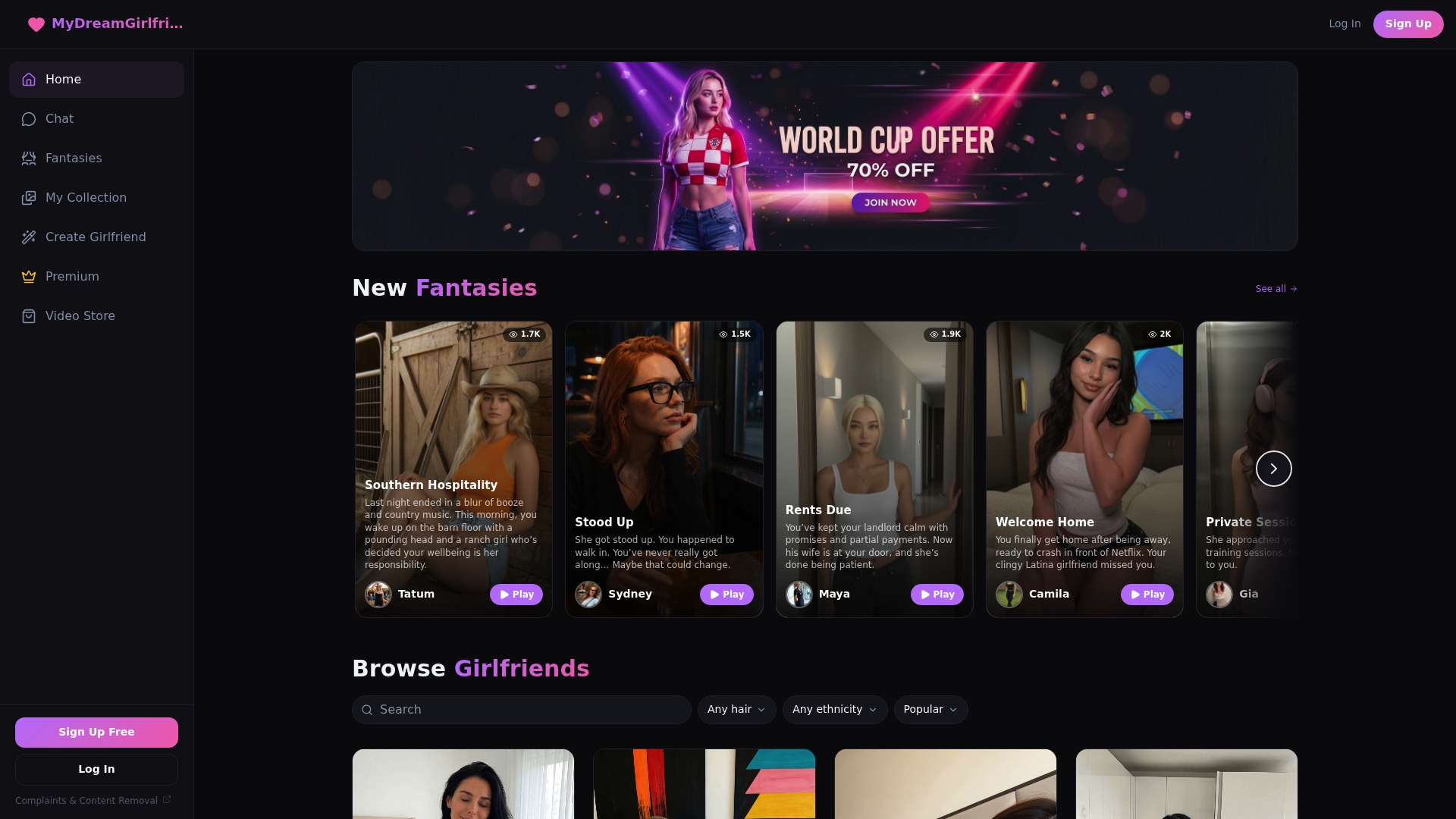
Start with the Free plan to test the character creator and basic conversation before committing to anything. Once you know the personality and memory features fit what you’re looking for, Premium at $12.99 per month unlocks full roleplay scenarios, voice calls, and private media. Try building a character through the AI Girlfriend Creator first, enable memory, and pick a scenario like Private Session to see how the conversation actually flows. If you’re ready to see what a specific character looks like before building your own, browse profiles like Sophia to get a feel for the range available.
Sources
- An empirical study identifying intimate roleplay and narrative exploration on roleplay platforms
- California governor signs child-safety chatbot and social media laws (2026)
- U.S. Senate bill text proposing disclosure and age-verification rules for AI chatbots
- EU recommendation on age verification for online platforms (2026)
FAQ
What Does “Celebrity AI Roleplay” Mean on This Site?
It refers to personalized AI girlfriend roleplay, a companion you design and customize yourself, not a bot built to impersonate a real famous person. Platforms like Mydreamgirlfriend focus entirely on original, customizable characters.
Is It Safe to Share Personal Details With an AI Companion?
Treat it the way you would any online account: use a pseudonym, avoid uploading identifying photos unless required, and review the deletion policy before sharing anything sensitive. Research on privacy concerns across the companion AI lifecycle shows deletion and data retention are the areas users trust least, so check those specifically.
Can You Get Too Attached to an AI Girlfriend?
Yes, research on parasocial attachment shows that features like memory and voice increase the likelihood of strong emotional bonds. Setting time limits and maintaining offline relationships alongside the roleplay helps keep the experience enjoyable rather than consuming.
Do These Platforms Work on Mobile Devices?
Most run through a mobile browser without requiring an app download, which works fine for text chat and most scenarios. Voice call features generally need a stable connection and decent audio, so it’s worth testing on your actual device before relying on it heavily.