
Spicy AI prompts are mature, consent-first instructions written for text roleplay or image generators, built around atmosphere, composition, and persona rather than crude descriptors. The fastest path to a usable result is copying a proven example below, then swapping one variable (subject, wardrobe, or lighting) at a time. Every prompt should name fictional, consenting adults and get checked against your platform’s content rules before you push it further.
TL;DR:
- Use a structured prompt template focusing on subject, scenario, pose, wardrobe, setting, lighting, camera, mood, and format to achieve more reliable results.
- When creating image prompts, prioritize visual details like pose, lens, and lighting, while roleplay prompts should emphasize character identity, consent, and narrative tone.
- Iterate prompts by changing one variable at a time, generating multiple variations to find the most effective setup and avoid common failures like attribute confusion.
- Always include clear consent and fictional adult framing in prompts to ensure safety and compliance with platform standards, avoiding real person references or non-consensual scenarios.
- Build a consistent character persona for ongoing roleplay to maintain tone and memory, reducing the need to rewrite setup scenes for each session.
Table of Contents
- Copy-Ready Spicy AI Prompt Examples You Can Use Today
- A Modular Template That Actually Produces Reliable Results
- Image Prompts vs. Text Roleplay: Different Fields Matter
- How to Iterate on a Spicy Prompt Without Wasting Your Time
- Safety and Consent Rules That Override Every Prompt Below
- What Roleplay Platforms Teach You About Prompt Structure
- Comparing Spicy Prompt Results Across AI Models
- Why Craft Beats a List of Adjectives
- Try Immersive Roleplay Built Around Persona, Not Just Prompts
- Sources
- FAQ
Copy-Ready Spicy AI Prompt Examples You Can Use Today
Most people waste their first ten attempts guessing at phrasing. Skip that. These are structured, ready to paste, and annotated so you know exactly what to change.
Boudoir and fashion image prompts work best when you describe the frame like a photographer would, not like a dating profile.
- “Adult fictional model, seated on a velvet chaise, soft window light from the left, 85mm lens, shallow depth of field, silk robe falling off one shoulder, muted sepia tones, editorial boudoir photography style.” Swap the fabric (silk to lace) or light source (window to candle) to shift the mood.
- “Adult fictional couple, foreheads touching, hands intertwined, backlit by golden hour sun, 50mm lens, warm color grade, cotton bedsheets, tender and unhurried mood.” Replace “tender” with “playful” and the whole scene changes energy without touching composition.
- “Adult fictional woman, standing profile near a rain-streaked window, low key lighting, 35mm lens, deep shadows, satin slip, film-noir color palette.” For wardrobe reference points and fabric language, a resource like The Wedding Garter’s boudoir styling guide is genuinely useful even outside a bridal context.
Text roleplay snippets need fewer visual cues and more scene grammar: point of view, consent, pacing.
- “Write a short scene (under 300 words), first person POV, two adult fictional characters, established dating relationship, consensual evening at home, slow-burn tension, no explicit anatomy, focus on dialogue and anticipation.”
- “Continue the scene: adult fictional characters, mutual consent already established, private hotel room, playful banter transitioning to intimacy, keep it under 400 words, fade to black before explicit description.”
For every prompt, swap only the subject, wardrobe, or setting clause, and note the expected shift: warmer light reads as intimate, harsher shadow reads as tense. Mydreamgirlfriend’s own roleplay scenario library uses this same logic, pairing a fixed persona with variable scene details.
A Modular Template That Actually Produces Reliable Results
Random adjectives produce random output. A modular template does not. Academic work on text-to-image prompting found that organizing prompts around subject and style, rather than a pile of loose descriptors, gives you far more control and cuts down on common failures like attribute binding and spatial confusion.
The order that works:
- Subject: adult fictional character, age and identity clear
- Scenario: what’s happening, and that it’s consensual
- Pose/action: body position, gesture, movement
- Wardrobe/materials: fabric, texture, color
- Setting: room, time of day, weather
- Lighting: source, direction, warmth
- Camera: lens, angle, distance
- Mood/style: tone word, art or photo style reference
- Output format: aspect ratio, resolution, or scene length
- Exclusions: what to leave out, stated briefly
A quick rewrite in action: “Woman on a bed, sexy lighting” becomes “Adult fictional woman, reclined on a bed, soft diffused lamp light from the right, 50mm lens, cream linen sheets, relaxed and unguarded mood, film photography style, square crop.” Same idea, dramatically more control.
Pro Tip: OpenAI’s own prompt guidance recommends stating what you want rather than stacking negatives. “Soft natural light” outperforms “not harsh, not fluorescent, not overexposed” almost every time.
Image Prompts vs. Text Roleplay: Different Fields Matter
An image generator and a roleplay model read your words for completely different purposes, so the same prompt structure won’t serve both.
For image prompts, prioritize:
- Pose, camera angle, and focal length
- Lighting direction and color temperature
- Fabric and material detail
- A short exclusion clause instead of a long negative list
For text and roleplay prompts, prioritize:
- Clear adult identities for every character
- Explicit consent framing stated in plain language
- POV (first person, second person, third person limited)
- Tone and pacing (slow-burn, playful, scene length in words)
Vague adjectives like “sexy” or “hot” get interpreted inconsistently across models, which is why visual-fact language consistently outperforms mood adjectives in image generation specifically. Roleplay works the opposite way. Tone words matter more there than camera specs, because there’s no camera.
How to Iterate on a Spicy Prompt Without Wasting Your Time
Nobody nails a prompt on the first try, and treating this like a one-shot request is the most common mistake.
- Start with one clear scene idea and generate 3 to 6 variants from the same base prompt.
- Change exactly one variable per round, lens first, then lighting, then wardrobe. Never change three things at once, or you won’t know what fixed the problem.
- When a specific flaw keeps showing up (extra fingers, wrong fabric texture), add a targeted correction rather than a vague “make it better” note.
- Save every prompt that worked, word for word, so you can reuse the winning structure later.
Interactive prompt research backs this up directly: showing keywords alongside their resulting images helps people find effective terms faster than guessing blind. Treating a prompt as a conversation rather than a single command is the same principle roleplay writers use to keep scenes on track.
Safety and Consent Rules That Override Every Prompt Below
None of the templates above matter if the output puts you at risk or crosses a real ethical line. Every spicy prompt, image or text, needs guardrails baked in, not bolted on afterward.
- State “fictional adults” and “consensual” directly in the prompt text, every time, not just once at the start of a session.
- Never name, describe, or reference a real, identifiable person. That includes celebrities and people you know personally.
- Never request minors, non-consensual scenarios, or non-consensual image edits of anyone, under any framing.
- Find your model’s mature or spicy mode setting before assuming standard prompts will work, and test a milder version of your prompt against the platform’s safety filter first.
Major providers actively block content involving minors and non-consensual material at the moderation layer, and violating those filters repeatedly usually leads to account restrictions, not just a failed generation. Cultural sensitivity matters here too: avoid leaning on stereotypes tied to ethnicity or nationality when describing a character, and default to specific, respectful details instead of tropes.
What Roleplay Platforms Teach You About Prompt Structure
Persona and memory systems, the backbone of any AI companion platform, are really just prompt fields with a longer memory attached. A defined personality corresponds to your “subject” field. A remembered relationship history corresponds to “scenario.” Ongoing preferences correspond to “mood” and “style” locked in over time.
Mydreamgirlfriend’s uncensored roleplay scenarios work this way by design, pairing a consistent character with variable scene setups so the tone stays coherent across sessions instead of resetting every time. That’s the same discipline a strong one-off prompt needs, just automated.

Comparing Spicy Prompt Results Across AI Models
Not every model interprets the same prompt the same way, and that’s worth planning for rather than fighting.
Image generators tend to reward highly specific visual language. A prompt like “adult fictional woman, three-quarter angle, 85mm lens, warm tungsten light, velvet texture” produces a consistent, photographic result on most diffusion-based tools, while a vague prompt like “sexy woman, nice lighting” produces wildly inconsistent output from the same model, run to run.
Text and roleplay models respond better to narrative framing than photographic detail. A prompt built around POV, established relationship context, and explicit consent language (“adult fictional characters, established couple, consensual scene, second-person POV”) tends to stay in character longer and drift less than one built from adjective lists.
The practical takeaway: don’t reuse an image prompt’s structure for a roleplay model, or vice versa. Match the field emphasis (visual facts for images, narrative facts for text) to the model type, and expect to rewrite, not just paste, when you move between them. Recent prompt-rewriting research backs this up: chain-of-thought style reprompting, where an underspecified request gets rewritten into a more precise version before generation, measurably improves faithfulness to the original intent on image models specifically.

Why Craft Beats a List of Adjectives
The best spicy prompts read like direction to a photographer, not a checklist of sexual descriptors. Atmosphere, camera placement, fabric, and emotional tension carry more weight than any adjective stack ever will, and they’re also what separates a tasteful, usable result from something clumsy or flat. Consent framing isn’t a compliance checkbox either. It’s what keeps the creative work grounded and defensible. Treat iteration as part of the craft, not a failure state, and the results improve fast.
— Pierce
Try Immersive Roleplay Built Around Persona, Not Just Prompts
Writing a strong prompt from scratch every session gets old fast. Some AI companion platforms skip that step entirely: build a companion once, with the appearance, personality, and backstory you want, and the companion remembers the relationship across every conversation instead of starting cold each time. That’s the real gap between a one-off prompt and a platform built for ongoing roleplay, no rewriting the same scene setup every session.
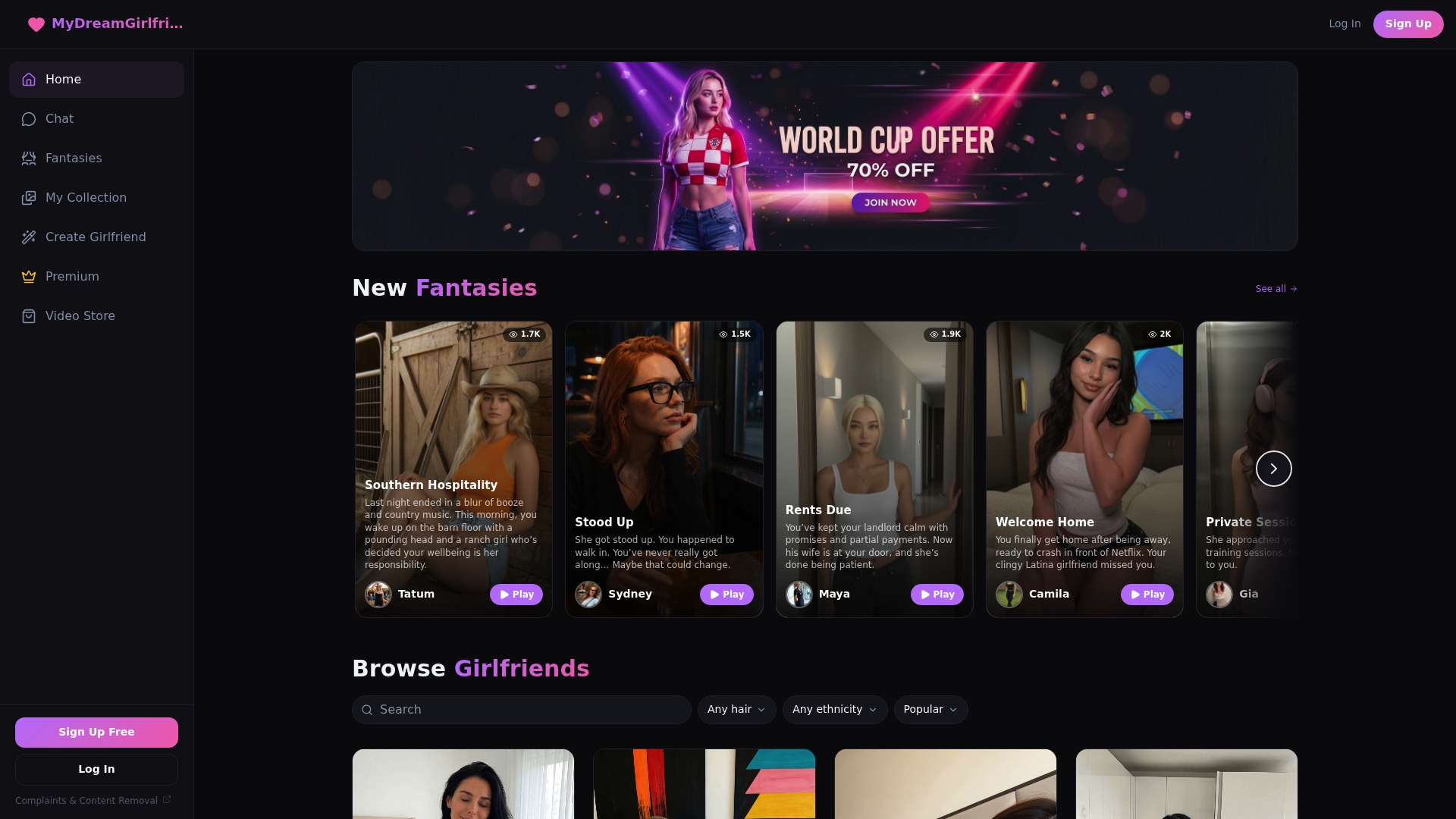
You get flirty text chat, voice calls, and unlockable photo and video content, all shaped around the persona you build in the character creator. Want a low-friction way to see how the AI chat handles memory and tone before committing to anything? The free plan gets you into a conversation in minutes. If you already know you want unlimited access to roleplay scenarios and spicy media, the Premium subscription runs $12.99 per month. Either way, start by building your companion, not by rewriting the same prompt for the tenth time.
Sources
- Best practices for prompt engineering with the OpenAI API | OpenAI Help Center
- An academic study on text-to-image prompt structures and failure modes
- PromptEnhancer: Taming your rewriter for text-to-image generation via fine-grained reward (CVPR 2026)
FAQ
What Are Some Good NSFW Story Prompts?
The strongest ones name adult fictional characters, state consent clearly, set a POV, and ask for a scene rather than a full chapter, something like “first-person POV, established consenting adult couple, slow-burn evening scene, under 400 words.” Keep pacing and tone words specific rather than relying on explicit adjectives to carry the scene.
What AI Has a Spicy Mode?
Several major chat and roleplay platforms offer a mature or NSFW-adjacent mode, usually toggled in settings or unlocked through a subscription tier. Mydreamgirlfriend offers uncensored roleplay scenarios built into its persona system, so you don’t need to hunt for a hidden setting.
What Are Some Spicy Writing Prompts?
Try pairing a scenario with a clear boundary statement: “adult fictional characters, consensual private setting, playful tension building toward intimacy, second-person POV, fade out before explicit description.” Changing the setting or pacing word alone can shift the entire tone without rewriting the whole prompt.
What Are Some Crazy AI Prompts?
The most unusual results usually come from combining an unexpected setting with a tightly controlled visual or narrative structure, not from piling on extreme adjectives. A modular template (subject, scenario, lighting, mood, exclusions) keeps even an unconventional idea coherent instead of chaotic.
How Do I Keep Spicy Prompts Safe and Within Platform Rules?
Always state that characters are fictional adults acting with consent, and never reference a real, identifiable person. Test a milder version of your prompt against the platform’s content moderation filters before pushing toward more explicit territory.