
Great romantic roleplay ideas run the full range from a shy coffee-shop meet-cute to negotiated kink scenes to solo warmups with an AI companion, and the ones that actually work share one habit: everyone agrees on a boundary before the scene starts. Pick a low-pressure starter below, say out loud what’s off-limits, and try it tonight. If you want a private place to rehearse lines first, MyDreamGirlfriend gives solo practice a judgment-free test run.
TL;DR:
- Starting with brief scenes that have clear end cues and simple scripts reduces pressure and builds confidence for first-time roleplay attempts.
- Ordinary settings like a coffee shop or living room, paired with low lighting and music, create cozy scenarios that emphasize intimacy and linger-over moments.
- Gradually increasing scene intensity requires explicit negotiation, hard limits, safewords, and post-scene debriefs to ensure safety and comfort during kink and NSFW roleplays.
- Practicing solo or with AI companions helps rehearse dialogue and experiment with boundaries privately before involving a partner.
- Approaching your partner with curiosity in a relaxed setting fosters mutual consent, with a focus on structure and boundaries to avoid pressure and embarrassment.
Table of Contents
- Romantic Roleplay Ideas for Total Beginners
- Cozy and Romantic Scenarios Built for Closeness
- Playful and Novelty Roleplay Scenarios
- Kink-Aware and NSFW Roleplay: Safety First
- Solo and AI Roleplay: Practicing Without a Partner
- Ready-to-Use Scripts and Prompt Templates
- Bringing Up Roleplay With a Partner (and Getting Real Consent)
- What I’ve Learned Watching People Talk Themselves Out of Trying This
- Practice Privately With MyDreamGirlfriend First
- Where to Learn More About Safe Roleplay
- Sources
- FAQ
Romantic Roleplay Ideas for Total Beginners
You don’t need a costume box or a script from a movie to start. The easiest entry point into adult roleplay ideas is a “strangers meet” setup, because it needs almost nothing but two people willing to use different voices for ten minutes. A hotel bar, a coffee shop, or a delivery person at the door are the most commonly recommended beginner roleplay scenarios precisely because they require no props and barely any setup.
Set the scene in two or three lines, stay in your regular clothes if you want, and pick fake names only if that helps you drop the giggles. Agree on an “end cue,” a specific word or gesture that snaps you both back to normal, before you say line one.
- Strangers at a bar: “Is this seat taken, or are you waiting for someone more interesting?”
- Coffee shop mix-up: “I think you took my order. Buy me a drink to make up for it?”
- Delivery arrives late: “Sorry I’m so late. Can I make it up to you somehow?”
- New neighbor: “I heard the walls are thin here. Should we test that theory?”
Keep the first attempt short — and if you want other options to keep it light, check out these jeux d’ambiance pour adultes that work well for easy, low-pressure date nights. Three exchanges and an end cue beats a twenty-minute scene that stalls halfway through.
Cozy and Romantic Scenarios Built for Closeness
Not every scene needs tension or a twist. Some of the best romantic roleplay ideas are just ordinary moments dressed up with a little more attention: an anniversary dinner where you introduce yourselves as if it’s a first date, a slow dance lesson in the kitchen, a blanket fort during a storm, or a night spent naming constellations and making wishes on things that aren’t stars.
Lighting and music do most of the work here. Dim the lamps, put on something slow, and let the pacing stay unhurried. These scenes reward lingering, not escalating.
- Anniversary redo: “Hi, I don’t think we’ve met. I’m [name]. Can I get you a drink?”
- Slow dance lesson: “You’re stepping on my feet on purpose, aren’t you?”
- Rainy-day sanctuary: “Come here. I built us somewhere to hide from the world for an hour.”
- Stargazing wishes: “If I tell you my wish, does it still count?”
Pro Tip: Turn a mundane weekly habit, like folding laundry or cooking dinner, into the “setting” for a scene. Familiar spaces lower anxiety, which makes the dialogue feel less performative and more like an inside joke between you two.
Playful and Novelty Roleplay Scenarios
When a relationship needs a jolt of humor more than intimacy, playful scenarios do the job. Think celebrity-and-star-struck-fan, bartender-and-regular, secret-agent-and-target, or photographer-and-model. These lean into teasing and surprise rather than tenderness, and they’re forgiving of a bad accent or a scene that collapses into laughter halfway through.
Props help but aren’t required. A sunglasses-and-notebook combo sells “photographer” fine without a real camera. What matters more is letting the scene stay light: novelty roleplay works best when nobody is trying to be perfect at it.
- Celebrity and fan: “I can’t believe it’s really you. Can I get a photo? Or maybe just five minutes alone?”
- Bartender and regular: “You always order the same thing. Let me guess what you actually want tonight.”
- Secret agent and target: “You’ve been following me for three blocks. I’m flattered, but I have questions.”
- Photographer and model: “Chin down, eyes up. Now stop smiling like that, it’s distracting.”
Role reversal is the cheapest refresh available: whoever usually leads the scene switches to following, and the dynamic shifts without a single new prop.
Kink-Aware and NSFW Roleplay: Safety First
Interest in kink themes is common. Surveys find that nearly half of respondents pick BDSM as a fantasy category when given the option, which says more about how normal the curiosity is than about anyone’s intent to act on it. Wanting to explore doesn’t obligate you to do anything beyond a conversation.
Group scenes by intensity rather than by theme, since matching comfort levels matters more than matching aesthetics.
- Low intensity: light teasing, power-tilted dialogue (boss and employee, teacher and student), no restraints, easy to stop mid-sentence.
- Medium intensity: light bondage with pre-agreed release methods, blindfolds, spanking with a discussed limit, a dominant/submissive dynamic with clear roles.
- High intensity: consensual non-consent (CNC), extended restraint, sensory deprivation. These require real experience and should never be a first scene.
Before anything past low intensity, run through a negotiation checklist: hard limits (never), soft limits (maybe, with conditions), a safeword or color system (green means continue, yellow means slow down, red means stop now), and a nonverbal signal for when speaking isn’t possible. CNC specifically demands an explicit pre-scene agreement listing exactly which acts are allowed, a stop signal that can’t be mistaken for in-character protest, and a plan for how you’ll check in afterward.
Aftercare isn’t optional once intensity climbs. Plan five to ten minutes of physical reassurance and a plain conversation about how the scene felt, then check in again the next day. Feelings that surface during a high-intensity scene sometimes don’t surface until hours later, which is why the delayed check-in matters as much as the immediate one.

Solo and AI Roleplay: Practicing Without a Partner
You don’t need a partner in the room to try roleplay. Reading a scene script aloud, journaling a character’s internal voice, or improvising a short monologue in the mirror all count as legitimate rehearsal, and they cost you nothing but ten quiet minutes.
Virtual and AI companions extend that further. An AI girlfriend roleplay session lets you rehearse dialogue, test a scenario’s pacing, or explore a fantasy privately before ever bringing it to a partner. Set the tone first: define the personality you want to talk to, state your boundaries plainly, and give the conversation an opening line instead of starting cold. Something as simple as “You’re my neighbor and you just knocked on my door soaked from the rain” gives an AI enough to build on immediately.
- Define personality traits and tone before the scene starts, not mid-conversation.
- State boundaries explicitly, the same way you would with a human partner.
- Give the AI a one-line opening scenario rather than an open-ended prompt.
- End the session with a clear closing line so the scene doesn’t trail off unresolved.
Pro Tip: Save your favorite opening lines in a notes app so you’re not starting from a blank page every time. Reusing a script that already worked once removes most of the awkwardness of round two.
Keep any private content local to your device and check the privacy settings on whatever platform you use. That’s true whether you’re journaling, roleplaying with a partner over text, or chatting with an AI companion.
Ready-to-Use Scripts and Prompt Templates
Short scripts remove the blank-page problem, which is the single biggest reason people never try roleplay at all. A three-line structure, a start, a spice line, and a safe end line, gives you a complete scene without needing to improvise the whole thing.
- Start: “Excuse me, is this seat taken?” Spice: “I was hoping you’d say no. I’ve been trying to work up the nerve to talk to you.” End: “I should go, but can I get your number first?”
- Start: “You’re late.” Spice: “I know. Traffic. Are you going to punish me for it?” End: “Okay, okay, truce. Come here.”
- Start: “I found your note. Meet me on the roof at midnight.” Spice: “You actually came. I wasn’t sure you would.” End: “Let’s go back inside before someone sees us.”
For text-based teasing, a single escalating line often works better than a full paragraph: “Thinking about you in that jacket you wore last night” opens a door without demanding a full scene commitment.
If you’re building an AI prompt instead, structure it the same way a director would brief an actor: name the personality (“playful, a little jealous, quick with a comeback”), set the mood (“flirty but slow-burn, not rushed”), state the boundary (“keep it to suggestive dialogue, nothing explicit”), and give it an end cue (“wrap the scene when I say ‘curtain call’”). That structure works whether you’re prompting a partner over text or an AI chat companion.
Bringing Up Roleplay With a Partner (and Getting Real Consent)
Timing changes everything. Bringing up roleplay mid-argument or right before bed reads as pressure; bringing it up over coffee on a Sunday reads as curiosity. Lead with interest, not a demand: “I read something about roleplay ideas and thought it sounded fun, want to try one sometime?” costs you nothing and gives your partner an easy out if they’re not interested.
If they’re curious, keep the first conversation about structure, not specifics. “What would make you comfortable trying something like this?” opens the door wider than jumping straight to scenario details. Identifying the feeling behind a fantasy, wanting to feel pursued, adored, or powerful, makes the whole conversation less embarrassing than trying to describe a specific act out loud.
Before your first scene, run through a short checklist together:
- Confirm both people are consenting adults, fully sober, and free to stop at any point.
- Agree on roles and who’s playing what before you start.
- Name at least one hard limit each, even if it feels obvious.
- Pick a safeword or signal that works even mid-scene.
- Decide your exit plan: what “stop” looks like and what happens right after.
- Set aside five minutes afterward for a plain, non-judgmental debrief.
Debriefing matters even after a scene that went well. A thirty-second “that was fun, how did that feel for you?” does more for trust than the scene itself, because it proves the conversation didn’t end when the roleplay did.
What I’ve Learned Watching People Talk Themselves Out of Trying This
Most people don’t skip roleplay because the idea embarrasses them. They skip it because the first ten seconds feel unscripted, and nobody wants to be the one who breaks character by laughing at the wrong moment. That’s normal. It’s not a sign you’re bad at this or that your relationship lacks chemistry. It’s a sign you haven’t practiced yet.
Start smaller than you think you need to. A three-line scene with a clear end cue teaches you more about what you enjoy than an elaborate scenario you talk yourself out of attempting. Debrief honestly afterward, even if the scene fell flat, because that conversation is where you actually learn what to try next.
If rehearsing alone feels easier than rehearsing with a partner watching, that’s a legitimate strategy, not a shortcut. A private space like MyDreamGirlfriend exists precisely for that kind of low-stakes practice, where a bad line doesn’t cost you anything but a restart.
— Pierce
Practice Privately With MyDreamGirlfriend First
If the idea of fumbling your first line in front of a partner is the thing actually holding you back, rehearse it somewhere with zero stakes first. MyDreamGirlfriend lets you build a companion with the personality, appearance, and tone you want, then run through scenarios privately, with no judgment and no audience.
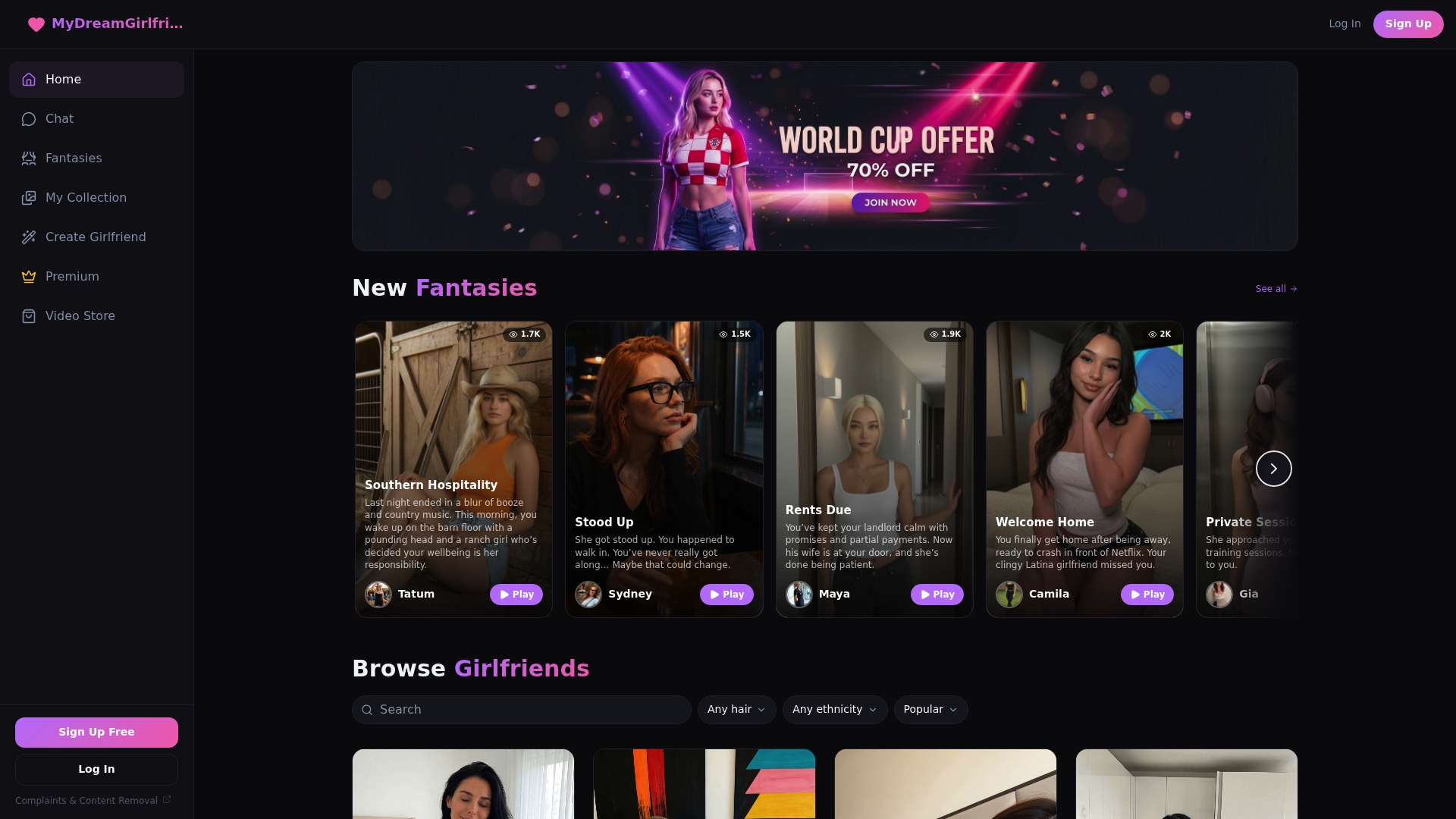
The platform is built around uncensored roleplay scenarios and persistent memory, so your companion remembers the character you set up last week instead of starting cold every time you open the app. That continuity is what makes it useful as an actual rehearsal space rather than a one-off novelty: you can test a jealous-girlfriend dynamic, a slow-burn romance, or a playful tease-and-flirt scene, see what feels natural, and carry the lines that worked into your real relationship. Start with the free plan to build your first companion, or go straight to Premium for current pricing and details about unlimited access to scenes, photos, and voice features.
Where to Learn More About Safe Roleplay
- Role-Play in the Bedroom: How to Explore Fantasy, Desire, and Connection Safely covers how to identify the feeling behind a fantasy before negotiating a scene.
- BDSM Roleplay Ideas & Negotiation Guide breaks down intensity scaling, stop signals, and aftercare for higher-risk scenes.
- 77 Roleplay Ideas for Couples: Scenarios, Scripts and Tips offers additional beginner-friendly scenario inspiration.
- 30 Sex Role Play Ideas Couples Should Try At Least Once is a solid reference for more scenario variety once you’ve tried the basics.
Sources
- Role-Play in the Bedroom: How to Explore Fantasy, Desire, and Connection Safely - Dr. Stacy
- BDSM Roleplay Ideas & Negotiation Guide - SparkChambers
- 77 Roleplay Ideas for Couples: Scenarios, Scripts and Tips | Couples Flirt
FAQ
What Are Some Good Romantic Roleplay Ideas for Couples?
Anniversary redos, slow dance lessons, a rainy-day blanket fort, and stargazing wishes all work well because they build on tenderness rather than raw intensity. Pair any of these with a two or three line script and a clear end cue so the scene has a defined start and stop.
What Are Some Examples of NSFW Roleplay Scenarios?
NSFW scenarios range from light power-play dialogue like boss and employee up to bondage or consensual non-consent scenes, which need explicit prior negotiation and aftercare. Always start at the lowest intensity tier that interests you and only move up once both people have discussed hard limits, a safeword, and a stop signal.
How Do I Start Roleplay With a Partner Who’s Never Tried It?
Bring it up in a neutral, low-pressure moment, not during an argument or right before bed, and frame it as curiosity rather than a request. A simple “I read about some roleplay ideas and thought it sounded fun, want to try one?” gives your partner room to say yes, no, or “tell me more” without pressure.
Can I Practice Roleplay Alone or With AI?
Yes. Reading scripts aloud, journaling in character, or chatting with an AI girlfriend roleplay companion all work as private rehearsal before you try a scene with a partner. Setting a clear personality, tone, and boundary at the start of an AI conversation makes the practice closer to a real scene.
What Should Happen After a Roleplay Scene Ends?
A short debrief, even just thirty seconds of “how did that feel for you?”, helps both people process the scene and builds trust for the next one. For higher-intensity scenes, plan a second check-in the next day, since some reactions surface only after the moment has passed.