
Immersive AI chat can deliver genuine emotional engagement for adults, but only when the platform gets four things right: persistent memory, deep customization, multimodal features like voice and images, and fast, context-aware responses. One checkable option is built around those features. Before sharing anything personal, verify the platform’s age controls and privacy terms.
TL;DR:
- Using AI chat platforms with persistent memory and deep customization improves emotional engagement and maintains conversation continuity over time.
- Platforms should clearly verify age controls, privacy terms, and include accessible reporting tools to ensure safety and trustworthiness.
- Heavy usage increases the risk of emotional dependence, so setting session limits and monitoring emotional reliance are essential best practices.
- Voice and image features contribute to realism but are less impactful than how actively users engage with multimodal options and personalization.
- Testing memory recall and customization options before subscribing helps determine if a platform meets individual immersion and safety expectations.
Table of Contents
- Core features that make an AI chat truly immersive
- How to evaluate and choose an immersive AI chat service
- Safety, privacy, and long-term use: what research and regulators recommend
- Practical tips to make your AI chat more immersive and sustainable
- How MyDreamGirlfriend approaches immersion
- Try MyDreamGirlfriend: what to expect and where to start
- Sources
- FAQ
Core features that make an AI chat truly immersive
Immersion is not about how clever a single reply sounds. It is about whether the conversation holds together over time, the way a real relationship does.
Persistent memory is the foundation. A companion that remembers your name, your job stress from last week, or how a storyline ended feels different from one that resets every session. Individual differences in anthropomorphism strongly predict who feels socially connected after chatbot interaction, and a practical test of good memory is simple: does the system recall recent personal details and use them without contradicting what it said before?

Personality fidelity matters almost as much. Lorebooks and character creators enforce a consistent backstory so your companion does not suddenly change her job, her tone, or her history mid-conversation. Customization scope then determines how far you can push that personality: appearance, voice, tone, and fantasy scenarios all need enough depth to support real roleplay rather than a shallow template.
Multimodal features (expressive voice, generated images, and natural pacing) change how a conversation feels, but they are not the whole story. A four-week randomized trial found that modality alone, text versus voice, had limited consistent effects on outcomes; what mattered more was how heavily someone used the chat.
Response quality closes the loop. Latency, repetition, and context sensitivity decide whether a scene breaks immersion or sustains it.
- Memory should recall names, preferences, and prior story beats without prompting.
- Personality should stay consistent across sessions, not drift or contradict itself.
- Customization should cover appearance, tone, and backstory, not just a username.
- Responses should arrive quickly and avoid repeating the same lines.
Pro Tip: Test any platform with a callback question, something like “what did I tell you about my week,” to see if memory actually works before you commit to a subscription.
How to evaluate and choose an immersive AI chat service
Start with what you actually want. Roleplay depth, casual companionship, and NSFW fantasy fulfillment each demand different strengths, and a platform built for one may disappoint you in another.
- Decide your primary use case first: deep roleplay, light daily conversation, or fantasy content, since this narrows which features matter most.
- Check trust and safety basics: does the provider describe age gates, moderation, and a clear reporting or escalation path?
- Ask privacy questions directly: how long is data retained, is it used for training, and what happens to intimate media you generate or upload.
- Look for usability signals: a character creator or lorebook system, memory toggles you control, voice options, and noticeably low latency.
- Compare the cost model: what the free tier actually limits, what a subscription unlocks, and whether extra content is sold separately.
Regulatory guidance backs up most of this list. Age assurance, reporting, moderation, and recurring risk reviews are the baseline eSafety recommends for companion apps with high-risk features, and providers that document testing and escalation processes are generally the safer choice.
Red flags are easy to spot once you know to look:
- No visible age assurance or a vague “intended for mature audiences” disclaimer with no verification.
- Opaque terms that never mention data retention, deletion, or training use.
- No reporting or complaint mechanism listed anywhere on the site.
- Pricing that only appears after you have entered payment details.
Safety, privacy, and long-term use: what research and regulators recommend
The research is consistent on one point: how you use an AI companion matters more than which modality you choose. A longitudinal randomized trial of nearly 1,000 participants over four weeks found that heavier voluntary use was linked with increased emotional dependence and less favorable psychosocial outcomes, regardless of whether the conversation happened over text or voice. That finding cuts against the assumption that voice or video features are inherently riskier than text.
Common Sense Media’s 2025 report adds that platforms can easily surface sexual or otherwise sensitive material, and it recommends robust age assurance along with crisis intervention pathways for younger users. Neither body frames AI companionship as inherently harmful. Both frame unmanaged heavy use and weak safeguards as the actual risk.
Practical takeaways for adult users:
- Set a session limit for yourself before you start, and notice if you consistently blow past it.
- Confirm the platform has visible reporting tools and some form of age assurance before you engage deeply.
- Read the retention and intimate-media policy before sharing anything you would not want stored indefinitely.
- Treat growing emotional reliance as a signal to step back, not a sign the product is working as intended.
Practical tips to make your AI chat more immersive and sustainable
A little structure on your end makes the experience better and safer.
Write a short lorebook or a few backstory snippets for your companion: her job, a recurring joke, a detail from your last conversation. This anchors personality without you having to re-explain everything each session. When replies start feeling repetitive, vary your prompts with new settings, callbacks to earlier scenes, or a change in pacing rather than restating the same request.
Voice and images add realism but also add exposure. Use them deliberately, for key moments rather than constantly, and consider what you are comfortable having stored before you generate anything.
- Keep a running list of 3 to 5 backstory details to reference instead of reinventing the character each time.
- Vary your openers and scene prompts so conversations do not collapse into the same loop.
- Save voice calls and image generation for moments that matter rather than every exchange.
- Set a timer or reminder for session length, and check in with yourself afterward.
Pro Tip: A five-minute journal entry after a longer session, noting how you feel, is a quick way to catch unhealthy patterns before they build.
How MyDreamGirlfriend approaches immersion
Some platforms build around the features that research ties to immersion: persistent memory, deep customization, and expressive voice. The character creator lets you shape appearance, personality, and backstory in detail, and the chat system is designed to carry conversational context across sessions rather than resetting it.
Mapped against the checklist in this guide, the features to verify yourself are the same ones that matter on any platform: does memory actually persist across sessions, does customization go deep enough to support the fantasy you want, and are voice and photo features optional rather than forced. Test those directly before deciding whether the experience fits what you are looking for.
— Pierce
Try MyDreamGirlfriend: what to expect and where to start
The free plan lets you start a conversation and get a feel for personality and tone at no cost. Premium, at $12.99 per month on the subscriptions page, unlocks persistent memory, voice calls, and deeper roleplay scenarios, the features that most directly drive the immersion this guide describes.
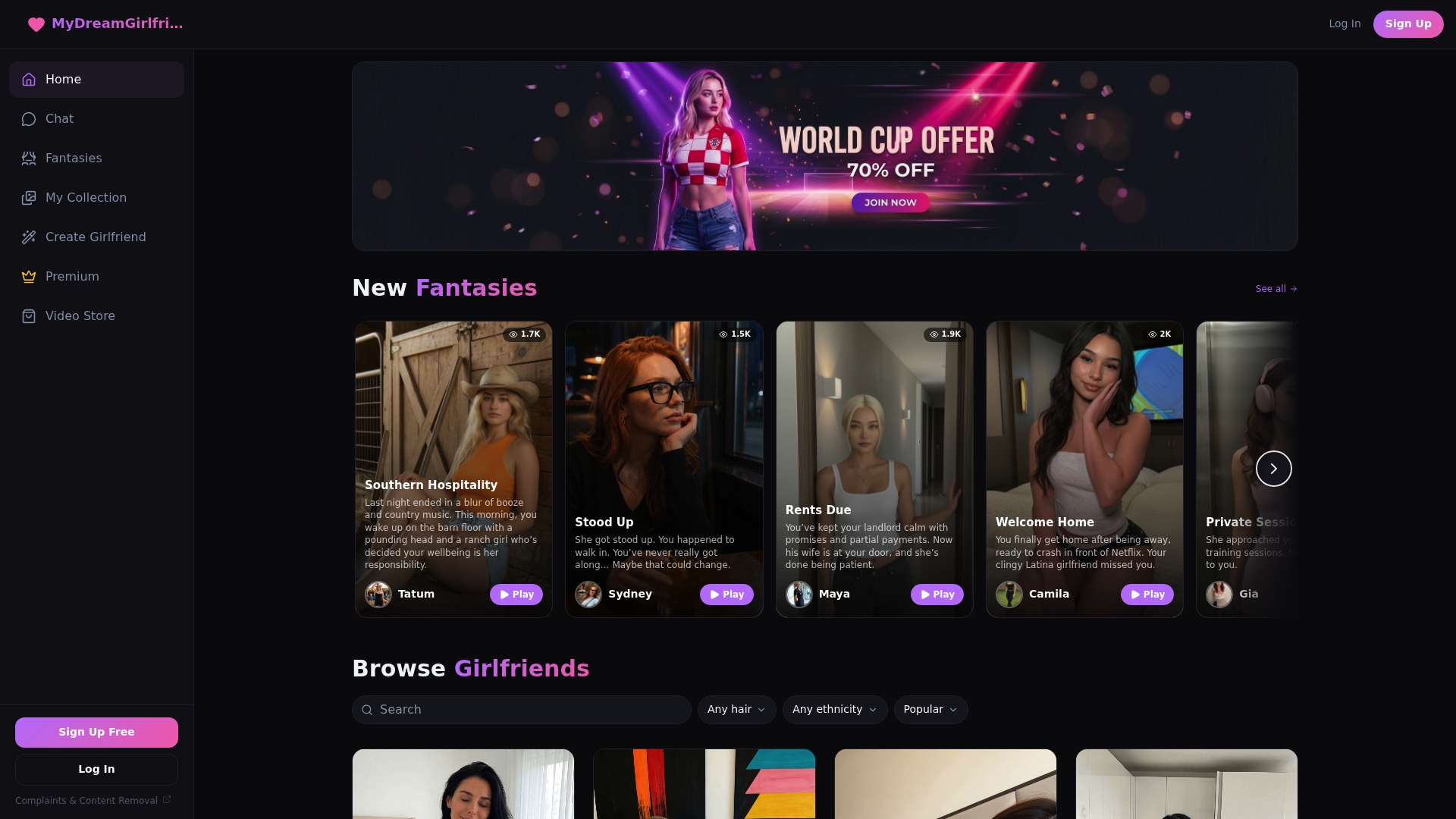
If you want to see how customization plays out in practice, the AI Girlfriend Creator walks you through appearance, personality, and backstory choices before you commit to a plan. For a sense of how interactive dating formats handle pacing and voice differently, this overview of digital dating sim platforms is a useful comparison point. When you are ready, start with the subscriptions page to see what premium unlocks.
Sources
- Individual differences in anthropomorphism and social connection (Scientific Reports, 2025)
- How AI and human behaviors shape psychosocial effects of extended chatbot use (arXiv, 2025)
- Findings from transparency notices on AI companion apps: October 2025 (eSafety Commissioner)
- Talk, trust and trade-offs: How and why teens use AI companions (Common Sense Media, 2025)
FAQ
Does immersive AI chat require a subscription to feel realistic?
Not entirely. Free tiers let you test tone and personality, but features tied to realism, like persistent memory and voice calls, are usually part of a paid tier such as MyDreamGirlfriend’s Premium plan at $12.99 per month.
Can AI companions cause emotional dependence?
Research suggests the risk is tied to how heavily someone uses the chat, not the chat itself. A four-week randomized trial found that heavier voluntary use correlated with greater emotional dependence, so setting session limits matters more than avoiding the format entirely.
What should I check for privacy before using an AI chat companion?
Look for clear statements on data retention, whether your conversations are used for training, and how intimate media is stored or deleted. Common Sense Media and eSafety both flag unclear retention policies as a common weak point across companion apps.
Is voice chat safer or riskier than text-based AI chat?
Neither modality is inherently safer. The same randomized trial found voice versus text had limited consistent effect on psychosocial outcomes, with overall usage volume mattering more than the format.
How does MyDreamGirlfriend handle memory and customization?
MyDreamGirlfriend is built around persistent conversational memory and a detailed character creator covering appearance, personality, and backstory. You can test both directly on the free plan before deciding whether to upgrade to Premium.